Pages

Showing posts with label intelligence. Show all posts

Tuesday, August 30, 2016

Redefining the X and Y-Axes of Cognitive Enhancement

By Somnath Das


This post was written as part of a class assignment from students who took a neuroethics course with Dr. Rommelfanger in Paris of Summer 2016.


I am a Senior at Emory University and am currently pursuing a double major in Neuroscience and Chemistry. Currently, I am applying to medical school. My interest in healthcare lies primarily in understanding the behavioral motivations of patients as they navigate through various healthcare systems. I also wish to study how to effectively translate innovations powered by biomedical research into accurate health information for patients and optimized healthcare delivery. Neuroethics allows me to focus these interests onto patient dignity and rights when considering the role of novel therapeutics and interventions in treatment. Studying this fascinating field has given me a perspective on the role that deontological considerations play in both neuroscience and medicine as a whole. It is with this perspective that I hope to approach my patients with a balanced worldview, taking into account both individual rights as well as stakeholders and developers participating in a rapidly changing field.


Hearing from leading scholars at the Neuroethics Network was a once in a lifetime moment for me. Participating in a wide-ranging, multi-faceted discussion about frontiers in the field proved to be really engaging and fostered my development as a student. Each seminar challenged my understanding of various topics both within and beyond the field of neuroscience, and each speaker gradually enhanced my appreciation of what is a growing field.


One session that I particularly enjoyed focused on Science Fiction and Neuroethics. During the session, we viewed the movie Limitless. In the movie, Bradley Cooper takes NZT, which allows him almost unlimited cognitive abilities. He gains fame, fortune, and myriad positive and negative consequences. The movie asks us to consider both the benefits and drawbacks of cognitive enhancement; Cooper’s character eventually realizes that the drug not only enhances cognition, but this enhancement is to the detriment of his physical health. Compounded with the drug’s side effects are looming parties attempting to get their own fix, which put Cooper’s life in significant danger throughout the movie. In the end, the movie aims to balance out its own plot by blessing Cooper’s character with this drug followed by having him discover and contend with his own Achilles heel.


After the movie, the panel delved deeply into discussion about the movie’s themes, particularly what we can learn from science fiction when understanding science. The movie shows a young white male winning victories through the Western lens of success – i.e. an individualist and capitalist society’s perspective on what it means to truly win. Eventually, a member of the audience noted that the current debate on cognitive enhancement is Western-oriented, and thus provoked an intense discussion on how the movie and different societies perceive enhancement and success. One of the panelists noted that if a person from a collectivist society were to be offered cognitive enhancement, they would be concerned about whether their own social networks have access to enhancement as well. The fact that the drawbacks of NZT affected Cooper only physically could also be taken into consideration as a uniquely Western portrayal of enhancement. A movie from a collectivist society could have easily defined the drug’s side effects to include hampered ability to connect emotionally with others (or to be excluded from a group) and thus affect their ability to actively participate in society despite their newfound intelligence. Therefore, Limitless is a uniquely Western (perhaps even uniquely American) portrayal of the benefits of drugs that enhance our cognitive abilities. Yet, cognitive enhancement has the potential to affect all societies, not just our own.


Image courtesy of Flikr. 

Another fascinating idea that repeatedly came up during the panel focused on how cognitively enhancing drugs would shift or flatten a society’s own bell curve. Ethical considerations ranging from universal access to drugs to how these enhancers may change our definition of disability were brought up. However, throughout the discussion I gradually realized that before we begin discussing the bell curve’s distribution, we must also consider what exactly is on the y-axis; the panelists had a discussion about what exactly these drugs are helping, and one noted that cognitive enhancers strengthen already established neuronal networks that enable the user to be better at what they already knew was beneficial towards their self-gain. The movie, for example, did not discuss Cooper’s ability to predict and understand what others were thinking; yet a user’s theory of mind is part of their cognitive ability, too. Cooper’s sensory abilities and emotional intelligence were also not profoundly enhanced, but these abilities, too, are cognitive in nature. I went up and spoke to the panelist about this thought, and he told me that he felt that “cognitive” enhancement is a misnomer. These drugs do not enhance all cognition, but rather they strengthen already existing cortical networks to perform tasks that were previously learned such as typing on the computer, learning a new language, or computing a math problem. They are not creating a new person per se, they are rather bettering the old one.


Ethical considerations such as drug access for all and drug safety were repeatedly brought up during our Neuroethics debates in class as well as during the conference. However, there is a critical need to reassess our own perspective on how this debate really should be structured. Cognitive enhancement’s effects have already made deep inroads into our society [1], so a debate representing its efficacy across multiple parameters is necessary in order to safely control the regulation of this neurotechnology. Increasing globalization also means that cognitive enhancement is likely to affect societies other than our own, and thus there is a need to reframe the debate to have a global lens as well. As I learned from the Neuroethics Network, if we reframe the debate to reflect the reality of cognitive enhancement’s potential and limitations of the current technology and the multiple stakeholders affected by these neuroscientific developments, we will be more able to propose more fruitful uses of such neurotechnologies.


References


1. Mehlman, Maxwell J. "Cognition-Enhancing Drugs." The Milbank Quarterly 82, no. 3 (2004): 483-506.


Want to cite this post?

Das, Somnath. (2016). Redefining the X and Y-Axes of Cognitive Enhancement. The Neuroethics Blog. Retrieved on , from http://www.theneuroethicsblog.com/2016/08/redefining-x-and-y-axes-of-cognitive.html

Tuesday, March 4, 2014

Lumosity: a "personal trainer for your brain"?

Is intelligence more like height or strength? Could high school students improve their IQs in time for the college entrance exams with a few weeks of “brain training” like college students pump up their biceps before spring break? For many years, psychologists believed that intelligence, and particularly fluid intelligence, is for the most part a fixed quantity – somewhat like height. Fluid intelligence, which is thought of as the ability to perceive patterns amongst noise, understand meaningful connections, and analyze information in the moment is a strong predictor of future success yet has been remarkably resistant to training1. In a way, this sounds strikingly similar to what neuroscientists once said about the biology of the brain (i.e. neurons don’t regenerate after injury and they are only lost, not added throughout life). Now we know that the brain is incredibly plastic and that new neurons are produced even into adulthood2. So, why wouldn’t an aspect of intelligence, undoubtedly a product of the dynamic brain, also be mutable? Recently, a lucrative new industry has aimed to capitalize on this notion. Web-based programs such as Lumosity.com have grown rapidly. They aggressively market their services with the assertion that they are backed by neuroscience but with a decidedly fad-diet feel. Who wouldn’t want to “unlock your inner genius”?


The human brain may in fact be the “most complex object in the universe”. There are 1011 neurons (not to mention glia) which, though once thought to be static, are quite plastic and modulate their several thousand connections (each) based on activity in terms of both structure (anatomy) and function (connection strength)3. These processes can occur during learning or recovery from injury. Add to this the relatively recent discovery that new neurons are produced in the brain throughout adulthood and it seems that the possibilities for changing the brain are nearly limitless2,3. The idea that the brain could be trained like muscle, in a way, was born out of this new understanding of neuroplasticity along with data from psychologists suggesting that intelligence is not as fixed as was once thought.


This idea has really caught on. In fact, the brain training industry is booming. Lumosity, a company that offers a “personal trainer for your brain,” claims to have more than 50 million users worldwide. Although the concept of adaptive working memory training was initially conceived as an alternative intervention for ADHD4, it is now very much marketed to professionals for (workplace) performance enhancement akin to how Viagra and the like buy up airtime on ESPN. Lumosity’s ads promise “improved brain performance” after use of their “neuroscience-based games” and lately can be heard after nearly every segment on NPR.


Observers have traced the roots of this industry back to Torkel Klingberg’s 2002 paper in the Journal of Clinical and Experimental Neuropsychology4 in which a cohort of children with ADHD, and also an unaffected group of young adults, showed improvements in working memory (working memory is, for example, the ability to remember a grocery list while you’re shopping) and scored better on Raven’s progressive matrices (a test of general cognitive ability) after five weeks of regular training with an adaptive working memory task. Klingberg went on to found Cogmed, one of the first brain training companies, which was sold to Pearson education in 2010. Sharpbrains.com has estimated that the brain training market surpassed $1 billion in 2012 and could reach $6 billion by 2020. So what is all the hype about?


Brain training promises a simple approach to a complex issue and perhaps that is why it appeals to so many people. Essentially, the underlying premise is that training on specific working memory tasks will translate to overall improvements in reasoning ability and general cognitive performance, just as a basketball player spends hours lifting weights to improve all-around strength and thereby performance on the court. With training it is no surprise that ability in the bench press increases, but does the brain also work this way? Can training on specific working memory tasks – weight-lifting in this analogy – translate to improved reasoning ability and general cognitive performance? The central question is whether individuals who play these training games are simply getting better at the training tasks, through practice, or if these people are actually getting smarter.


While there is a great deal of interest in answering this question, the results have been somewhat inconclusive. Since Klingberg’s 2002 study, there have been many high-profile articles providing support for both sides. One of the most influential papers was Jaeggi and Buschkuehl’s 2008 study published in PNAS5 which suggested that not only could fluid intelligence be improved with working memory training but also that these mental exercises could yield an increase of nearly a full IQ point per hour. Recently, however, the enthusiasm has been tempered somewhat by several prominent studies with negative results. A group at Georgia Tech was unable to replicate Jaeggi and Buschkuel’s results6 and some in the field have even taken to the popular press to express skepticism of these findings7. Perhaps more troubling for the industry, a large study of more than 11,000 online brain training users published in Nature found no effect of these exercises on general cognitive abilities despite significant improvements on the training tasks themselves8. Finally, 2013 meta-analysis9 found that, at this point, the evidence across the literature is not sufficient to conclude that adaptive working memory training improves intelligence or even training task performance beyond a few months (and there was no overall effect on working memory across all studies at the average 9 month follow-up).


However, in some cases the question of whether improvements in working memory generalize to increased intelligence may not be all that important. For example, Klingberg’s original study measured the effects of working memory training on children with ADHD4. While it would be great if these training tasks could improve reasoning ability and fluid intelligence, a significant enhancement in attention span alone would likely improve school performance and could make these programs a welcome alternative to psychostimulant pharmacotherapy. In this case, increased ability in attention-based training tasks alone would likely make the effort worthwhile and IQ gains would essentially be a bonus. It should also be noted that measurement of intelligence itself is subject to significant controversy10. Raven’s progressive matrices, a standard nonverbal test of reasoning ability and fluid intelligence used in Jaeggi and Buschkuel’s study5, certainly does not cover the entire spectrum of cognitive ability nor does it necessarily predict school or job performance. One study using this test found that a cohort of children diagnosed with Asperger’s disorder significantly out-performed typically developing children with similar IQ scores11.


Nonetheless, those of us who are buffeted by the ubiquitous advertising of brain training companies like Lumosity can’t help but think that there must be something to this because, after all, these are “neuroscience-based” games. What is the scientific basis for Lumosity’s claims? Their website advertises 15 “completed” studies but eight of these are posters that may or may not have been reviewed by a panel before being presented at conferences. In some conferences in the biomedical sciences, at least, conference posters are very rarely rejected simply because their presenters are a good source of revenue and it is thought that the merits of the poster will be judged by other attendees12. Posters typically present preliminary findings and are not subject to the same rigorous peer-review as published articles and thus would hardly be considered complete. Seven of these eight posters report data collected at Lumos Labs by Lumosity employees. Still, five peer-reviewed papers have been published. However, one was authored by an internal research group headed by the senior director of research at Lumos Labs13 and appeared in Mensa Research Journal which, according to their website, is “primarily a reprint publication” and not typically an outlet for high-impact research. A second was a pilot study from an Australian group that had only one significant finding in the Lumosity-trained group – an improvement in a measure of visual attention14. Finally, three additional papers have been published by a group at Stanford led by Shelli Kesler studying effects of these programs in very specific groups such as post-chemotherapy cancer patients15-17. Two of these were pilot studies without control groups16,17, and a third found significant improvement in measures of executive function immediately following Lumosity training compared to an un-trained control group (which received no mental exercise of any kind)15. While these data may seem promising, the preliminary nature of these studies and lack of real controls make it difficult to come to any conclusions as to what effect the training actually has.


This is the fundamental problem with the industry – the science simply does not (yet) back up their claims. By aggressively advertising an under-studied product, Lumosity is setting high expectations for users. These exercises may in fact work in some way for a great number of people, but if it were as easy as their claims make it seem, wouldn’t the data be much clearer? As a neuroscientist, it is also difficult not to take issue with their overuse of the term “neuroscience” itself. Unfortunately it is cheapened when applied to commercial products like these, which seem to take a page out of the fad-diet industry’s book by seductively promising that science has found a new, easy way to a better you. If in 10 years the idea of brain training becomes laughable to a critical general public, will neuroscience as a field be dragged down with it? Clearly, Lumosity believes that the term neuroscience carries some gravitas, because most of the research they cite, and most of literature on brain training, actually comes from psychology methodology, rather than biomedical research techniques. There was indeed a revolution in neuroscience brought on by the discovery of neuroplasticity (in truth an abstract term that is more globally applied to numerous phenomena related to the brain’s ability to change and adapt), but that was decades ago and the neurobiology of intelligence, at the cellular and molecular level, is still poorly understood18.


On the surface it may seem that there is no harm in using these programs, but there is always a cost. In this case, it may be time that could be spent doing something else that is known to sharpen mental acuity and brain health, like physical exercise19. In addition, Lumosity researchers collect data on users’ performance (and are essentially paid by users to collect this data, rather than the other way around) and then share it with researchers around the world. Is this the future of big science or are Lumosity users just paying a for-profit company to collect (and share) data on their cognitive abilities*? The scientific literature shows that there is hardly a consensus as to whether fluid intelligence can be reliably improved through training of any kind, and therefore it may in fact be more analogous to height than strength. Still, companies like Lumosity disregard this and offer a “personal trainer for your brain.” Perhaps the biggest danger is that these companies misrepresent how science actually works, to a very wide audience, and could undermine the public’s trust of scientific integrity, which is already enough of a problem. Real progress in science results from rational, hypothesis-driven research, which is subjected to replication attempts, peer review, and ample skepticism – particularly from the investigator. The hope is that brain training programs do, in fact, work. Of course, it would be nice to unlock that inner genius. However, as consumers and as the primary funders of natural science research, the public deserves much more of the full story.


* From Lumosity’s privacy policy: “we collect and store data about the games you play and your performance in those games. We may also collect and store information such as your browser type, IP address, language, operating system, unique device identifier, the date and time of your visit, the pages you view and the websites you visited immediately before and after visiting Lumosity.”


References


1. Shipstead, Z., Redick, T. S. & Engle, R. W. Is working memory training effective? Psychological bulletin 138, 628-654, doi:10.1037/a0027473 (2012).

2. Gage, F. H. Neurogenesis in the adult brain. The Journal of neuroscience : the official journal of the Society for Neuroscience 22, 612-613 (2002).

3. Lledo, P. M., Alonso, M. & Grubb, M. S. Adult neurogenesis and functional plasticity in neuronal circuits. Nature reviews. Neuroscience 7, 179-193, doi:10.1038/nrn1867 (2006).

4. Klingberg, T., Forssberg, H. & Westerberg, H. Training of working memory in children with ADHD. Journal of clinical and experimental neuropsychology 24, 781-791, doi:10.1076/jcen.24.6.781.8395 (2002).

5. Jaeggi, S. M., Buschkuehl, M., Jonides, J. & Perrig, W. J. Improving fluid intelligence with training on working memory. Proceedings of the National Academy of Sciences of the United States of America 105, 6829-6833, doi:10.1073/pnas.0801268105 (2008).

6. Redick, T. S. et al. No evidence of intelligence improvement after working memory training: a randomized, placebo-controlled study. Journal of experimental psychology. General 142, 359-379, doi:10.1037/a0029082 (2013).

7. Hambrick, D. Z. in The New York Times    SR4 (2012).

8. Owen, A. M. et al. Putting brain training to the test. Nature 465, 775-778, doi:10.1038/nature09042 (2010).

9. Melby-Lervag, M. & Hulme, C. Is working memory training effective? A meta-analytic review. Developmental psychology 49, 270-291, doi:10.1037/a0028228 (2013).

10. Weinberg, R. A. Intelligence and Iq - Landmark Issues and Great Debates. Am Psychol 44, 98-104 (1989).

11. Hayashi, M., Kato, M., Igarashi, K. & Kashima, H. Superior fluid intelligence in children with Asperger's disorder. Brain Cognition 66, 306-310, doi:DOI 10.1016/j.bandc.2007.09.008 (2008).

12. Erren, T. C. & Bourne, P. E. Ten simple rules for a good poster presentation. PLoS computational biology 3, e102, doi:10.1371/journal.pcbi.0030102 (2007).

13. Hardy, J. L., Drescher, D., Sarker, K., Kellett, G., Scanlon, M. Enhancing visual attention and working memory with a Web-based cognitive training program. Mensa Research Journal 42, 13-20 (2011).

14. Finn, M., McDonald, S. Computerised Cognitive Training for Older Persons With Mild Cognitive Impairment: A Pilot Study Using a Randomised Controlled Trial Design. Brain Impairment 12, 187–199 (2011).

15. Kesler, S. et al. Cognitive training for improving executive function in chemotherapy-treated breast cancer survivors. Clinical breast cancer 13, 299-306, doi:10.1016/j.clbc.2013.02.004 (2013).

16. Kesler, S. R., Lacayo, N. J. & Jo, B. A pilot study of an online cognitive rehabilitation program for executive function skills in children with cancer-related brain injury. Brain injury : [BI] 25, 101-112, doi:10.3109/02699052.2010.536194 (2011).

17. Kesler, S. R., Sheau, K., Koovakkattu, D. & Reiss, A. L. Changes in frontal-parietal activation and math skills performance following adaptive number sense training: preliminary results from a pilot study. Neuropsychological rehabilitation 21, 433-454, doi:10.1080/09602011.2011.578446 (2011).

18. Gray, J. R. & Thompson, P. M. Neurobiology of intelligence: science and ethics. Nature reviews. Neuroscience 5, 471-482, doi:10.1038/nrn1405 (2004).

Cook, G. in Elements blog, newyorker.com    (2013).


Want to cite this post?


Purcell, R. (2014). Lumosity: a "personal trainer for your brain"? The Neuroethics Blog. Retrieved on , from http://www.theneuroethicsblog.com/2014/03/lumosity-personal-trainer-for-your-brain_4.html

Tuesday, September 24, 2013

Intelligence Testing: Accurate or Extremely Biased?


By Emily Young


In the early 1900s, psychologist Charles Spearman noticed that children who did well in one subject in school were likely to do well in other subjects as well, and those who did poorly in one subject were likely to do poorly across all subjects. He concluded that there is a factor, g, which correlates with testing performance (Spearman 1904). The g factor is defined as the measure of the variance of testing performance between individuals and is sometimes called “general intelligence”.


Later on, psychologist Raymond Cattell determined that there are two subsets of g, called fluid intelligence (denoted Gf) and crystallized intelligence (denoted Gc). Fluid intelligence is defined as abstract reasoning or logic; it is an individual’s ability to solve a novel problem or puzzle. Crystalized intelligence is more knowledge based, and is defined as the ability to use one’s learned skills, knowledge, and experience (Cattell 1987). It is important to note that while crystallized intelligence relies on knowledge, it is not a measure of knowledge but rather a measure of the ability to use one’s knowledge.


The first standardized intelligence test was created in 1905 by French Psychologist Albert Binet, as a method to screen for mental retardation in French schoolboys. The test measured intelligence by comparing an individual’s score to the average score of children his own age (Binet 1905). The test was later revised by Lewis Terman of Stanford University and named the Stanford-Binet Intelligence Scales. The Stanford-Binet is now in its fifth edition and includes five sections: fluid reasoning, knowledge, quantitative reasoning, visual-spatial processing, and working memory.


Since the Stanford-Binet, many other standardized intelligence scales have been developed. One of the most popular modern intelligence tests is the Raven’s Progressive Matrices (RPM) test (Raven, 2003). The test gives individuals a series of boxes, each containing shapes that change from box to box, and a box that is empty. The test taker must recognize the pattern that is shown and correctly identify the shape that should go in the empty box from a collection of options. Unlike the Stanford-Binet, RPM is entirely visual; the test taker does not have to answer written questions, meaning the measured IQ is not dependent on reading comprehension. This allows for better testing that eliminates variables such as native language, age, and possible reading disability.


A general example of the questions on the Raven’s Progessive Matrices test.


So what exactly are these IQ tests measuring? The Stanford-Binet measures g through tasks that measure both Gf and Gc. Because RPM is entirely non-verbal and puzzle based, it almost exclusively measures Gf.


Which brings us to the next question; are these tests effectively measuring g?


Since their creation, modern Western intelligence testing has shown a difference in average intelligence, varying from group to group; whites score higher than blacks, the rich score higher than the poor. In some tests, women and men score differently from task to task. Are these differences due to heritable differences in intelligence between race, gender, and socioeconomic status? Or are environment, schooling, and stigma to blame? Or, are the tests themselves flawed?


While intelligence tests claim to be culture-fair, none of the tests created so far are one hundred percent unbiased. As Serpell (1979) found, when asked to reproduce figures from using wire, pencil and paper, and clay, Zambian children performed better in the wire task, while English children performed better in the pencil and paper task. Each group did better in the medium to which they were more accustomed. Pencil and paper IQ tests may be intrinsically biased towards Western culture.


Furthermore, while African-Americans have historically scored lower than white Americans on intelligence testing, this gap as been lessening in recent years (Dickens and Flynn 2006). This could be the result of one of two things; the first possibility is that average intelligence is increasing in the black community at a higher rate than in the white community (measured intelligence has been steadily increasing across all groups due to the Flynn effect). However, it seems more likely that post-segregation, white and black cultures have been merging, and schools have been integrated, meaning that white and black children have a better chance of receiving the same education. If this is the case, IQ tests are either measuring knowledge more than the test creators think they do, or the tests are extremely culturally biased, but this bias is lessening due to assimilation of white and black culture in America.


Not only are intelligence tests culturally biased, but they also seem to be biased in favor of neurotypical individuals. For example, while typically developing individuals generally perform similarly on RPM and the Wechsler Adult Intelligence Scale (WAIS), individuals with Autism typically score higher on RPM than on WAIS (Bolte et al. 2009, Mottron 2004). This is because while RPM is a visual task, WAIS is almost entirely verbal. Individuals with autism seem to use visual strategies to solve tasks and therefore have difficulty on tasks that can only be solved verbally (Kunda and Goel 2010). While this phenomenon is typically seen as a cognitive deficit, it is important to note that autistic individuals outperform neurotypical individuals on some visual tasks.


Therefore, by only measuring one specific part of intelligence, some IQ tests portray autistic individuals as having a cognitive deficit. What if some disorders, such as autism, are not actually disorders, but simply a way of thinking that differs from what is considered “normal”?


For example, Dr. Temple Grandin, an autistic woman with a PhD in Animal Sciences, uses her incredible visual working memory to design cattle equipment that is much more humane and far less anxiety-inducing than previous models. Grandin says her autism allows her to see the world in pictures; her inner thoughts are entirely devoid of language, she simply thinks in extremely detailed movies. She says her visual memory and sensitivity to details has allowed her to be so good at designing things, because details that neurotypical people gloss over are extremely important to her and end up making a huge difference in the efficiency of the final product.


Temple Grandin utilized her incredible working memory to design humane cattle-holding equipment for the agriculture industry.


Autism may not be the only example of a disorder being mischaracterized. Studies have shown that children with ADHD on average have lower IQs than neurotypical children (Kuntsi, 2003). However, in his TEDx talk, Stephen Tonti, a senior at Carnegie Mellon, discusses why he believes ADHD is not a disorder, but simply a difference in cognition. Tonti argues that by viewing ADHD as a disorder implies that it needs to be fixed. He states that his ADHD makes him better at some tasks than neurotypical individuals, and that the world needs a diversity of cognition in order to run smoothly.


Therefore, while IQ tests are intended to measure intelligence, they often only measure one type of intelligence, and are therefore biased against certain groups of people. By trying to fit cognition into a box, IQ testing disvalues cognitive diversity. This may be causing negative impacts. By telling an individual that their intelligence is low when in fact it is simply different, we could not only be holding people back, but we might also be depriving the world of a diverse group of thinkers that could solve problems from a different perspective.


Even if current IQ tests are not fair across all groups, the future of intelligence testing may be brighter; as discussed previously on the Neuroethics Blog, fMRI intelligence testing could eliminate biases in intelligence testing. By observing testers’ thought processes in action, researchers would be able to see which brain pathways a subject recruits to solve a test, and whether he or she uses a visual or verbal approach to the question, thereby observing fluid and crystal intelligence in action.


References


Binet, Alfred. (1905) L'Annee Psychologique, 12,191-244.


Bölte, S., Dziobek, I., & Poustka, F. “Brief report: The level and nature of autistic intelligence revisited”. Journal of Autism and Developmental Disorders 39 (2009): 678–682.


Cattell, Raymond B., and Raymond B. Cattell. "The Discovery of Fluid and Crystallized General Intelligence." Intelligence: Its Structure, Growth, and Action. Amsterdam: North-Holland, 1987. 87-120. Print.


Dickens, William T., and James R. Flynn. "Black Americans Reduce the Racial IQ Gap: Evidence from Standardization Samples." Psychological Science 17.10 (2006): 913-20. Web.


Kunda, Maithilee, and Ashok K. Goel. "Thinking in Pictures as a Cognitive Account of Autism." Journal of Autism and Developmental Disorders 41.9 (2011): 1157-177. Print.


Kuntsi, J., T.C. Eley, A. Taylor, C. Hughes, P. Asherson, A. Caspi, and T.E. Moffitt. "Co-occurrence of ADHD and Low IQ Has Genetic Origins." American Journal of Medical Genetics 124B.1 (2004): 41-47. Print.


Mottron, Laurent, Michelle Dawson, Isabelle Soulières, Benedicte Hubert, and Jake Burack. "Enhanced Perceptual Functioning in Autism: An Update, and Eight Principles of Autistic Perception." Journal of Autism and Developmental Disorders 36.1 (2006): 27-43. Print.


Raven, J., J. C. Raven, and J. Court. Manual for Raven’s Progressive Matrices and Vocabulary Scales, Section I: General Overview. San Antonio: Harcourt Assessment, 2003. Print.


Serpell, Robert. "How Specific Are Perceptual Skills? A Cross-cultural Study of Pattern Reproduction." British Journal of Psychology 70.3 (1979): 365-80. Print.


Spearman, Charles E. "'General Intelligence', Objectively Determined And Measured." American Journal of Psychology 15 (1904): 201-93. Web.


Want to cite this post?


Young, E. (2013). Intelligence Testing: Accurate, or Extremely Biased? Retrieved on , from http://www.theneuroethicsblog.com/2013/09/intelligence-testing-accurate-or.html

Tuesday, June 18, 2013

Can Human Brain Tissue Make Mice Smarter? Emory Neuroethics Journal Club Review

What makes humans smart?  This was the primary question posed in the final Journal Club of the Spring 2013 semester.  Led by Riley Zeller-Townson, the club discussed Han et al. (2013), a paper that discusses the enhancement of learning in mice after grafting human glial progenitor cells into their brains. Riley began by explaining the paper and the work leading up to it. Most of the roles of glial cells involve supporting and protecting neurons, such as synaptic plasticity, myelination, and maintaining the blood-brain barrier (Barres, 2003). This study focuses on one subtype of glia, called astrocytes, cells that provide nutrients to neurons (Tsacopoulos et al, 1996).


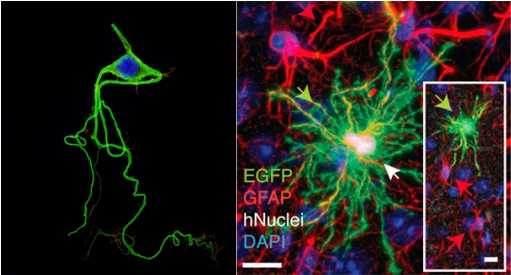
Neurons (shown on left) possess both axons and dendrites and are shaped differently than glial cells (Source).  The glial cell shown on the right is an astrocyte, which is more “star” shaped due to its many branched processes (Han et al 2013).

While people generally think of neurons as being the important type of brain cells, research is beginning to show that the merits of glial cells were previously underestimated. Interestingly, post-mortem analysis of Albert Einstein’s brain showed that he had more glia than the average person (Diamond et al, 1985).  Along the same vein, previous studies have shown that primate glia are larger, more complex, and faster than those of mice (Colombo, 1996; Oberheim et al., 2009). Therefore, is it possible that glial cells are the root of intelligence?

Han et al. tested this hypothesis by grafting human astroglia progenitors into neonatal immune-deficient mice.  Because the mice retained their own astroglia as well, the mice were chimeric, or having both mouse and human glia.  The human glial cells were fluorescently labeled before implantation so that they could be identified after each mouse was sacrificed, which occurred anywhere from 0.5-20 months of age.  The successfully grafted glial cells were found to have distributed across the forebrain, including the hippocampus and cortex.  Additionally, human glia were found in the amygdala, thalamus, and neostriatum in mice ages 12-20 months.


Next, the authors did a battery of tests that revealed that the cells were not only present, but also functional.  The authors found that not only were the human astrocyte progenitor cells present in the mouse brain, but they actually differentiated into humanoid protoplasmic astrocytes that formed synapses with mouse astrocytes.  In the chimeric mouse brain, the human astrocytes produced Ca2+ signals that were three times faster than Ca2+ signals produced by mouse astrocytes (this had previously been demonstrated in human tissue, but held true for chimeric mouse tissue). Next, the authors compared hippocampal dentate synaptic activity in chimeric mice to unengrafted and allografted mice and found that tissues with engrafted human glia showed a greater level of excitatory synaptic transmission. This finding goes hand in hand with the next subsequent finding that Long Term Potentiation (LTP), an experimental measure correlated with memory formation, increased in chimeric mice. The authors speculate that this increase was due to insertion of GluR1, a specific type of excitatory receptor often associated with memory and learning, into mice neurons by human glia, which lowered the threshold for LTP induction.


Because LTP was increased in chimeric mice, one would assume that these mice, not just their cells, would also showed quicker learning behaviors than the control mice. As expected, mice engrafted with human glia performed better in all four behavioral tasks compared to unengrafted and allografted mice, showing that the improvement was due to the human glia, not the act of engrafting cells into the mice.


Overall, the results of the paper suggest that astrocytes play a role in learning, and that more complex astrocytes might increase learning by lowering the threshold at which LTP occurs. Furthermore, the paper implies that human astrocytes, and possibly other subtypes of untested human glial cells, play a role in the high level of cognition observed in humans (and possibly in mice).


The Rats of
NIMH (Source)


After introducing the paper and its findings, the subject turned to the ethical considerations associated with the study.  Riley introduced another paper (Greely et al 2007) as a response to Han et al.  In his paper, Greely discusses the possible ethical issues that would arise by performing this type of study.  Greely lists several possible ethical issues, including the risk of conferring humanity upon the mice, the potential for pain and suffering, public reaction, and respect for human tissues.


In response to Greely’s first concern, journal club attendee and bioethics professor Dr. Jonathan Crane pointed out that “conferring humanity” upon the mice was the wrong term, as “humanity” simply means the traits that make us human.   Dr. Crane pointed out that humans do not really have any unique capabilities that other animals do not have, we just have them in a different degree.  He points out the Greely is most likely concerned about the risk of conferring “personhood,” or making the mouse a autonomous individual to the same extent that an adult human is.


Of course, if personhood were conferred upon a species that we cannot communicate with, would we even be able to recognize it?  It seems a big issue with this type of study is not only the possibly innately unethical problem of creating an unnatural sentient being, but also the issue of creating a (more?) autonomous being, not realizing it as such, and continuing to treat it like a typical lab animal.


Greely’s second concern, the potential for pain and suffering in the chimeric mouse, was also addressed.  While Greely’s paper noted the possibility of increased pain in the mouse due to having human neurons, the group discussed the mouse’s possibly increased emotional pain as well.  It was addressed that a mouse with human “intelligence” might also gain a human-like propensity for depression or realizing the futility of life as an experimental animal.   The authors seem to have guarded against this in the Han et al. study by noting that the chimeric mice were just as social as normal mice.  However, if these types of studies continue and mice intelligence is further increased, depression and suffering in the chimeric mouse will be a concern. The experimenters compared the reaction times and pain thresholds of chimeric mice to normal mice and found them to be the same.  These findings, coupled with the observation that the chimeric mice are just as social as normal mice are checks the experimenters used to show that the mice were not suffering mentally or physically.  These checks should also be present in future studies with chimeric species.  However, the downside is that these tests cannot gauge suffering until it has already happened.


Greely’s concern about public reactions was also discussed.  When discussing public reactions, it was addressed that different groups would be opposed to this study for different reasons.  Some groups would be opposed because of the belief that implanting human brain cells into a disvalues human intelligence.   Emory medical ethicist Dr. John Banja noted that some would question whether or not it is ethical to create hybrid species in the first place.  Dr. Crane pointed out that the study is also an affront to the mouse, as it is attempting to improve an animal that is perfect to begin with.


Riley’s main concern was that progression of this experiment will continue to create new species that we know nothing about.  Without knowing which mouse traits and which human traits a hybrid will have, it is impossible to care for it in the correct way from the beginning.  Riley pointed out that sometimes it takes thousands of years to create a cultural consensus on what is ethical regarding a certain issue, so if a new species pops up overnight society may not treat the animals respectfully.  Furthermore, these animals could completely change biological science: furthering this study could lead to a greater understanding of the mechanisms for learning, memory, and eventually even consciousness in humans.  An alternative to this however would be is a unique and species is created that is later discovered to have human-like consciousness and increased suffering.  The scientific community would stall as it would have to deal with public dissent amidst trying to find a more ethical method of testing the same hypotheses.


While future advancements along this line of work could have the potential to help us understand exactly what intelligence is, how it works, and why some people have more of it than others, these types of experiments could also have the ability to create a brand new species that society is not ready to care for or treat with respect.  Furthermore, it may not be possible to determine when the ethical boundary has been overstepped until it has already happened. Therefore, in continuations of this study, it is important to use chimeric animals with discretion and continue testing for possible suffering.


If you missed out on this journal club meeting you can watch a video of it and previous meetings here.


References


Alexander V. Gourine, V. K. (2010). Astrocytes Control Breathing Through pH-Dependent Release of ATP. Science, 571-575.


Barres, B. A. (2003). What is a Glial Cell? Glia, 4-5.


Colombo, J. (1996). Interlaminar astroglial processes in the cerebral cortex of adult monkeys but not of adult rats. Cells Tissues Organ, 57-62.


Henry T. Greely, M. K. (2007). Thinking About the Human Neuron Mouse. The American Journal of Bioethics, 27-40.


Magistretti, M. T. (1996). Metabolic Coupling between Glia and Neurons . Journal of Neuroscience, 877-885.


Marian C. Diamond, A. B. (1985). On the brain of a scientist: Albert Einstein. Experimental Neurology, 198–204.


Oberheim, N. W. (2006). Astrocytic complexity distinguishes the human brain. Trend in Neuroscience, 547-553.


Xiaoning Han, M. C. (2013). Forebrain Engraftment by Human Glial Progenitor Cells Enhances Synaptic Plasticity and Learning in Adult Mice. Cell, 342-353.


Want to cite this post?


Young, E. (2013). Can Human Brain Tissue Make Mice Smarter? Emory Neuroethics Journal Club Review. The Neuroethics Blog. Retrieved on

, from http://www.theneuroethicsblog.com/2013/06/can-human-brain-tissue-make-mice.html.

Tuesday, December 4, 2012

The Future of Intelligence Testing


Few people I know actually enjoy standardized tests. Wouldn’t it be great if technology could eliminate the need for bubble-in forms and Scantron sheets? How nice would it be to simply go in and get a snapshot of your brain to find out how smart you are? Imagine walking into the test center, signing on the dotted line, getting a quick scan, and walking out with your scores in hand, helping you gain admittance into a college or land your next job. No brain-racking questions, no tricky analogies, and no obscure vocabulary. Goodbye SAT, hello functional magnetic resonance imaging (fMRI).


Image from 


http://theturingcentenary.files.wordpress.com/2012/06/brain-functions.jpg    


In the general, there have been two types of intelligence studies: psychometric and biological. Biological approaches make use of neuroimaging techniques and examine brain function. Psychometrics focuses on mental abilities (think IQ tests). Dr. Ian Deary and associates suggest that a greater overlap of these techniques will reveal new findings. In their paper, 'Testing versus understanding human intelligence,' they state:


“The lack of overlap between these approaches means that it is unclear what the scores of intelligence tests mean in terms of fundamental biological processes of the brain.”[2]


Applying psychometric analysis techniques (IQ tests) coupled with advanced imaging has the potential to reveal the locations of “higher” cognition and neural processing. I expect that future technologies will have incredibly improved resolution, which will allow scientists to see not only what regions the brain uses but also the exact pathways that are activated for each action. By understanding which pathways are utilized for specific tasks, it may be possible to identify which genes as well as environmental factors (nutrition, education) are responsible for their development. This can lead to programs dedicated to training specific areas of the brain (several of which already exist) [5], and perhaps even drugs that foster development.


I believe it is increasingly important to consider the implications of a technology powerful enough to quickly evaluate an individual’s level of intelligence. However, before I get there, it is necessary to first explain what we can and cannot currently do. What we cannot currently do is use neuroimaging to determine how smart you are. What we can currently do is use neuroimaging to see what parts of your brain contribute to how you process information, access memories and function [3].


Localizing Intelligence


Different parts of your brain do different things and none of these brain regions work in isolation. Some regions contribute to eating, seeing, and other regions play a role in “intelligence”. The varying techniques of imaging-based testing search for different correlates of intelligence [4] (i.e., general intelligence, problem solving, learning abilities). Developments in imaging technologies have improved our ability for greater analysis, allowing for the study of both damaged and healthy brains. For example, MRI studies have found that the volume of gray matter correlates to intelligence, providing evidence for generalizations made regarding brain volume and intelligence [7]. A 2006 study of 100 postmortem brains examined the relationship between an individual’s Full Scale Wechsler Adult Intelligence Scale (WAIS) score and the volume of their brain regions. The factors they considered important to the relationship between brain size and intelligence were age, sex and hemispheric functional lateralization (They found that general verbal ability was correlated with cerebral volume in women and right-handed men. They did not find a relationship between ability and volume in with every group, however).


Additionally, PET and fMRI studies have revealed more information regarding the functionality of certain regions of the brain. By recording and interpreting the brain activity of subjects as they complete a variety of tasks, researchers are able to draw inferences based on the performance in the types of task (and thus, the type of intelligence) that calls on particular areas of the brain.  This is interesting, as knowing how parts of the brain are utilized may reveal more information about the structure and hierarchy used in neural development. It also may provide interesting information regarding the pathways of neural signals throughout the nervous system. Image-based testing may allow researchers to discover why certain neurons are connected, if they are indeed aligned in a purposeful manner and consequently, how to repair such pathways when they are damaged.


Image from http://news.wustl.edu/news/Pages/24068.aspx

A study from Washington University in St. Louis has shed light on how our brains utilize various networks for performance with working memory tasks [1]. They described a mechanism, global connectivity, which coordinates control of other networks. In a sense, global connectivity is the CEO of your brain, insuring that all components of your system are functioning and allowing for effective control of thought and behavior. Specifically, they found that a region of the lateral prefrontal cortex (LPFC), whose activity has been found to predict working memory performance, employs global connectivity. They report that,


“critically, global connectivity in this LPFC region, involving connections both within and outside the frontoparietal network, showed a highly selective relationship with individual differences in fluid intelligence. These findings suggest LPFC is a global hub with a brainwide influence that facilitates the ability to implement control processes central to human intelligence.”


This fascinating study identified a very specific characteristic of the brain (the global connectivity of the left LPFC) that suggested investigators were accurately able to predict fluid intelligence (where fluid intelligence refers to reasoning and novel problem solving ability) [4].


Potential Issues


We are learning more about the brain and the biological bases for intelligence every day. We have expanded our understanding of memory, cognitive thought and neural computation [2,6]. Our understanding of imaging techniques and what we can learn from them continues to grow. It may very well be possible to someday use neuroimaging to evaluate an individual’s intelligence. It is becoming more widely accepted that a neurobiological basis for intelligence exists (at least for reasoning and problem-solving) [4]. At the same time, the success of these intelligence studies presents ethical issues. Gray et al. pose the question, “Is it ever ethical to assess population-group (racial or ethnic) differences in intelligence?” While little variation has been found between racial groups, the public perception of intelligence studies has been negatively impacted by concerns of racism [4]. It is important to consider the consequences of studies that investigate intelligence differences in population-groups (racial, ethnic, and socioeconomic status). Gray states that it is not necessary to consider race when exploring the neurobiological bases of intelligence. The majority of variation occurs within a racial group and not between them. However, if a study were to investigate race and intelligence, Gray states that it will be necessary to have consent as well as active support from the target groups (i.e., financial support).


There are in fact studies that have investigated test score differences associated with race. Claude Steele, Ph.D., a professor of social psychology at Stanford University, discussed the test performance differences of white and black Americans. In his interview with PBS, Dr. Steele explained that a serious gap in test scores exists between whites and blacks, citing 100-point differences on the verbal and quantitative sections of the SAT. This is a concern for policy makers who are responsible for maintaining a standard level of education, as these low scores may help identify areas that need improvement. However, the negative effect of these findings is due to something Dr. Steele refers to as “stereotype threat.” He explains that when a salient negative stereotype about a group that you identify with may apply (i.e., lower SAT scores), when you are in that test situation the prospect of matching the stereotype can be distracting and upsetting. This stereotype threat impacts test taking, undermining test performance.


When considering the neurobiological bases of intelligence, it may be harder to escape these stereotypes. It may someday become known which genes code for higher intelligence, and thus higher test scores. Already, we have begun studying what regions of the brain relate to intelligence test performance. The next step will be discovering which genes code for the development of those regions, then connecting the dots from genes to intelligence. Furthermore, an understanding of the environmental and social influence that control the activation of these genes (and thus development) will be needed. Future generations may have stereotype threats that are based on genes rather than groups. When you know that you carry the genes for a certain level of intelligence, you may find yourself doubtful of your ability to perform above the level predicted by your genome and fall short of your potential.


There is a lot to be learned regarding how our genes relate to intelligence and by understanding how different gene pools code for their “smarts,” our understanding could grow immensely. However, as I mentioned earlier, suggesting that one group is genetically hard-coded to be smarter than another will have enormous implications. Science and research are going to continue pushing this ethical boundary and I predict that we eventually will be able to find many links between genes and intelligence. It is both beneficial and crucial to discuss how genes and intelligence should be studied now, before the research takes place. We have a unique opportunity where ethics can lay the guidelines before this technology emerges.


There are exciting possibilities that neuroimaging intelligence tests may bring. On the one hand, we can learn so much about the brain, how we think and how we can make it better. On the other hand, it may drive ethnic and racial groups, as well as socio-economic groups, farther apart. So we really have to ask ourselves, is that the price we have to pay to not fill out another Scantron sheet?


Want to Cite This Post?

Craig, E. The Future of Intelligence Testing. The Neuroethics Blog. Retrieved on from, http://www.theneuroethicsblog.com/2012/12/the-future-of-intelligence-testing.html


Related articles


http://headblitz.com/what-brain-scans-might-replace-iq-tests-in-the-future/

http://www.mobiledia.com/news/142925.html

http://www.medicaldaily.com/articles/11216/20120801/intelligence-mri-iq-test-brain.htm

http://www.psychologytoday.com/blog/finding-the-next-einstein/201202/could-brain-imaging-replace-the-sat

http://en.wikipedia.org/wiki/Neuroimaging_intelligence_testing


References


1. Cole, M. W., Yarkoni, T., Repovs, G., Anticevic, A., & Braver, T. S. (2012). Global connectivity of prefrontal cortex predicts cognitive control and intelligence. The Journal of neuroscience : the official journal of the Society for Neuroscience, 32(26), 8988–99. doi:10.1523/JNEUROSCI.0536-12.2012

2. Deary, I. J., & Caryl, P. G. (1997). Neuroscience and human intelligence differences. Trends in neurosciences, 20(8), 365–71. Retrieved from http://www.ncbi.nlm.nih.gov/pubmed/9246731

3. Duncan, J. (2000). A Neural Basis for General Intelligence. Science, 289(5478), 457–460. doi:10.1126/science.289.5478.457

4. Gray, J. R., & Thompson, P. M. (2004). Neurobiology of intelligence: science and ethics. Nature reviews. Neuroscience, 5(6), 471–82. doi:10.1038/nrn1405

5. Hackman, D. a, Farah, M. J., & Meaney, M. J. (2010). Socioeconomic status and the brain: mechanistic insights from human and animal research. Nature reviews. Neuroscience, 11(9), 651–9. doi:10.1038/nrn2897

6. Prabhakaran, V., Rypma, B., & Gabrieli, J. D. E. (2001). Neural substrates of mathematical reasoning: A functional magnetic resonance imaging study of neocortical activation during performance of the necessary arithmetic operations test. Neuropsychology, 15(1), 115–127. doi:10.1037//0894-4105.15.1.115

7. Witelson, S. F., Beresh, H., & Kigar, D. L. (2006). Intelligence and brain size in 100 postmortem brains: sex, lateralization and age factors. Brain : a journal of neurology, 129(Pt 2), 386–98. doi:10.1093/brain/awh69