Pages

Showing posts with label learning. Show all posts

Tuesday, August 9, 2016

The Ethics of Using Brain Stimulation to Enhance Learning in Children


By Peter Leistikow


This post was written as part of a class assignment from students who took a neuroethics course with Dr. Rommelfanger in Paris in Summer 2016.


Peter Leistikow is an undergraduate student at Emory University studying Neuroscience and Sociology. When he is not doing research in pharmacology, Peter works as a volunteer Advanced EMT in the student-run Emory Emergency Medical Service. 


Ever since the advent of electricity, people have tried to harness this power for therapeutic purposes. Nineteenth century posters touted the benefits of “self-applicable curatives for nervous, functional, chronic, and organic diseases” in the form of electric belts and harnesses (Browne 2014). Although these items are historical curiosities today, scientists are still trying to harness the potential benefits of electricity, especially in the treatment of psychiatric and learning disorders.


Transcranial direct current stimulation (TDCS) is a non-invasive experimental procedure that utilizes direct currents applied to two electrodes on the head with the goal of stimulating specific brain areas (John Hopkins Medicine 2016). Although there is evidence that this technology, and it’s closely related variant transcranial random-noise stimulation (TRNS), can increase attention and aid in treating cognitive impairments and depression, TDCS has caught the interest of companies and hobbyists assembling these devices for cognitive enhancement (Hogenboom 2014). This has worried some researchers, who have called for regulations regarding the sale and use of this technology which they fear can have detrimental effects if used incorrectly (Wexler 2015).


Meanwhile, researchers have continued to investigate TDCS, and the media has taken notice. In an article published just last year, neuroscientist Roi Cohen Kadosh explains his then-forthcoming study in which TRNS was administered to a group of twelve 8 to-10-year-old children with learning difficulties such as dyslexia or dyscalculia as the children played a game in which they guided a ball using gestures (Geddes 2015). In fact, they are a few of at least 1000 children estimated to have taken part in brain stimulation as part of clinical trials. As this research progresses, several issues must be addressed, namely costs and benefits of early life treatment, access to treatment, and future use as enhancement.


Because this technology can be used on a developing brain, there exists an opportunity to permanently change the structural organization of a child’s brain. Unfortunately, the promise of early treatment is tempered by the possibility of irreparable damage to the child’s brain. The thinner skulls of pediatric patients could have profound effects on everything from effects of treatment to dosing guidelines and side effects, and there is increasing skepticism regarding children as “small adults” for the purpose of utilizing TDCS data obtained from adults (Davis 2014). The allure of stopping or even reversing the effects of learning disabilities such as dyslexia is tempting, given that current clinical interventions are promising yet inconclusive; nevertheless, more studies are needed for parents of children with disabilities to make an informed choice regarding the therapeutic value of this technology (Cioni et al. 2016).


Image Courtesy of  PublicDomainPictures

Along these same lines, access to this technology must be such that parents will not resort to purchasing or constructing this technology without being trained in its applications and shortcomings. Some may argue that regulation of this technology and criminalization of its use outside of a clinical setting may deter parents until further data is available, but ultimately the success of needle exchange programs and other public health initiatives shows us that harm reduction is the most ethical path until an optimal end point can be reached (Kleinig 2009). In this case, the optimal end point would be proven therapeutic value of TDCS for pediatric patients, and an equitable dissemination of TDCS for those whom it is indicated. Although there is understandable skepticism regarding this technology among researchers, it may be possible to expand TDCS access to children of parents who would otherwise attempt home use of this technology. It should be a priority of researchers to advocate for parents of children with disabilities in order that they might have equitable access to TDCS and make informed decisions regarding their child’s treatment, especially given that risks and rewards of treatment may vary by disorder type and severity. At the same time, it is crucial that parents seeking a “last resort” option are not commodified and used for studies that have little interest in alleviating their child’s disability.


Central to the debate over TDCS is where treatment ends and enhancement begins. Maslen et al. (2014) argue that for a child experiencing significant neurological burden, brain stimulation may be permissible despite negative side-effects, while cognitive enhancement involves even more significant cognitive trade-offs and should not be permitted. However, enhancement is defined relative to the abilities of others, and direct marketing to consumers by pharmaceutical companies and other corporations as seen in the testosterone supplement industry could further obfuscate the already blurred line between treatment and enhancement (Purcell 2014). Already the ease of constructing or purchasing TDCS could conceivably lead to its ubiquity among competitive parents once the technology is optimized. Thus, there is a need for the adoption of standardized criteria to determine who is eligible for TDCS use. Researchers may be able to assist in the development of these criteria by acknowledging how their TCDS findings will be used by hobbyists for both treatment and enhancement in further investigations into the cognitive effects of TCDS (Wexler 2015).


It is crucial that we continue to advocate for responsible use of experimental technology whether within or outside of the laboratory. Unlike the dubious electricity-based endeavors of antiquity, our approach to both the science and ethics of transcranial direct stimulation must be appropriately rigorous.


References


1. Browne, A. 2014. It’s electrifying! Medical uses of electricity. New York Historical Society, October 1. Available at: http://blog.nyhistory.org/electric-medicine/ (accessed June 11, 2016).


2. Cioni, G., Inguaggiato, E. and Sgandurra, G. 2016. Early intervention in neurodevelopmental disorders: underlying neural mechanisms. Developmental Medicine & Child Neurology 58: 61–66. doi: 10.1111/dmcn.13050


3. Davis, N. J. 2014. Transcranial stimulation of the developing brain: a plea for extreme caution. Frontiers in Human Neuroscience 8: 600. DOI: 10.3389/fnhum.2014.00600


4. Geddes, L. 2015. Brain stimulation in children spurs hope — and concern. Nature, September 23. Available at: http://www.nature.com/news/brain-stimulation-in-children-spurs-hope-and-concern-1.18405 (accessed June 11, 2016).


5. Hogenboom, M. 2014. Warning over electrical brain stimulation. BBC News, August 24. Available at: http://www.bbc.com/news/health-27343047 (accessed June 11, 2016).


6. John Hopkins Medicine. 2016. Transcranial direct current stimulation. Available at: http://www.hopkinsmedicine.org/psychiatry/specialty_areas/brain_stimulation/tdcs.html (accessed June 11, 2016).


7. Kleinig, J. 2009. Thinking ethically about needle and syringe programs. Substance Use & Misuse 41(6): 815-825. DOI: 10.1080/10826080600668670


8. Maslen, H., Earp, B. D., Kardosh, R. C., & Savulescu, J. (2014). Brain stimulation for treatment and enhancement in children: an ethical analysis. Frontiers in Human Neuroscience 8: 953.


9. Purcell, R. 2014. The new normal: how the definition of disease impacts enhancement. The Neuroethics Blog, July 24. Available at: http://www.theneuroethicsblog.com/2014/07/the-new-normal-how-definition-of.html (accessed June 11, 2016).


10. Wexler, A. (2015). A pragmatic analysis of the regulation of consumer transcranial direct current stimulation devices in the United States. Journal of Law and the Biosciences 2(3):669-696.


Want to cite this post?


Leistikow, Peter. (2016). The Ethics of Using Brain Stimulation to Enhance Learning in Children. The Neuroethics Blog. Retrieved on , from http://www.theneuroethicsblog.com/2016/08/the-ethics-of-using-brain-stimulation.html

Tuesday, March 4, 2014

Lumosity: a "personal trainer for your brain"?

Is intelligence more like height or strength? Could high school students improve their IQs in time for the college entrance exams with a few weeks of “brain training” like college students pump up their biceps before spring break? For many years, psychologists believed that intelligence, and particularly fluid intelligence, is for the most part a fixed quantity – somewhat like height. Fluid intelligence, which is thought of as the ability to perceive patterns amongst noise, understand meaningful connections, and analyze information in the moment is a strong predictor of future success yet has been remarkably resistant to training1. In a way, this sounds strikingly similar to what neuroscientists once said about the biology of the brain (i.e. neurons don’t regenerate after injury and they are only lost, not added throughout life). Now we know that the brain is incredibly plastic and that new neurons are produced even into adulthood2. So, why wouldn’t an aspect of intelligence, undoubtedly a product of the dynamic brain, also be mutable? Recently, a lucrative new industry has aimed to capitalize on this notion. Web-based programs such as Lumosity.com have grown rapidly. They aggressively market their services with the assertion that they are backed by neuroscience but with a decidedly fad-diet feel. Who wouldn’t want to “unlock your inner genius”?


The human brain may in fact be the “most complex object in the universe”. There are 1011 neurons (not to mention glia) which, though once thought to be static, are quite plastic and modulate their several thousand connections (each) based on activity in terms of both structure (anatomy) and function (connection strength)3. These processes can occur during learning or recovery from injury. Add to this the relatively recent discovery that new neurons are produced in the brain throughout adulthood and it seems that the possibilities for changing the brain are nearly limitless2,3. The idea that the brain could be trained like muscle, in a way, was born out of this new understanding of neuroplasticity along with data from psychologists suggesting that intelligence is not as fixed as was once thought.


This idea has really caught on. In fact, the brain training industry is booming. Lumosity, a company that offers a “personal trainer for your brain,” claims to have more than 50 million users worldwide. Although the concept of adaptive working memory training was initially conceived as an alternative intervention for ADHD4, it is now very much marketed to professionals for (workplace) performance enhancement akin to how Viagra and the like buy up airtime on ESPN. Lumosity’s ads promise “improved brain performance” after use of their “neuroscience-based games” and lately can be heard after nearly every segment on NPR.


Observers have traced the roots of this industry back to Torkel Klingberg’s 2002 paper in the Journal of Clinical and Experimental Neuropsychology4 in which a cohort of children with ADHD, and also an unaffected group of young adults, showed improvements in working memory (working memory is, for example, the ability to remember a grocery list while you’re shopping) and scored better on Raven’s progressive matrices (a test of general cognitive ability) after five weeks of regular training with an adaptive working memory task. Klingberg went on to found Cogmed, one of the first brain training companies, which was sold to Pearson education in 2010. Sharpbrains.com has estimated that the brain training market surpassed $1 billion in 2012 and could reach $6 billion by 2020. So what is all the hype about?


Brain training promises a simple approach to a complex issue and perhaps that is why it appeals to so many people. Essentially, the underlying premise is that training on specific working memory tasks will translate to overall improvements in reasoning ability and general cognitive performance, just as a basketball player spends hours lifting weights to improve all-around strength and thereby performance on the court. With training it is no surprise that ability in the bench press increases, but does the brain also work this way? Can training on specific working memory tasks – weight-lifting in this analogy – translate to improved reasoning ability and general cognitive performance? The central question is whether individuals who play these training games are simply getting better at the training tasks, through practice, or if these people are actually getting smarter.


While there is a great deal of interest in answering this question, the results have been somewhat inconclusive. Since Klingberg’s 2002 study, there have been many high-profile articles providing support for both sides. One of the most influential papers was Jaeggi and Buschkuehl’s 2008 study published in PNAS5 which suggested that not only could fluid intelligence be improved with working memory training but also that these mental exercises could yield an increase of nearly a full IQ point per hour. Recently, however, the enthusiasm has been tempered somewhat by several prominent studies with negative results. A group at Georgia Tech was unable to replicate Jaeggi and Buschkuel’s results6 and some in the field have even taken to the popular press to express skepticism of these findings7. Perhaps more troubling for the industry, a large study of more than 11,000 online brain training users published in Nature found no effect of these exercises on general cognitive abilities despite significant improvements on the training tasks themselves8. Finally, 2013 meta-analysis9 found that, at this point, the evidence across the literature is not sufficient to conclude that adaptive working memory training improves intelligence or even training task performance beyond a few months (and there was no overall effect on working memory across all studies at the average 9 month follow-up).


However, in some cases the question of whether improvements in working memory generalize to increased intelligence may not be all that important. For example, Klingberg’s original study measured the effects of working memory training on children with ADHD4. While it would be great if these training tasks could improve reasoning ability and fluid intelligence, a significant enhancement in attention span alone would likely improve school performance and could make these programs a welcome alternative to psychostimulant pharmacotherapy. In this case, increased ability in attention-based training tasks alone would likely make the effort worthwhile and IQ gains would essentially be a bonus. It should also be noted that measurement of intelligence itself is subject to significant controversy10. Raven’s progressive matrices, a standard nonverbal test of reasoning ability and fluid intelligence used in Jaeggi and Buschkuel’s study5, certainly does not cover the entire spectrum of cognitive ability nor does it necessarily predict school or job performance. One study using this test found that a cohort of children diagnosed with Asperger’s disorder significantly out-performed typically developing children with similar IQ scores11.


Nonetheless, those of us who are buffeted by the ubiquitous advertising of brain training companies like Lumosity can’t help but think that there must be something to this because, after all, these are “neuroscience-based” games. What is the scientific basis for Lumosity’s claims? Their website advertises 15 “completed” studies but eight of these are posters that may or may not have been reviewed by a panel before being presented at conferences. In some conferences in the biomedical sciences, at least, conference posters are very rarely rejected simply because their presenters are a good source of revenue and it is thought that the merits of the poster will be judged by other attendees12. Posters typically present preliminary findings and are not subject to the same rigorous peer-review as published articles and thus would hardly be considered complete. Seven of these eight posters report data collected at Lumos Labs by Lumosity employees. Still, five peer-reviewed papers have been published. However, one was authored by an internal research group headed by the senior director of research at Lumos Labs13 and appeared in Mensa Research Journal which, according to their website, is “primarily a reprint publication” and not typically an outlet for high-impact research. A second was a pilot study from an Australian group that had only one significant finding in the Lumosity-trained group – an improvement in a measure of visual attention14. Finally, three additional papers have been published by a group at Stanford led by Shelli Kesler studying effects of these programs in very specific groups such as post-chemotherapy cancer patients15-17. Two of these were pilot studies without control groups16,17, and a third found significant improvement in measures of executive function immediately following Lumosity training compared to an un-trained control group (which received no mental exercise of any kind)15. While these data may seem promising, the preliminary nature of these studies and lack of real controls make it difficult to come to any conclusions as to what effect the training actually has.


This is the fundamental problem with the industry – the science simply does not (yet) back up their claims. By aggressively advertising an under-studied product, Lumosity is setting high expectations for users. These exercises may in fact work in some way for a great number of people, but if it were as easy as their claims make it seem, wouldn’t the data be much clearer? As a neuroscientist, it is also difficult not to take issue with their overuse of the term “neuroscience” itself. Unfortunately it is cheapened when applied to commercial products like these, which seem to take a page out of the fad-diet industry’s book by seductively promising that science has found a new, easy way to a better you. If in 10 years the idea of brain training becomes laughable to a critical general public, will neuroscience as a field be dragged down with it? Clearly, Lumosity believes that the term neuroscience carries some gravitas, because most of the research they cite, and most of literature on brain training, actually comes from psychology methodology, rather than biomedical research techniques. There was indeed a revolution in neuroscience brought on by the discovery of neuroplasticity (in truth an abstract term that is more globally applied to numerous phenomena related to the brain’s ability to change and adapt), but that was decades ago and the neurobiology of intelligence, at the cellular and molecular level, is still poorly understood18.


On the surface it may seem that there is no harm in using these programs, but there is always a cost. In this case, it may be time that could be spent doing something else that is known to sharpen mental acuity and brain health, like physical exercise19. In addition, Lumosity researchers collect data on users’ performance (and are essentially paid by users to collect this data, rather than the other way around) and then share it with researchers around the world. Is this the future of big science or are Lumosity users just paying a for-profit company to collect (and share) data on their cognitive abilities*? The scientific literature shows that there is hardly a consensus as to whether fluid intelligence can be reliably improved through training of any kind, and therefore it may in fact be more analogous to height than strength. Still, companies like Lumosity disregard this and offer a “personal trainer for your brain.” Perhaps the biggest danger is that these companies misrepresent how science actually works, to a very wide audience, and could undermine the public’s trust of scientific integrity, which is already enough of a problem. Real progress in science results from rational, hypothesis-driven research, which is subjected to replication attempts, peer review, and ample skepticism – particularly from the investigator. The hope is that brain training programs do, in fact, work. Of course, it would be nice to unlock that inner genius. However, as consumers and as the primary funders of natural science research, the public deserves much more of the full story.


* From Lumosity’s privacy policy: “we collect and store data about the games you play and your performance in those games. We may also collect and store information such as your browser type, IP address, language, operating system, unique device identifier, the date and time of your visit, the pages you view and the websites you visited immediately before and after visiting Lumosity.”


References


1. Shipstead, Z., Redick, T. S. & Engle, R. W. Is working memory training effective? Psychological bulletin 138, 628-654, doi:10.1037/a0027473 (2012).

2. Gage, F. H. Neurogenesis in the adult brain. The Journal of neuroscience : the official journal of the Society for Neuroscience 22, 612-613 (2002).

3. Lledo, P. M., Alonso, M. & Grubb, M. S. Adult neurogenesis and functional plasticity in neuronal circuits. Nature reviews. Neuroscience 7, 179-193, doi:10.1038/nrn1867 (2006).

4. Klingberg, T., Forssberg, H. & Westerberg, H. Training of working memory in children with ADHD. Journal of clinical and experimental neuropsychology 24, 781-791, doi:10.1076/jcen.24.6.781.8395 (2002).

5. Jaeggi, S. M., Buschkuehl, M., Jonides, J. & Perrig, W. J. Improving fluid intelligence with training on working memory. Proceedings of the National Academy of Sciences of the United States of America 105, 6829-6833, doi:10.1073/pnas.0801268105 (2008).

6. Redick, T. S. et al. No evidence of intelligence improvement after working memory training: a randomized, placebo-controlled study. Journal of experimental psychology. General 142, 359-379, doi:10.1037/a0029082 (2013).

7. Hambrick, D. Z. in The New York Times    SR4 (2012).

8. Owen, A. M. et al. Putting brain training to the test. Nature 465, 775-778, doi:10.1038/nature09042 (2010).

9. Melby-Lervag, M. & Hulme, C. Is working memory training effective? A meta-analytic review. Developmental psychology 49, 270-291, doi:10.1037/a0028228 (2013).

10. Weinberg, R. A. Intelligence and Iq - Landmark Issues and Great Debates. Am Psychol 44, 98-104 (1989).

11. Hayashi, M., Kato, M., Igarashi, K. & Kashima, H. Superior fluid intelligence in children with Asperger's disorder. Brain Cognition 66, 306-310, doi:DOI 10.1016/j.bandc.2007.09.008 (2008).

12. Erren, T. C. & Bourne, P. E. Ten simple rules for a good poster presentation. PLoS computational biology 3, e102, doi:10.1371/journal.pcbi.0030102 (2007).

13. Hardy, J. L., Drescher, D., Sarker, K., Kellett, G., Scanlon, M. Enhancing visual attention and working memory with a Web-based cognitive training program. Mensa Research Journal 42, 13-20 (2011).

14. Finn, M., McDonald, S. Computerised Cognitive Training for Older Persons With Mild Cognitive Impairment: A Pilot Study Using a Randomised Controlled Trial Design. Brain Impairment 12, 187–199 (2011).

15. Kesler, S. et al. Cognitive training for improving executive function in chemotherapy-treated breast cancer survivors. Clinical breast cancer 13, 299-306, doi:10.1016/j.clbc.2013.02.004 (2013).

16. Kesler, S. R., Lacayo, N. J. & Jo, B. A pilot study of an online cognitive rehabilitation program for executive function skills in children with cancer-related brain injury. Brain injury : [BI] 25, 101-112, doi:10.3109/02699052.2010.536194 (2011).

17. Kesler, S. R., Sheau, K., Koovakkattu, D. & Reiss, A. L. Changes in frontal-parietal activation and math skills performance following adaptive number sense training: preliminary results from a pilot study. Neuropsychological rehabilitation 21, 433-454, doi:10.1080/09602011.2011.578446 (2011).

18. Gray, J. R. & Thompson, P. M. Neurobiology of intelligence: science and ethics. Nature reviews. Neuroscience 5, 471-482, doi:10.1038/nrn1405 (2004).

Cook, G. in Elements blog, newyorker.com    (2013).


Want to cite this post?


Purcell, R. (2014). Lumosity: a "personal trainer for your brain"? The Neuroethics Blog. Retrieved on , from http://www.theneuroethicsblog.com/2014/03/lumosity-personal-trainer-for-your-brain_4.html

Tuesday, June 18, 2013

Can Human Brain Tissue Make Mice Smarter? Emory Neuroethics Journal Club Review

What makes humans smart?  This was the primary question posed in the final Journal Club of the Spring 2013 semester.  Led by Riley Zeller-Townson, the club discussed Han et al. (2013), a paper that discusses the enhancement of learning in mice after grafting human glial progenitor cells into their brains. Riley began by explaining the paper and the work leading up to it. Most of the roles of glial cells involve supporting and protecting neurons, such as synaptic plasticity, myelination, and maintaining the blood-brain barrier (Barres, 2003). This study focuses on one subtype of glia, called astrocytes, cells that provide nutrients to neurons (Tsacopoulos et al, 1996).


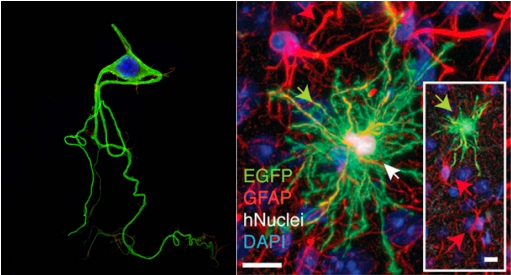
Neurons (shown on left) possess both axons and dendrites and are shaped differently than glial cells (Source).  The glial cell shown on the right is an astrocyte, which is more “star” shaped due to its many branched processes (Han et al 2013).

While people generally think of neurons as being the important type of brain cells, research is beginning to show that the merits of glial cells were previously underestimated. Interestingly, post-mortem analysis of Albert Einstein’s brain showed that he had more glia than the average person (Diamond et al, 1985).  Along the same vein, previous studies have shown that primate glia are larger, more complex, and faster than those of mice (Colombo, 1996; Oberheim et al., 2009). Therefore, is it possible that glial cells are the root of intelligence?

Han et al. tested this hypothesis by grafting human astroglia progenitors into neonatal immune-deficient mice.  Because the mice retained their own astroglia as well, the mice were chimeric, or having both mouse and human glia.  The human glial cells were fluorescently labeled before implantation so that they could be identified after each mouse was sacrificed, which occurred anywhere from 0.5-20 months of age.  The successfully grafted glial cells were found to have distributed across the forebrain, including the hippocampus and cortex.  Additionally, human glia were found in the amygdala, thalamus, and neostriatum in mice ages 12-20 months.


Next, the authors did a battery of tests that revealed that the cells were not only present, but also functional.  The authors found that not only were the human astrocyte progenitor cells present in the mouse brain, but they actually differentiated into humanoid protoplasmic astrocytes that formed synapses with mouse astrocytes.  In the chimeric mouse brain, the human astrocytes produced Ca2+ signals that were three times faster than Ca2+ signals produced by mouse astrocytes (this had previously been demonstrated in human tissue, but held true for chimeric mouse tissue). Next, the authors compared hippocampal dentate synaptic activity in chimeric mice to unengrafted and allografted mice and found that tissues with engrafted human glia showed a greater level of excitatory synaptic transmission. This finding goes hand in hand with the next subsequent finding that Long Term Potentiation (LTP), an experimental measure correlated with memory formation, increased in chimeric mice. The authors speculate that this increase was due to insertion of GluR1, a specific type of excitatory receptor often associated with memory and learning, into mice neurons by human glia, which lowered the threshold for LTP induction.


Because LTP was increased in chimeric mice, one would assume that these mice, not just their cells, would also showed quicker learning behaviors than the control mice. As expected, mice engrafted with human glia performed better in all four behavioral tasks compared to unengrafted and allografted mice, showing that the improvement was due to the human glia, not the act of engrafting cells into the mice.


Overall, the results of the paper suggest that astrocytes play a role in learning, and that more complex astrocytes might increase learning by lowering the threshold at which LTP occurs. Furthermore, the paper implies that human astrocytes, and possibly other subtypes of untested human glial cells, play a role in the high level of cognition observed in humans (and possibly in mice).


The Rats of
NIMH (Source)


After introducing the paper and its findings, the subject turned to the ethical considerations associated with the study.  Riley introduced another paper (Greely et al 2007) as a response to Han et al.  In his paper, Greely discusses the possible ethical issues that would arise by performing this type of study.  Greely lists several possible ethical issues, including the risk of conferring humanity upon the mice, the potential for pain and suffering, public reaction, and respect for human tissues.


In response to Greely’s first concern, journal club attendee and bioethics professor Dr. Jonathan Crane pointed out that “conferring humanity” upon the mice was the wrong term, as “humanity” simply means the traits that make us human.   Dr. Crane pointed out that humans do not really have any unique capabilities that other animals do not have, we just have them in a different degree.  He points out the Greely is most likely concerned about the risk of conferring “personhood,” or making the mouse a autonomous individual to the same extent that an adult human is.


Of course, if personhood were conferred upon a species that we cannot communicate with, would we even be able to recognize it?  It seems a big issue with this type of study is not only the possibly innately unethical problem of creating an unnatural sentient being, but also the issue of creating a (more?) autonomous being, not realizing it as such, and continuing to treat it like a typical lab animal.


Greely’s second concern, the potential for pain and suffering in the chimeric mouse, was also addressed.  While Greely’s paper noted the possibility of increased pain in the mouse due to having human neurons, the group discussed the mouse’s possibly increased emotional pain as well.  It was addressed that a mouse with human “intelligence” might also gain a human-like propensity for depression or realizing the futility of life as an experimental animal.   The authors seem to have guarded against this in the Han et al. study by noting that the chimeric mice were just as social as normal mice.  However, if these types of studies continue and mice intelligence is further increased, depression and suffering in the chimeric mouse will be a concern. The experimenters compared the reaction times and pain thresholds of chimeric mice to normal mice and found them to be the same.  These findings, coupled with the observation that the chimeric mice are just as social as normal mice are checks the experimenters used to show that the mice were not suffering mentally or physically.  These checks should also be present in future studies with chimeric species.  However, the downside is that these tests cannot gauge suffering until it has already happened.


Greely’s concern about public reactions was also discussed.  When discussing public reactions, it was addressed that different groups would be opposed to this study for different reasons.  Some groups would be opposed because of the belief that implanting human brain cells into a disvalues human intelligence.   Emory medical ethicist Dr. John Banja noted that some would question whether or not it is ethical to create hybrid species in the first place.  Dr. Crane pointed out that the study is also an affront to the mouse, as it is attempting to improve an animal that is perfect to begin with.


Riley’s main concern was that progression of this experiment will continue to create new species that we know nothing about.  Without knowing which mouse traits and which human traits a hybrid will have, it is impossible to care for it in the correct way from the beginning.  Riley pointed out that sometimes it takes thousands of years to create a cultural consensus on what is ethical regarding a certain issue, so if a new species pops up overnight society may not treat the animals respectfully.  Furthermore, these animals could completely change biological science: furthering this study could lead to a greater understanding of the mechanisms for learning, memory, and eventually even consciousness in humans.  An alternative to this however would be is a unique and species is created that is later discovered to have human-like consciousness and increased suffering.  The scientific community would stall as it would have to deal with public dissent amidst trying to find a more ethical method of testing the same hypotheses.


While future advancements along this line of work could have the potential to help us understand exactly what intelligence is, how it works, and why some people have more of it than others, these types of experiments could also have the ability to create a brand new species that society is not ready to care for or treat with respect.  Furthermore, it may not be possible to determine when the ethical boundary has been overstepped until it has already happened. Therefore, in continuations of this study, it is important to use chimeric animals with discretion and continue testing for possible suffering.


If you missed out on this journal club meeting you can watch a video of it and previous meetings here.


References


Alexander V. Gourine, V. K. (2010). Astrocytes Control Breathing Through pH-Dependent Release of ATP. Science, 571-575.


Barres, B. A. (2003). What is a Glial Cell? Glia, 4-5.


Colombo, J. (1996). Interlaminar astroglial processes in the cerebral cortex of adult monkeys but not of adult rats. Cells Tissues Organ, 57-62.


Henry T. Greely, M. K. (2007). Thinking About the Human Neuron Mouse. The American Journal of Bioethics, 27-40.


Magistretti, M. T. (1996). Metabolic Coupling between Glia and Neurons . Journal of Neuroscience, 877-885.


Marian C. Diamond, A. B. (1985). On the brain of a scientist: Albert Einstein. Experimental Neurology, 198–204.


Oberheim, N. W. (2006). Astrocytic complexity distinguishes the human brain. Trend in Neuroscience, 547-553.


Xiaoning Han, M. C. (2013). Forebrain Engraftment by Human Glial Progenitor Cells Enhances Synaptic Plasticity and Learning in Adult Mice. Cell, 342-353.


Want to cite this post?


Young, E. (2013). Can Human Brain Tissue Make Mice Smarter? Emory Neuroethics Journal Club Review. The Neuroethics Blog. Retrieved on

, from http://www.theneuroethicsblog.com/2013/06/can-human-brain-tissue-make-mice.html.