Pages

Tuesday, July 15, 2014

Intellectual Property from Clinical Research on Neuropsychiatric Disorders: What Constitutes Informed Consent?

By Elaine F. Walker, Ph.D. & Arthur T. Ryan, M.A.


Elaine Walker is a Professor of Psychology and Neuroscience in the Department of Psychology at Emory University and is the Director of the Development and Mental Health Research Program, which is supported by the National Institute of Mental Health. Her research is focused on child and adolescent development and the brain changes that are associated with adolescence. She is also a member of the AJOB Neuroscience editorial board.


The pace of advances in biomedical research has accelerated in conjunction with new technologies for studying cellular processes. While this progress holds promise for relieving human suffering from a range of illnesses, it also poses significant and thorny questions about the ownership of new knowledge. In June of 2013, the Supreme Court issued a unanimous ruling on the Association for Molecular Pathology v Myriad Genetics, Inc.; all justices agreed that naturally occurring DNA sequences cannot be patented1. This ruling was precipitated by a patent owned by Myriad genetics on the DNA sequences for the human BRCA1 and BRCA2 genes, which are associated with human variation in susceptibility to cancer. The ruling concluded that genes are products of nature and, therefore, cannot be claimed as the intellectual property (IP) of any individual or commercial entity. Within hours after this ruling, other companies announced that they would offer genetic testing for BRCA1 and BRCA2 at a significantly lower cost than Myriad had been charging for years.


While the Supreme Court's ruling on the patentability of naturally occurring human genetic sequences had broad and immediate implications, it represents only the tip of the iceberg with respect to the contentious issues that will confront intellectual property (IP) rights for future biomedical advances. We can anticipate more ethical and legal debates regarding commercialization in the fields of proteomics (the study of protein structure and function), epigenetics (changes in gene expression mediated by RNA, as opposed to changes in the DNA code), stem cells, and the study of the human connectome (the map of neural connections in the brain). The implications of the pursuit of patents in these areas will extend to all fields of medicine, but they present some particularly complex problems with regard to the brain disorders that are the province of neurology and psychiatry.


By way of background, most consent forms approved by institutional review boards (IRBs) do not explicitly inform prospective participants that IP may be generated using the biospecimens they provide during their participation. Some have argued that researchers are ethically obligated to inform participants that the investigator may benefit financially from the research, whereas the participant will not2. On the other hand, it has been argued that individuals who are capable of providing informed consent would be expected to be aware that patents might be obtained on marketable biomedical products that result from scientific advances3.


Can the same assumptions be made for all prospective participants? Clinical research aimed at elucidating the causes and effective treatments for neuropsychiatric disorders are dependent on the participation of volunteers who are either at risk for, or diagnosed with, such a disorder. This includes studies of individuals at risk for psychotic and mood disorders, and dementia and other neurodegenerative illnesses. As a result, these research volunteers may be suffering from symptoms that impair their cognitive capacities. Such impairments have the potential to diminish their ability to comprehend the information provided during the consenting process, as well as their comprehension of the broader implications of their property rights to their biospecimens and the knowledge that might be generated with them4. Nonetheless, informed consent procedures are used with these clinical research populations, albeit with extra consideration given to assure their understanding of the procedures. Ruling out informed consent by individuals who may be suffering from, or at risk for, a brain disorder would severely compromise scientific progress on these illnesses. At the same time, the ethical complexities of patents on the IP generated by such research cannot be ignored.


Concerns about risk status are a motivator for many participants in clinical research. Most IRBs require that consent forms include a ‘disclaimer’ statement concerning the likely absence of direct benefit to the participant. Yet, it is not clear that most prospective participants, especially those at risk for neuropsychiatric disorders, are aware that they may not have access to any advances in risk prediction that accrue from the research in which they participate. Thus, if a diagnostic test that enhances risk prediction and/or informs effective treatment results from the research, participants may assume that their access to it is assured. Yet this may not be the case if the ‘discovery’ becomes IP and the investigator applies for a patent.


Several scenarios may ensue and these are unlikely to be anticipated by most participants. For example, the pursuit of a patent may delay the public disclosure of the research findings, and in the interim the individual may succumb to an illness that might have been prevented if the discovery had been more promptly revealed. Further, the cost of the patented diagnostic test may be prohibitive for the individual, despite the fact that the participant contributed biospecimens that were used for the test's development. While such concerns are not unique to neuropsychiatric research, the ethical concerns are amplified in the case of individuals with cognitive impairments.


If participants were informed, as is the case in some European nations, that the researchers may benefit financially from discoveries made using their biospecimens, would that affect their willingness to participate? Although we are not aware of any research directly addressing this question, the results of studies of the general population indicate that many would be disinclined to consent to research participation if they were so informed 3,5.


It is clear that research advances in biomedical risk assessment, combined with trends toward commercialization, raise serious questions that are likely to become even more salient. Perhaps the most important question we must address is what information should be conveyed while obtaining the informed consent of prospective clinical research participants who provide biospecimens that might be used for commercial purposes. The ethical issues in this arena are especially noteworthy when the study population is characterized by limited cognitive capacity and when individual participants may be motivated by the desire for illness prevention or treatment access.


References


1. Ass’n for Molecular Pathology v. Myriad. Ct 133, 2107 (2013).


2. Godard, B., Schmidtke, J., Cassiman, J.-J. & Aymé, S. Data storage and DNA banking for biomedical research: informed consent, confidentiality, quality issues, ownership, return of benefits. A professional perspective. Eur. J. Hum. Genet. 11, S88–S122 (2003).


3. Steinsbekk, K. S., Ursin, L. Ø., Skolbekken, J.-A. & Solberg, B. We’re not in it for the money—lay people’s moral intuitions on commercial use of ‘their’biobank. Med. Health Care Philos. 16, 151–162 (2013).


4. Caplan, A. L. & Arp, R. Contemporary Debates in Bioethics. (John Wiley & Sons, 2013).


5. Sterckx, S., Cockbain, J., Howard, H., Huys, I. & Borry, P. ‘Trust is not something you can reclaim easily’: patenting in the field of direct-to-consumer genetic testing. Genet. Med. 15, 382–387 (2013).


Other Relevant Articles 


Andrews, L. B., & Paradise, J. (2005). Gene patents: the need for bioethics scrutiny and legal change. Yale J. Health Pol'y L. & Ethics, 5, 403.


DuBois, J. M., Beskow, L., Campbell, J., Dugosh, K., Festinger, D., Hartz, S., ... & Lidz, C. (2012). Restoring balance: a consensus statement on the protection of vulnerable research participants. American journal of public health, 102(12), 2220-2225.


Kim, S. Y., Caine, E. D., Currier, G. W., Leibovici, A., & Ryan, J. M. (2001). Assessing the competence of persons with Alzheimer’s disease in providing informed consent for participation in research. American Journal of Psychiatry, 158(5), 712-717.


Klein, R. D. (2013). AMP v Myriad: The Supreme Court Gives a Win to Personalized Medicine. The Journal of Molecular Diagnostics, 15(6), 731-732.


Rojahn, Susan Y. Cheaper Genetic Tests for Breast Cancer Risks in 2014? MIT Technology Review, December 31, 2013.


Want to cite this post?


Walker, E., Ryan, A. (2014). Intellectual Property from Clinical Research on Neuropsychiatric Disorders: What Constitutes Informed Consent? The Neuroethics Blog. Retrieved on , from http://www.theneuroethicsblog.com/2014/07/intellectual-property-from-clinical.html




Tuesday, July 8, 2014

Early Intervention and The Schizophrenia Prodrome

On May 7th the Emory
University Graduate Students in Psychology and Neuroscience (GSPN)
hosted a colloquium talk given by Vijay
Mittal
, assistant Professor of Psychology and Neuroscience at the
University of Colorado at Boulder. In the talk, titled “Translational
Clinical Science in the Psychosis Prodrome: From Biomarkers to Early
Identification and Intervention,” Dr. Mittal, who received his
Ph.D. from Emory, discussed some of his research on the prodrome for
schizophrenia.1


Dr. Vijay Mittal

The prodrome for schizophrenia is a
collection of neurological and psychological symptoms that can
indicate risk for developing schizophrenia (as has been discussed previously on this
blog) prior to the development of clinically relevant symptoms.
Research on the prodrome
is gaining much attention and funding because it could lead to a
better understanding of how schizophrenia develops and better ways to
intervene prior to its onset.


Mittal began his talk with a background
on the schizophrenia prodrome. He explained that, though
schizophrenia usually manifests itself during late adolescence,
people who develop schizophrenia exhibit atypical characteristics
from a young age, during the premorbid and prodromal stages. In the
premorbid stage (which occurs during childhood) some minor cognitive
and social impairments are present, though they are hard to
differentiate from typical development. In the prodromal stage (which
starts during puberty) those traits worsen and new ones develop that
are similar to (though less frequent and severe than) the main
symptoms of schizophrenia (both the positive
and negative
). Common symptoms of the prodrome include perceptual
aberration, paranoia, mild delusions (which can be distinguished from
reality2), depression, anhedonia, cognitive decline, and
social withdrawal.


The positive, negative, and cognitive symptoms of schizophrenia.

Via dasmaninstitute.org.


According to the current model of
schizophrenia development, Mittal explained, certain individuals
(through both inherited and environmental factors) have
neurological vulnerabilities that can lead to more severe neurological
damage, primarily effecting the dopamine system, as a result of the
normal physiological changes that occur during puberty (specifically
hormonal changes and synaptic
pruning
). This explains why the prodrome occurs during puberty,
why schizophrenia develops after puberty, and why some symptoms are
even present from childhood.


Attention is being given to the
prodrome in schizophrenia research because it is the best predictor
of later psychosis (even more so than familial history). That said,
it is still not a very good one. Only a minority of the people who
exhibit prodromal traits go on to develop schizophrenia (Mittal gave
a range of 10% to 35%; the North American Prodrome
Longitudinal Study gives a range of between
20% and 50%
). Because of this, Mittal explained, treatment with
antipsychotic medications is not usually prescribed for people with
prodromal traits, because it would be unethical to give expensive
medications with severe side effects to people who will most likely
not develop any pathology.


Mittal stressed the need for better
ways to predict schizophrenia, and he presented some of his research
on the topic. One method he described is testing for motor
abnormalities in addition to the more obvious psychological and
neurological symptoms. Some people with schizophrenia exhibit
excessive, involuntary movements (hyperkinesia) or have difficulty
moving (hypokinesia), and so do some during the prodromal phase. By taking such motor abnormalities into account (including
subclinical ones), Mittal
and colleagues
were able to predict which prodromal patients who
would go on to develop schizophrenia with 72% accuracy. This study
was based on observing videotapes of patients, but clinical
handwriting analysis software, like that developed by NeuroScript
(currently used to test for movement disorders, injuries, and
medication side effects), could also be used to test for such motor
symptoms. Other diagnostic methods could be based on measuring
neurological biomarkers for schizophrenia risk, including reduced
putamen, thalamus, and hippocampus volume and decline in white
matter.


The importance of developing better diagnostic
techniques for susceptibility for schizophrenia is clear. It would lead to both a better understanding of the
causes and development of the disorder and have important
clinical applications. Such techniques could allow for better monitoring of high-risk
individuals and the ability to reassure low-risk prodromal patients that their
symptoms are not likely to become more severe. The fear and stigma of being classified as at risk for schizophrenia is often cited as one of the main ethical concerns of diagnosing people with the schizophrenia prodrome.3 Mittal is currently working on a paper in which he and his co-authors explore the ethical concerns of predicting schizophrenia, specifically how the decision to inform patients that they are at risk for schizophrenia involves balancing the benefits of potential early intervention with the stress and stigma that can come with such a diagnosis.4


In his talk, Mittal argued that
better diagnostic methods are important primarily because they will allow
early intervention with antipsychotic medications, which would
decrease the likelihood of high-risk patients developing
schizophrenia and decrease the severity of schizophrenia for those who
develop it. But antipsychotic use for prodromal patients is
controversial and there is no clear evidence that it can prevent
later schizophrenia3 (though the drugs are sometimes prescribed to treat the prodromal symptoms themselves). The evidence Mittal presented to
make his case was a study where low
doses of antipsychotics were given to a group of patients with prodromal symptoms and 18% of them developed schizophrenia, compared to 45% of the control group. Though he admitted that the results are not
statistically significant because of a high dropout rate due to the
side effects of the medication.


The diagnostic techniques that Mittal discussed have promise for improving the way that schizophrenia is diagnosed and treated. But how accurate would these technologies need to be before they can be ethically
integrated into the care of patients at risk for developing
schizophrenia? Care will need to be taken when
discussing the limitations and benefits of prodromal screening given
the potential for false positive and false negatives. Also, while these technologies would open the door for use of preventative treatments (particularly antipsychotics), it seems that stronger evidence of their efficacy is required before they are widely prescribed. 


References


1) Mittal, Vijay. “Translational Clinical Science in the Psychosis Prodrome: From Biomarkers to Early Identification and Intervention.” Emory University Graduate Students in Psychology and Neuroscience. Atlanta, GA. 7 May, 2014.


2) Rachel Aviv, "Which Way Madness Lies: Can psychosis be prevented?" Harper's, December 2010, 35-46.


3) Walker, E., Goulding, S., Ryan, A., Holtzman, C., MacDonald, A. (2013). The identification of risk for serious mental illnesses: Clinical and ethical challenges. The Neuroethics Blog. Retrieved on June 20, 2014, from http://www.theneuroethicsblog.com/2013/05/the-identification-of-risk-for-serious.html


4) V. Mittal (personal communication, July, 2, 2014)


Want to cite this post?


Queen, J. (2014). Early Intervention and The Schizophrenia Prodrome. The Neuroethics Blog. Retrieved on , from http://www.theneuroethicsblog.com/2014/07/early-intervention-and-schizophrenia.html

Tuesday, July 1, 2014

“Pass-thoughts” and non-deliberate physiological computing: When passwords and keyboards become obsolete

Imagine opening your email on your computer not by typing a number code, a password, or even by scanning a finger, but instead by simply thinking of a password. Physical keys and garage door openers could also become artifacts of the past once they are replaced with what could be referred to as pass-thoughts. Just last year, researchers at UC Berkley used EEG signals emitted from subjects as biomarker identifiers to allow access to a computer. The entire system – the headset, the Bluetooth device, and the computer – had an error rate of less than 1%.1 While wearing EEG headsets to open our devices may seem futuristic, this type of scenario could become more prevalent in the future due to advances in physiological computing (PC). Physiological computing is a unique form of human computer interactions because the input device for a computer is any form of real-time physiological data, such as a heart-rate or EEG signal. This is in stark contrast to the peripheral devices that we are familiar with today, such as a keyboard, remote, or mouse.2


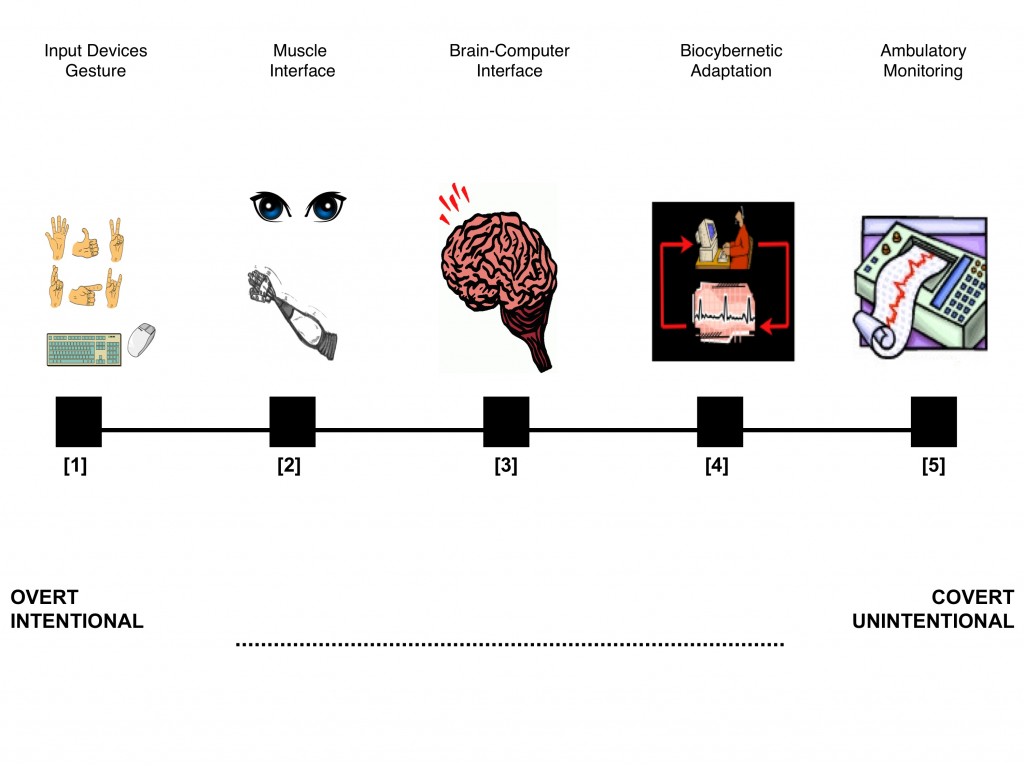
The field of physiological computing is still quite new, but research has suggested that different physiological computers require varying degrees of intentionality from the human user, and that the devices can be placed on a spectrum.3


Via physiologicalcomputing.net


On one end of the spectrum are technologies where users can deliberately interact with input devices based on voluntary muscle movement such as electrooculography (EOG) to direct the movement of a cursor (shown in 2 on the spectrum).4 In contrast, brain-computer-interfaces (BCI)­ such as the exoskeleton showcased at the recent first kick for the 2014 World Cup, bypass this step­ since BCIs are often developed for those with diminished movement capacities and disabilities. However, in both cases the general principle is the same: the interface is ultimately translating a neural signal that the user has specifically and deliberately directed to complete a task.5


Via cbsnews.com


Non-deliberate PC, on the other hand, bypasses any voluntary input, and instead involves a “biocybernetic” approach where spontaneous physiological changes, such as a heart rate or brain electrical signals are recorded via an electrocardiogram (EKG) or an electroencephalogram (EEG), respectively. These signals are then correlated to meaningful information, such as the case mentioned above where specific EEG signals act as identifying information to allow access to a computer. These types of technologies are able to associate recorded physiological changes with the motivational, cognitive or emotional state of the user. Once the interface determines the user’s emotional state, it can often adapt in an attempt to promote a specific type of positive mentality or negate a potentially hazardous emotional state. For example, if a computer calculates that the user is stressed, it can play soothing music or offer to help to diffuse the negative situation. The long-term recording of physiological data usually for learning purposes is referred to as ambulatory monitoring.6


Via thenextweb.com


Technologies that incorporate aspects of physiological computing, such as the recently released Kinect 2 from Microsoft, have recently become prevalent in consumer products. Using technology similar to that developed at MIT and referred to as Eulerian Video Modification,7 the camera on the Kinect detects small changes in skin color pigmentation and monitors heart rate optically (although pulse rate can be an indicator for an emotional state, at this time the Kinect 2 focuses on monitoring heart rates during physical activity, but does not correlate this data to an emotional state).


Portable, wireless sensors that are able to not only record, but also convert raw EEG signals into some form of meaningful information are currently available. EPOC by Emotiv and MindWave by NeuroSky have developed and currently sell wireless headsets that act as EEG sensors. Since certain EEG signals could be used as an indicators of a specific emotional state, such as frustration,8 the interface can label or adapt to a user in real-time. That said, while these EEG sensors give the impression that the user can execute commands with seemingly only the power of thought, these technologies are not yet able to comprehend intentions or mimic emotions (but, see recent data on AI recently passing Turing Test). For an interface to recognize intentions, first a system, similar to a dictionary, must be created so that the computer records the EEG data for a series of tasks that the interface will be able to recognize later. Not to mention, “intent” is still not clearly understood mechanistically through neuroscience.


Pertinent ethical issues include those related to ownership and privacy. Raw EEG or electrocardiogram (ECG) data is powerful information, especially when linked to changes in an emotional state. Emotiv will provide the raw EEG data from its users for an additional fee, but NeuroSky does not provide this information. Do we have any claim over our own (neuro-)physiological data once it leaves us? Even if raw EEG signals are worthless without an algorithm to decipher the meaning, the data still originated from only one, original source. Until it was pulled for ownership issues (NASA wanted to ensure that the data was no longer federal property), the EKG of Neil Armstrong’s heart as he took the first steps on the moon was to be auctioned off last year.9 But did NASA ever have a right to lay claim to this information, even if without an algorithm the EKG is seemingly meaningless? Or, does Neil Armstrong (or in this case, his family) have any right to claim ownership since NASA paid for and played a role in developing the technology that enabled this collection? These will be the types of questions that need to be addressed as more and more people continue to offer up their physiological data by using these types of technologies and popular commercial venues.


Via time.com


It seems inevitable that one day enough people will participate in the use of these EEG sensors and a massive database of neurological signals will begin to develop. Having a large dataset of neurological data that can potentially be correlated to disease states is already the goal of well established companies such as Lumosity 10 and BrainResource.11 Additionally, the United States government recently launched PCORnet: The National Patient-Centered Clinical Network Project with the intention of building a national health-data system by combining data from 29 different health data networks.12 The United Kingdom has met ethical conflicts with the introduction of a similar system, care.data,13 and the United States already has a history of alleged National Security Agency privacy violations, but government backed organizations are moving forward with the massive collection of medical records and perhaps one day, extensive physiological data. A precedent for having a dataset of extensive, personal information is the company 23andMe, which provided information based on DNA analysis. Nothing is protecting the users of 23andMe’s service from having their personal information sold,14 but the Genetic Information Nondiscrimination Act (GINA) passed in 2008 protects people from having their genetic information interfere with insurance policies and employment. This type of law does not exist for neurological data. Regulations and discussions should be taking place now before companies like Emotiv or NeuroSky have 5 years’ worth of data from their customers whose privacy is not protected in the slightest.


Already specific EEG signals can be used to characterize neurological disorders. With the collection of more data, we have the potential to be able to recognize and use specific signals as “brain signatures” for other neurological disorders or even tendencies toward certain behaviors (The well-established company Brainwave Science is a proponent of using EEG technology to test guilt or innocence). This ability, while incredibly powerful, has a high risk for abuse in terms of covert monitoring of individuals.15 Of course, if a patient has epilepsy, a discrete EEG sensor that has the power to be predictive for seizure activity could greatly increase the health, safety, and quality of life for these patients.16 Would it be appropriate to monitor a person who has been given a neurological diagnosis that has rendered them emotionally unstable if the EEG sensor could detect a very high or low state though? If that EEG sensor means that they are deemed stable enough for certain activities they were once denied, such as driving, does that make the constant monitoring worth what many would consider a violation of privacy?


References


(1) New Research: Computers That Can Identify You by Your Thoughts http://www.ischool.berkeley.edu/newsandevents/news/20130403brainwaveauthentication (accessed Jun 26, 2014).


(2) Fairclough, S. H. Fundamentals of Physiological Computing. Interact. Comput. 2009, 21, 133–145.


(3) Physiological Computing F.A.Q. Physiological Computing Blog. http://www.physiologicalcomputing.net/?page_id=227 (assessed on June 28, 2014).


(4) Allanson, J.; Fairclough, S. H. A Research Agenda for Physiological Computing. Interact. Comput. 2004, 16, 857–878.


(5) Allison, B. Z.; Wolpaw, E. W.; Wolpaw, J. R. Brain-Computer Interface Systems: Progress and Prospects. Expert Rev. Med. Devices 2007, 4, 463–474.


(6) Fairclough, S.H., and Gilleade, K. (2014). Meaningful Interaction with Physiological Computing. In Advances in Physiological Computing, S.H. Fairclough, and K. Gilleade, eds. (Springer London), pp. 1–16.


(7) Wu, H.-Y.; Rubinstein, M.; Shih, E.; Guttag, J.; Durand, F.; Freeman, W. T. Eulerian Video Magnification for Revealing Subtle Changes in the World. ACM Transactions on Graphics (Proc. SIGGRAPH 2012 2012, 31.


(8) Kapoor, A.; Burleson, W.; Picard, R. W. Automatic Prediction of Frustration. Int. J. Hum.-Comput. Stud. 2007, 65, 724–736.


(9) Pearlman, R. Z. Neil Armstrong’s “Heartbeat,” Apollo Joystick Pulled from Auction http://www.space.com/21228-neil-armstrong-apollo-artifacts-auction.html (accessed Jun 26, 2014).


(10) Sternberg, D. A.; Ballard, K.; Hardy, J. L.; Katz, B.; Doraiswamy, P. M.; Scanlon, M. The Largest Human Cognitive Performance Dataset Reveals Insights into the Effects of Lifestyle Factors and Aging. Front. Hum. Neurosci. 2013, 7.


(11) McRae, K.; Rekshan, W.; Williams, L. M.; Cooper, N.; Gross, J. J. Effects of Antidepressant Medication on Emotion Regulation in Depressed Patients: An iSPOT-D Report. J. Affect. Disord. 2014, 159, 127–132.


(12) Collins, F. S.; Hudson, K. L.; Briggs, J. P.; Lauer, M. S. PCORnet: Turning a Dream into Reality. J. Am. Med. Inform. Assoc. 2014, amiajnl–2014–002864.


(13) Callaway, E. UK Push to Open up Patients’ Data. Nature 2013, 502, 283–283.


(14) Seife, C. 23andMe Is Terrifying, but Not for the Reasons the FDA Thinks. Scientific American, Nov. 27, 2013. http://www.scientificamerican.com/article/23andme-is-terrifying-but-not-for-reasons-fda/ (accessed Jun 26, 2014).


(15) Deceiving the Law. Nat. Neurosci. 2008, 11, 1231–1231.


(16) Jouny, C. C.; Franaszczuk, P. J.; Bergey, G. K. Improving Early Seizure Detection. Epilepsy Behav. EB 2011, 22 Suppl 1, S44–48.


Want to cite this post?


Strong, K. (2014). “Pass-thoughts” and non-deliberate physiological computing: When passwords and keyboards become obsolete. The Neuroethics Blog. Retrieved on , from http://www.theneuroethicsblog.com/2014/06/pass-thoughts-and-non-deliberate.html

Tuesday, June 24, 2014

Should you read more because a neuroscientist said so?

By Lindsey Grubbs


Lindsey Grubbs is a PhD student in the English Department at Emory University, where she is also working on a certificate in bioethics. She holds a master’s degree in English and gender studies from the University of Wyoming. She is interested in the relationship between literature and science, and works with American literature from the nineteenth century until today to interrogate and complicate the boundaries between health and wellness, normalcy and aberrance, and physical and mental complaints.


As neuroscientists begin to approach topics usually falling under the purview of other specialties, how can they ethically incorporate various forms of knowledge rather than provide simplified metrics that will, in a data hungry society, be easier for most to latch onto?


In 2013, we saw the publication of at least two high profile studies claiming neuroscientific proof for the potential moral benefits of reading fiction. Greg Berns and his associates published “Short- and Long-Term Effects of a Novel on Connectivity in the Brain” in Brain Connectivity (Berns, Blaine, Prietula, & Pye, 2013), and David Comer Kidd and Emanuele Castano published “Reading Literary Fiction Improves Theory of Mind” in Science (Kidd & Castano, 2013). The Berns article makes a relatively modest claim: the day after an evening session reading a novel, test subjects had short-term increased brain connectivity in areas of the brain associated with taking perspectives and understanding narratives, and longer-term connectivity that lasted several days in the bilateral somatosensory cortex, which the authors suggest could help explain the mechanism of “embodied semantics,” the idea that there is somatosensory involvement in the processing of language, as when tactile metaphors like “I had a rough day” activate the somatosensory cortex (Lacey, Stilla, & Sathian, 2012). As suggested by its title, the Kidd and Castano piece makes a more dramatic claim: the authors conducted five experiments and write that reading award-winning literary fiction improves subjects’ theory of mind both alone and in comparison to nonfiction or popular bestselling fiction. The reaction to these studies in the press follows the trend of a mania for neuroscientific evidence and colorful images of the brain1.  Why is it necessary, though, to grant scientific authority more weight as evidence than other forms of knowledge?


Via The Wire


Our society values information that seems objective over that which seems subjective—at times a value that makes sense, but one that is exaggerated in the case of something like responses to literature, which are inherently subjective. Writing for the New York Times, Alissa Quart writes, “The problem isn’t solely that self-appointed scientists often jump to faulty conclusions about neuroscience. It’s also that they are part of a larger cultural tendency, in which neuroscientific explanations eclipse historical, political, economic, literary and journalistic interpretations of experience” (Quart, 2012). The reading studies and the press reactions to them clarify the need for interdisciplinary work that truly engages with, rather than pays lip service to, multiple sources of knowledge—not just scientific protocol, but also generations of thoughtful work in the humanities.


Kidd and Castano’s study highlights the need for truly engaged interdisciplinary work, as it engages with literary topics without full consideration of the dynamics of reading—they perform what ought to be an interdisciplinary study without the necessary expertise, leading to a weaker study compounding the type of media “neurohype” this one received. While Kidd and Castano acknowledge literary theory by employing literary critic Roland Barthes’ differentiation between “readerly” texts, which encourage passive reading, and “writerly” texts, which engage the reader and require them to produce their own meanings (a move demonstrating that they’ve done some homework in literary theory), they use the terms imprecisely (Barthes likely would have classed all of the books in the study as “readerly”—none were “weird” enough to garner a “writerly” diagnosis, which describes text like James Joyce’s Finnegans Wake) and perhaps to the point of inaccuracy. Anyways, the terms originate over forty years ago, and hardly reflect more contemporary, nuanced understandings of how texts engage the reader.


More recent literary theory suggests that the value and substance of a text is not an inherent quality of a work; rather, the meaning of a text is created in the relationship between the reader and the page, both enmeshed in a complex context of race, class, gender, and other factors. By making the claim that “literary fiction” improves theory of mind while “popular fiction” does not—a messy distinction framed as though it were a straightforward one (it seems important to note that the results of Berns’ study—which used a “popular,” not “literary” novel—would suggest that this is wrong, and that reading need not be literary to improve empathy), Kidd and Castano’s study also risks propping up class-based distinctions. Supporting the bias that reading “high-culture” literature, which is undeniably bound up in classed, racialized, and gendered inequalities, is more morally salutary than reading other texts on the basis of one measure is irresponsible, and shows an inadequate engagement with the politics of reading. Despite a brief nod to the class-based distinctions between the two groups, the authors maintain that the notion of “literary value” has “ecological validity” because it can be detected by readers. But it is precisely this ecological validity that changes how the text will be read: we live in a culture that values certain types of writing from certain types of authors (most typically, dead white men), and this value is necessarily historically contingent—not “objective.” Today, we know when we pick up a mystery or sci-fi novel that we are supposed to read it easily, quickly, and probably with a bit of embarrassment. In contrast, when we pick up “serious” literature, we are supposed to engage and work at meaning—which we can easily imagine would impact the neural mechanisms at play.


Via stanford.edu


Incorporating an expert in literary study could have helped the experiment design avoid this problem. Consider the work of Natalie Phillips, an English professor working with neuroscientists and radiologists on a study of the neuroscience of reading and attention. Subjects read Jane Austen in an MRI and alternated between skimming casually and reading closely—revealing that the two types of reading produced very different patterns on the MRI. Her familiarity with literature allowed her to realize that there are not simply different types of texts, but also different types of reading—a key oversight in the Kidd and Castano study. Future research into the relationship between reading and the brain would be more thorough, convincing, and conceptually and ethically sound if it includes humanities scholars, who contribute a different kind of knowledge. Conversely, the growing body of work in the humanities that incorporates a cognitive approach must be vigilant about including science ethically, which is to say scientifically—not “pop-scientifically.”


As neuroscientists become more deeply engaged with social questions, as Berns and Kidd and Castano have done with these recent studies, we will need to begin sorting through a complex series of questions. Julianne Chiaet writes in Scientific American that Kidd and Castano’s study could influence educational programs, prison reform, and the treatment of autism. But how well supported does a scientific claim have to be before we use it to shape policy? Kidd and Castano acknowledge that the research is preliminary, focused on only one of a wide array of possible benefits of reading, and that much research remains—however, that doesn’t stop them from suggesting potential policy implications based on the limited knowledge they propose. They point to the new Common Core State Standards and argue that more fiction ought to be included in the curriculum (at the expense of other subjects of study). Alternatively, what are the implications of “prescribing” reading as a kind of social medication for those deemed pathologically asocial? Writing for Slate, Mark O’Connell expresses concern about looking at reading in a "morally instrumentalist" way. What are the dangers of suggesting that mandated reading programs could “fix” our criminals and children with autism at the expense of broader social reforms that would reduce the incentives to commit crimes or the stigma our culture aims at people with disabilities? Moving forward, tackling these types of questions will require the pooled expertise of those in the sciences and humanities.


1 Berns uses neuroimaging, while Kidd and Castano use measures of theory of mind like “reading the mind in the eyes” tests.


Bibliography


Berns, G. S., Blaine, K., Prietula, M. J., & Pye, B. E. (2013). Short- and Long-Term Effects of a Novel on Connectivity in the Brain. Brain Connectivity, 3(6), 590–600. doi:10.1089/brain.2013.0166


Chiaet, J. (2013). Novel Finding: Reading Literary Fiction Improves Empathy. Scientific American. Retrieved June 16, 2014, from http://www.scientificamerican.com/article/novel-finding-reading-literary-fiction-improves-empathy/


Kidd, D. C., & Castano, E. (2013). Reading Literary Fiction Improves Theory of Mind. Science, 342(6156), 377–380. doi:10.1126/science.1239918


Lacey, S., Stilla, R., & Sathian, K. (2012). Metaphorically feeling: Comprehending textural metaphors activates somatosensory cortex. Brain and Language, 120(3), 416–421. doi:10.1016/j.bandl.2011.12.016


O’Connell, M. (2013, October 28). 10 Novels to a Better You. Slate. Retrieved from http://www.slate.com/articles/arts/culturebox/2013/10/does_reading_fiction_make_you_a_more_empathic_better_person.2.html


Quart, A. (2012, November 23). Neuroscience: Under Attack. The New York Times. Retrieved from http://www.nytimes.com/2012/11/25/opinion/sunday/neuroscience-under-attack.html


"This is your brain on Jane Austen, and Stanford researchers are taking notes." (2012, September 7). Stanford University. Retrieved June 11, 2014, from http://news.stanford.edu/news/2012/september/austen-reading-fmri-090712.html


Want to cite this post?


Grubbs, L. (2014). Should you read more because a neuroscientist said so? The Neuroethics Blog. Retrieved on , from http://www.theneuroethicsblog.com/2014/06/should-you-read-more-because.html

Tuesday, June 17, 2014

Predicting Alzheimer's Disease: Potential Ethical, Legal, and Social Consequences

By Henry T. Greely, J.D.


Henry T. (Hank) Greely is the Deane F. and Kate Edelman Johnson Professor of Law and Professor, by courtesy, of Genetics at Stanford University. He directs the Stanford Center for Law and the Biosciences and the new Stanford Program in Neuroscience and Society  SPINS). He is also a member of the AJOB Neuroscience Editorial Board.


Would you want to know the date and time of your death? Life-Line, the first published fiction by Robert A. Heinlein, one of the giants of 20th century science fiction, explored that question. The story’s protagonist, Hugo Pinero, had invented a machine that could tell precisely when individuals would die, but, as Pinero found to his distress, he could not intervene to change their fates.


Would you want to know whether you would be diagnosed with Alzheimer disease (AD)? This question is rapidly leaving the realm of science fiction; indeed, it already has for some unlucky people. Our ability to predict who will suffer from this evil (and I chose that word carefully) condition is proceeding on several fronts and may already be coming into clinical use.


This post will briefly note the ways in which AD prediction is advancing and what some of the ethical, legal, and social implications of such an ability would be, before asking “should we care?”


Via the BBC


Science


Several different techniques are providing information about an individual’s risk of being diagnosed with AD, including genetics, biomarkers, and neuroimaging.


Genetics can predict AD with great confidence for about one person in a thousand. People who carry a mutated version of the PS1 gene (or, much more rarely, mutated versions of the PS2 or APP genes) are nearly certain to be diagnosed with AD, unless they die earlier from something else, and with an early onset version that typically strikes in one’s 40s or 50s. People with two copies of the APOe4 allele, about one to two percent of the population, have a very high risk (at least 50 percent, perhaps as high as 80 percent) of being diagnosed with AD in their sixties or seventies. People with one APOe4 allele and one APOe2 or APOe3 allele – that’s about 20 percent of the population – have two or three times the AD risk of people without an APOe4 allele. Other alleles of other genes have also been found to confer higher risk of AD, and some single nucleotide polymorphisms have been associated with higher risk of the disease.


Other researchers have identified biomarkers that are associated with risk of AD, both in the cerebral spinal fluid (CSF) and in the blood serum. Thus far, the CSF methods have looked for levels of the protein beta amyloid (42), which forms plaques on dead and dying neurons of those with AD, and the protein named “tau,” which forms tangles in the bodies of those neurons. Some of the blood work has looked at those biomarkers; others have looked at a range of different proteins in the blood. None of these methods is ready for clinical use; some of the published research has claimed nearly 90 percent accuracy in predicting relatively near-term AD diagnosis.


Recently, the FDA approved a radio ligand that attaches to the amyloid plaque in the brain and allows the existence of amyloid plaque to be seen by positron emission tomography (PET). The approved labeling is for use in diagnosing AD, not in predicting it, but the off-label use doctrine allows doctors to prescribe it for any purpose. Other researchers are trying to find ways to image tau tangles, though currently the only method for detecting them is through a brain biopsy (not an easy technique!). It is also known that magnetic resonance imaging (MRI) scans of brains can see changes in grey matter density in certain parts of the brains of people with AD; efforts are under way to use that method to predict AD diagnoses.


These various methods need not be used in isolation. They could be used together, in an effort to provide greater accuracy than any one test would do on its own. We are only at the beginning of efforts to assess those possibilities.


The FDA has not approved any of these methods (yet) for clinical use in predicting AD and professional groups have recommended against such use. It remains unclear how good any of these methods are alone or in combination, or at what age or ages they are useful. (A genetic cause may be strongly predictive even before birth; amyloid plaque levels may – or may not – be relevant only for people over 60.) Their accuracy might also vary between completely cognitively normal and those showing some minor signs of cognitive problems (which, for many people, would not progress to AD).


Importantly, these methods were not discovered in order to use them for clinical prediction. They are the results of basic research, of efforts to understand the natural history of the disease, in hopes of ultimately finding preventions or treatments. Their first use in humans has been in AD research, stratifying research subjects into high and low risk groups in the hope of making clinical trials faster and cheaper. But nothing prevents a physician from ordering the tests for a worried patient (with money to pay for tests that insurance will not reimburse).


Via Next Avenue 


Effects


Let’s assume that people did begin to get fairly accurate tests for their AD risks. What would follow?


If we had good interventions to prevent or treat the disease, much good might come from such testing, but we don’t (beyond “chicken soup” kinds of recommendations like “exercise”.) So how and why will people use these predictions and what non-medical consequences can we expect?


Some people will use the information for financial planning. A friend of mine is an “elder lawyer,” who spends a good amount of his time in financial planning for the elderly. He says that if we had a test that was 90% accurate, he would urge all of his clients to get such a test so they can plan how to use (and preserve) their assets for their struggle with AD.


On the other hand, some will worry about the effects of getting tested. Being at high risk for AD might lead to all the usual discrimination suspects – employment, health, life, and disability, plus one special one, long term care insurance. The relatively old ages at which AD strikes (except for the roughly 1% of cases that are early onset) mitigate, but do not eliminate, the number of people who would risk employment and health insurance discrimination. Most people will not be employed when they are diagnosed with AD. And, at time of diagnosis (and hence of increased health care costs), most of those affected will be over 65, and thus will have Medicare for health coverage (whatever may happen to Obamacare). Ironically, though, whether GINA, the Genetic Information Non-discrimination Act, protects them will depend on whether their risks were predicted using genetic methods or other methods. (The consequences of the use of mixed methods are not clear.)


A few special cases of possible “employment” discrimination might be noted. Every four years Americans “employ” someone as President. Would the public want to know the AD risks of the candidates? Not too long ago, President Ronald Reagan was diagnosed with AD only a few years after the end of his second term. The public, acting largely through the press, might want AD risk information from future candidates. (Teneille Brown has explored these issues in more depth1.)


Similarly, sitting presidents may well want that kind of information about candidates for appointment to jobs with life tenure – federal judges, and particularly Supreme Court justices. In 2009, Judge Karen Williams, Chief Judge of the United States Court of Appeals for the Fourth Circuit, retired from the bench at the age of 57 because of early onset AD. All things being equal, presidents want the judges they appoint to sit, and influence the law, for decades after the president’s term is over.


It is not clear that life insurers would care much about AD risk; the disease process is so long that the age at death, though somewhat reduced, may not be change significantly. But private disability insurers should care, as AD patients who are employed at the time of diagnosis may end up claiming on such policies.


And long-term care insurers, should care, a lot. AD patients will often need years of long-term care. The private long-term care market is relatively new and small. It is a policy initiative to try to deal with the upcoming huge cost of long term care for Baby Boomers, care that is not significantly covered by Medicare or private health insurance. If people were able to test for their AD risk and then, if they test positive, buy long-term care insurance on the same terms, the resulting “adverse selection” will cause insurers either to lose money or to raise their rates. Either outcome, in this young and relatively fragile market, could end long-term care insurance. On the other hand, if insurers can take AD risks into account (at least when the customer knows those risks), people at high risk will often find long term care insurance unaffordable, even though – and especially because – they will need it.


But other, less tangible, consequences may follow. Consider the effects on family dynamics. Will the children take away Dad’s car keys sooner if he has been predicted to be at high risk for AD? Will they take away his checkbook, and control over his finances? How will the relationships within the family change when spouses, partners, and children expect an AD diagnosis?


And, of course, what will be the effects on people predicted to be at high risk? They may face depression or other psychological consequences. They might even make plans for suicide.


These issues, of course, are not new – they occur already with an AD diagnosis. But an AD prediction may move the opening point of these concerns forward several years, years that otherwise might not have been clouded by the knowledge, or fear, of AD.


Should We Care?


In a different sense, none of these issues is new. They already exist with fatal diseases that can be confidently predicted, like Huntington disease, as well as fatal diseases once they are diagnosed. But AD is, in some ways, distinctive. Instead of striking one person in 20,000, like Huntington disease, it will strike an estimated 10% to 15% of the population. And its memory, and ultimately personality, destroying characteristics lead to special challenges, as well as, for some people, to special horror. What, if anything, should we do about it? For now, I will make only two suggestions: assurance of the accuracy of the predictions and a requirement for counseling.


The accuracy of the tests, alone and in combination, needs to be assessed carefully, and for people of different sexes, ethnicities, and other possibly relevant possibilities. I believe some kind of public assessment of accuracy, akin to (and possibly including) FDA approval, should be required before the testing is allowed.


Then, both before the test is taken as well as after any positive results are returned, we should require skilled counseling. The first session will help make sure that the individual understands the advantages and risks of taking the test. The second will help high risk people deal with the shock of the prediction – and with its longer-term consequences.


Conclusion


Pinero’s “life predictor” never existed and never will. That would have been good for the fictional Pinero: in the short story thugs paid by life insurance companies murdered him, on the very date his machine had predicted


Widespread, accurate (or even inaccurate) AD prediction is not yet here. It will be soon. As a common, expensive, and severe disease, its predictability will bring some foreseeable challenges, as well, no doubt, as some unforeseeable ones. We need to work to understand, and cope with, those challenges. And we need to start yesterday.


Reference


1) Teneille Brown, Double Helix Double Standards: Private Matters and Public People, J. Hlth Care L. & Pol. 11:295-376 (2008).


Want to cite this post?


Greely, H. (2014). Predicting Alzheimer Disease: Potential Ethical, Legal, and Social Consequences. The Neuroethics Blog. Retrieved on , from http://www.theneuroethicsblog.com/2014/06/predicting-alzheimer-disease-potential.html

Friday, June 6, 2014

June 9th and 10th: President's Commission for the Study of Bioethical Issues at Emory University

The Presidential Commission for the Study of Bioethical Issues is an advisory panel that counsels the President on bioethical issues in light of scientific and medical advances. Most recently, the panel published Gray Matters: Integrative Approaches for Neuroscience, Ethics, and Society as a part of the Brain Research through Advancing Innovative Neurotechnologies (BRAIN) Initiative. This document touched on relevant ethical issues related to neuroscience and made recommendations for integrating ethics into various facets of neuroscience research, education, and policy making.


On June 9–10, 2014, a public meeting of the President’s Commission for the Study of Bioethical Issues will be taking place at Emory University in the Rollins School of Public Health Building. The complete agenda is listed here, but the Commission will discuss the BRAIN Initiative and current work taking place in the field of neuroscience. Watch the live webcast and follow AJOB Neuroscience on Twitter if you are unable to attend!


Tuesday, June 3, 2014

Brain Imaging and Neurofeedback: Has Fiction Become Reality?

By Carolyn C. Meltzer, MD


Dr. Carolyn C. Meltzer is a professor at the Emory University School of Medicine Departments of Radiology and Imaging Sciences, Psychiatry and Behavioral Sciences, and Neurology. She is also a member of the AJOB Neuroscience Editorial Board.


“Power is in tearing human minds to pieces and putting them together again in new shapes of your own choosing.”

George Orwell, 1984


In the iconic geopolitical thriller “The Manchurian Candidate,” advanced mind control techniques are used on a Korean War prisoner to turn him into an assassin. As we move into an era in which functional neuroimaging may be applied in ways akin to “mind reading,” such as applied to lie detection and economic choices, this fictional work more closely mimics reality.


Functional neuroimaging tools have helped us to tease out neuronal networks and to better understand how we think and act in health and disease. With the exception of few specific instances of validated clinical use (such as mapping of exquisite cerebral cortex prior to resecting a nearby tumor), most behavioral functional imaging studies require group, rather than individual data.


New research has focused on exploiting brain-computer interfaces that address therapeutic approaches to neurological and psychiatric conditions in individualized care settings. Recording brain activity and using it to modulate behavior or motor activity - or to seek a specific therapeutic outcome - has spawned the field of neurofeedback. Initial applications have used invasive approaches, such as deep brain stimulation in movement disorders and medically intractable depression. More recently, emphasis has turned to non-invasive approaches. Florin and colleagues (2014) demonstrate how real-time magnetoencephalography (MEG) source imaging may modulate the activity of targeted specific brain regions reinforced by visual subject feedback.


There are many ethical issues to explore in the therapeutic setting of neurofeedback, including whether informed consent (autonomy) may be biased by patient desperation and/or unrealistic expectations (Hamani and Moro, 2012). An unanticipated alteration in mood or behavior (and potential alteration of identity) post-treatment may further alter the patient’s decision-making capabilities.


The ethical concerns further escalate as one contemplates current and potential future uses of neurofeedback in which the patient may not consciously consent or even be aware of its use. In a fascinating study by Monti and colleagues (2010), five of 54 brain injury patients in presumed vegetative states were shown to modulate their brain activity (using fMRI) in response to mental imagery tasks. Neurofeedback techniques using imaging signal modulation have already been attempted in conditions with law enforcement implications, such as pedophilia (Renaud et al. 2011) and drug addiction (Carter et al. 2011). Stopczynski, et al present a vision of a world in which a Smartphone Brain Scanner could track (and eventually modulate) a consumer’s emotional responses to product presentation.


Demonstration of a Smartphone Brain Scanner (Stopczynski et al 2014


Another avenue of use for neurofeedback is in national security and warfare. The Defense Advanced Research Projects Agency (DARPA) and the Department of Defense have funded neuroscience projects with relevance to deception detection, and enhanced endurance and attention capabilities of soldiers (Tennison and Moreno, 2012).


While most neurofeedback is performed for treatment of a condition, the potential exists for its use to target enhancement of mental function (2007 ethics). While some might argue that this is no different from many accepted therapies such as a cochlear implant or contact lenses, cognitive enhancement may introduce additional concerns of informed consent and the potential for undue social or economic motivators.


The BRAIN Initiative (Brain Research through Advancing Innovative Neurotechnologies), launched by President Obama on April 1, 2013 and developed by the National Institutes of Health, is a multi-decade effort to “revolutionize our understanding of the human brain.” Given the promise of further acceleration of innovation in neurofeedback tools, scientists, physicians, and policy makers need to be ready to ensure their ethical use.


References


Florin E, Bock E, Bailet S. Targeted reinforcement of neural oscillatory activity with real-time neuroimaging feedback. Neuroimage 2014;88:54-60.


Hamani C, Moro E. Emerging Horizons in Neuromodulation: New Frontiers in Brain and Spine Stimulation. International Review of Neurobiology. Academic Press 2012.


Monti M, Vanhaudenhuyse A, Coleman MR, Boly M, Pickard JD, Tshibanda L, Owen AM, Laureys S. Willful Modulation of Brain Activity in Disorders of Consciousness. N Engl J Med 2010; 362:579-589.


Renaud P, Joyal C, Stoleru S, Goyette M, Weiskopf N, Birbaumer N. Real-time functional magnetic imaging-brain-computer interface and virtual reality promising tools for the treatment of pedophilia. Progress in Brain Research 2011; 192:263-272.


Ethical and Legal Aspects of Neuromodulation: on the Road to Guidelines. Neuromodulation: Technology at the Neural Interface, 2007;10: 177–186.


Tennison M, Moreno JD. Neuroscience, Ethics, and National Security: The State of the Art. PLoS Biol. Mar 2012;10(3): e1001289.


Carter A, Bell E, Racine E, Hall W. Ethical Issues Raised by Proposals to Treat Addiction Using Deep Brain Stimulation. Neuroethics 2011;4:129-142.


Stopczynski A, Stahlhut C, Petersen MK, Larsen JE, Jensen CF, Ivanova MG, Andersen TS, Hansen LK. Smartphones as pocketable labs: Visions for mobile brain imaging and neurofeedback. International Journal of Psychophysiology 2014;91:54-66.


Want to cite this post?


Meltzer, C. (2014). Brain Imaging and Neurofeedback: Has Fiction Become Reality? The Neuroethics Blog. Retrieved on , from http://www.theneuroethicsblog.com/2014/05/brain-imaging-and-neurofeedback-has.html