Pages

Wednesday, March 21, 2012

Daubert and Frye: Neuroscience in the Courtroom?

I recently found myself thinking about how we would allow evidence dealing with neuroscience into the courtroom. The question interested me because I wanted to know how our judicial system would differentiate between real and useful evidence versus what may seem no better than allowing a Shaman enter to argue a point based on "evidentiary mysticism".  What I found was that there are two different legal rules for allowing use of neuroscience evidence. The first is the Frye rule and the second is the Daubert rule. Daubert applies in Federal Courts and in States that have adopted it, while the Frye rule applies in all other courts.


The difference between the texts of the standards can seem nuanced but presents two different outcomes judicially. Joseph T. Walsh has a great primer on the two rules if you would like to explore them more, but the issue that I would like to deal with here is simple and does not require a complete knowledge of both rules. Basically you just have to understand the common interpretation of both rules.


For our purposes Frye states that: “Where novel scientific evidence is at issue, the Frye inquiry allows the judiciary to defer to scientific expertise precisely as to whether or not it has gained “general acceptance” in the relevant field. The trial court’s gatekeeper role in this respect is conservative, thus helping to keep “pseudoscience” out of the court”.


On the other hand Daubert states that: “General acceptance is an austere standard absent from and incompatible with the Rules of Evidence. “Scientific knowledge” must be derived from scientific method supported by “good grounds” in validating the expert’s testimony, establishing a standard of “evidentiary reliability”.


What we are concerned with is that under the latter rule the trial judge acts more as a gatekeeper. In this role s/he acts to keep evidence out of the courtroom, regardless of whether society has deemed it generally acceptable, because lay jurors should not consider neuroscience evidence unless it is deemed relevant and reliable by the judge. At first glance the change in rules stands against the beliefs that I hold. This is because, like most people, I believe that every American citizen is supposed to be guaranteed a right to a jury trial, but with our newer rule a judge can simply toss evidence out based on his subjective valuation of the evidence presented before him. This in effect denies someone a trial on that evidence.
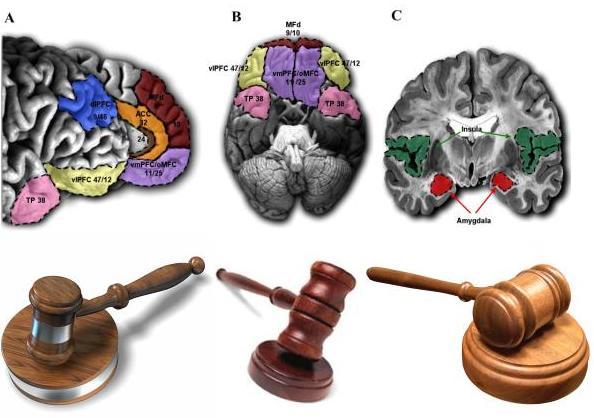


Political beliefs aside we should still evaluate the rules objectively and neuroscience is but one method of looking at them. So what does neuroscience tell us about the two rules? Is a judge better suited to deal with judging neuroscientific evidence than a jury? To me the answer is a clear “yes”. The evidence I have found points to a jury being susceptible to being fooled by such evidence. For example, Weisberg et al. found that non-experts who are given the task to choose between two explanations for a problem view explanations with irrelevant neuroscience information as more satisfying than explanations without (1). McCabe and Castel published similar findings when looking at the effect that actual brain images had on our reasoning. They found that, when presenting articles summarizing cognitive neuroscience, articles featuring brain images received higher ratings with regards to scientific reasoning "as compared to articles accompanied by bar graphs, a topographical map of brain activation, or no image." (2)


This effect is explained by Jonathan Marks who issued a warning against what J.D. Trout has termed "explanatory neurophilia." (3) In coining this term Trout warns us that when faced with evidence, of any kind, "the promise of cognitive tractability enhances fluency, but not necessarily accuracy."(4) Marks uses Troudt's view to criticize the use of neuroscience in the national security apparatus and issues a warning against the fact that brain images are partly open to interpretation by experts and are ripe for misuse by government officials as a tool of interrogation (5).


Although I find Mark’s and Troudt’s arguments interesting I do not believe that we should be completely dissuade from using neuroscientific evidence in a court of law. This is because as Weisberg et al. found there is a limit to the impact that superfluous neuroscientific information can have on our judgments, and there is also a noticeable benefit to be gained from extended and specific training on the judgment of such explanations (6).  It is clear that neuroscience provides us with a clear-cut case in which the Frye rule as a standard is not as efficient as that of Daubert. This is because Daubert allows the judge to play a greater gate-keeping roll when allowing evidence into the courtroom. The judge, who we hope is an expert in dealing with such evidence, is less likely to face the same explanatory neurophilia which jurors and laymen are victim to. The Supreme Court agreed with this assessment in Allison v. McGhan Med. Corp., 184 F.3d 1300 (1999) when it stated that:


"While meticulous Daubert inquiries may bring judges under criticism for donning white coats and making determinations that are outside their field of expertise, the Supreme Court has obviously deemed this less objectionable than dumping a barrage of questionable scientific evidence on a jury, who would likely be even less equipped than the judge to make reliability and relevance determinations and more likely than the judge to be awestruck by the expert's mystique."


Even though giving the judge ultimate deciding authority supports the centralization of decision making in our court system, I wholeheartedly agree with the decision made in the Allison vs. McGhan Med. Corp. case. While as an individual, I typically advocate for a more democratic court system I believe this is a clear-cut situation in which my philosophical beliefs stand against reality.


With that said, however, I am curious. Faced with my arguments above, what do you, the reader, make of it all? Was moving away from Frye a good idea based on what we know of how our brains work? Can you suggest a more efficient way of evaluating scientific evidence?


--Jamie Witter (Guest Writer)

Law Student, Georgia State University


Want to cite this post?


Witter, J. (2012). Daubert and Frye: Neuroscience in the Courtroom? The Neuroethics Blog. Retrieved on
, from
http://www.theneuroethicsblog.com/2012/03/daubert-and-frye-neuroscience-in.htm


1. Weisberg, D. S., Keil, F. C., Goodstein, J., Rawson, E., & Gray, J. R. (2008). The seductive allure of neuroscience explanations. Journal of cognitive neuroscience, 20(3), 470-7. doi:10.1162/jocn.2008.20040

2. McCabe, D. P., & Castel, A. D. (2008). Seeing is believing: the effect of brain images on judgments of scientific reasoning. Cognition, 107(1), 343-52. doi:10.1016/j.cognition.2007.07.017

3. Marks, J. H. (2010). A Neuroskeptic ’ s Guide to Neuroethics and National Security. Defense, 1(2), 4-12.

4. Trout, J. D. (2008). Seduction without cause: uncovering explanatory neurophilia. Trends in cognitive sciences, 12(8), 281-2. doi:10.1016/j.tics.2008.05.004

5. Marks, J. H. (2010). A Neuroskeptic’s Guide to Neuroethics and National Security. Defense, 1(2), 4-12.

6. Weisberg, D. S., Keil, F. C., Goodstein, J., Rawson, E., & Gray, J. R. (2008). The seductive allure of neuroscience explanations. Journal of cognitive neuroscience, 20(3), 470-7. doi:10.1162/jocn.2008.20040


Editor's note: For more information on the McCabe & Castel article, please see our post here.  


Also, the Emory Neuroscience Graduate Students in partnership with Emory's Neuroethics Program will be hosting a symposium on this topic on May 25th: The Truth About Lies: the Neuroscience, Law, and Ethics of Lie Detection Technologies featuring  Drs. Hank Greely, director of the Center for Law and Biosciences at Stanford Law School, Daniel Langleben, a professor of Psychiatry at University of Pennsylvania and pioneer of using fMRI to detect lies, and Steven Laken, founder, president, and CEO of Cephos; a company that markets the use of fMRI for courtroom lie detection. Stay tuned for more information.

Tuesday, March 20, 2012

Neuroimaging in the Courtroom: Video by Neuroethics Creative Team


The undergraduate Neuroethics Program Creative Team embarked on making one of their first videos featuring Dr. Paul Root Wolpe.  This short 3 minute video discusses the ethical implications of using neuroimaging as evidence in the courtroom. This video is a teaser for our upcoming event on May 25th at Emory (see below for more information). 


Thanks to our Neuroethics Creative Team!


  • Giacomo Waller

  • Sabrina Bernstein

  • Lauren Ladov


The Truth About Lies: the Neuroscience, Law, and Ethics of Lie Detection Technologies


You Can’t Handle the Truth! The Neuroscience Program, Center for Ethics Neuroethics Program, and the Scholars Program in Interdisciplinary Neuroscience Research (SPINR) are combining forces to hold a symposium on the intersection of neuroscience and law pertaining to the use of fMRI and other lie detection technologies in the courtroom. Drs. Hank Greely, director of the Center for Law and Biosciences at Stanford Law School, Daniel Langleben, a professor of Psychiatry at University of Pennsylvania and pioneer of using fMRI to detect lies, and Steven Laken, founder, president, and CEO of Cephos; a company that markets the use of fMRI for courtroom lie detection will be providing their expertise through a series of talks. Following the talks, Emory’s Carolyn Meltzer, Chair of the Department of Radiology and Imaging Sciences, will join the speakers answering questions from the audience during a panel discussion moderated by Julie Seaman from Emory Law School. Mark your calendars for 1pm-5pm, May 25th, 2012 for this thought-provoking event. More information to come.

Wednesday, March 14, 2012

Save the date! Neuroscience and Ethics Award on April 9th goes to Dr. Steven Hyman


You won't want to miss the Second Annual Neuroscience and Ethics Award!  We are proud to announce this year's award will go to Dr. Steven Hyman.


THE NEUROETHICS PROGRAM OF THE CENTER FOR ETHICS


YERKES NATIONAL PRIMATE RESEARCH CENTER


THE NEUROSCIENCE INITIATIVE


PRESENT THE


Second Annual Neuroscience


and Ethics Award


TO


Steven Hyman, M.D.


Former Provost of Harvard and Director of NIMH


SPEAKING ON:


Addiction as a Window on Volitional Control


Date: April, 9, 2012


Time: 4pm (followed by a reception)


Location: Woodruff Health Sciences Administration Building Auditorium


Dr. Steven Hyman is a renowned leader in neuroscience and  psychiatry, and has championed ethical inquiry in those fields. Dr.  Hyman is former director of the National Institute of Mental  Health and former Harvard University provost, where he is currently the Distinguished Service Professor of Stem Cell and  Regenerative Biology and Professor of Neurobiology. He is also  the Director of the Broad Institute’s Stanley Center for Psychiatric  Research, and President of the International Neuroethics Society as well as a member of the Institute of Medicine (IOM) of the United States National Academies and serves on the IOM council.


Tuesday, March 13, 2012

Incomplete Nature: How Mind Emerged from Matter

Let me preface this by saying that Incomplete Nature is probably one of the most daring and original published scientific monographs I’ve ever read. Of course, it could also be one of the worst, it's actually impossible to tell. That said, I’ve had Terrence Deacon’s first book, The Symbolic Species, sitting on a shelf at my house for about five years now. I picked it up when I was a sophomore in college, at the second link of a five-year chain that went evolutionary biology evolutionary psychology cognitive neuroscience philosophy of mind consciousness causality and information theory oh-my-God-nothing-is-real. At the time I clearly wasn’t ready for the book, as I read about the first ten pages before putting it down.


This was for two reasons. The first is that his books are long, dense, and convoluted, and his sentences tend to loop-the-loop back on themselves and self-cannibalize. This is certainly true for Incomplete Nature, which clocks in at over 600 pages, and has entire sections that are interesting and informative but completely unnecessary for the main point/plot (see also Melville 1851).


The second reason is that Terrence is a little bit, well, verbose. And by verbose I mean logorrheic, prolix, pedantic, etc etc. He also makes up his own words - a lot. Like Shakespeare, or Sarah Palin. This habit is clearly on full-throttle in Incomplete Nature, but mostly that’s because what he’s trying to talk about is something that is so mind-bendingly different from the corpuscular metaphysics of Descartes that most scientists and lay-people take for granted. So for example, in Incomplete Nature, he makes up the word “morphodynamics” before discovering it’s been in use for about eighty years in embryology and geology (cue five page digression into the history of the nominally similar term that’s not quite the same as the term he had in mind but is still kind of the same, or same enough to devote five pages to, followed by how his definition is different. Just give up the word, Terrence - let them take it). Other made-up words include “absential”, “autogen”, "autogenesis”, “constitutive absence”, “contragrade”, “ententional”, “entropy ratchet” and I’m nowhere near the end of the glossary so I’ll stop. So why all the neologisms? Just what point is Terrence trying to get across that requires forging new words just to get our attention?


Terrence Deacon sees a problem in our sciences, and that problem is this: how can information, meaning, representation, function, consciousness, have causal powers? As human beings we naively use these terms all the time, and our causal explanations of the world work so incredibly well! Let me put it in an example (as Terrence would approve of). So I know that tomorrow my morning latte will have a little snowman made of milk on the surface because my barista and I have been flirting for weeks and I’m pretty sure she likes me. That high-level pattern of flirtatious behavior is incredibly predictive of the future complicated design of the snowman, but the predominant (if ill-defined) position is that causality is all “happening” down at the atomic level. Therefore such higher-level patterns are meaningless - good for compression in stupid human brains, but not *real*. Terrence disagrees, and he disagrees in a number of ways. He wants to say that not only did consciousness cause the snowman to assume complex shapes, but that further past events cause the snowman, events that no longer even exist (and thus are “absential”). He wants to bring back teleology, show how life can beat entropy, show how evolution creates function, show how... well, okay, it’s a lot. If these problems seem so wide-ranging as to be almost all encompassing, it's because they are. Terrence goes from the problem of the origin of life (how do anti-entropic traveling waves of complexity get constructed?) to the origin of consciousness (what is the simplest form of a self?). Due to the size of the book itself, I will only be a describing it as abstractly as possible - a difficult task, as each portion builds on the last, incorporating the necessitated vocabulary. Or, to paraphrase David Foster Wallace in an interview I once saw: “If I could sum up the theme of the book I wouldn’t have had to write it.”


So I’ll just tell you the conclusion of the book, and then I can get on to more interesting things, such as why an anthropologist is writing a book about how to beat entropy. The conclusion: consciousness and the self are teleodynamic processes defined by the informational constraints they place on the dynamical phase-space of the organism by their anti-entropic (and thus function-creating) nature. Being anti-entropic means being fundamentally incomplete (kept from resting level). That's fine, as long as you've defined all your terms, equations, shown how it operates in simple example systems, etc, but Terrence seems to operate in the style of "intellectual jazz" - reading Deacon is like reading Sartre: "the being of the being of the becoming... of the being." The problem is that this all flirts so close to complete semantic vacuity. Mathematical descriptions are sparse, just a handful of them, and strict definitions are nowhere to be found. For example, the Belsousov-Zhabotinsky reaction is a chemical reaction in a shallow dish that demonstrates self-organization far from resting state. Is it conscious? Teleological? What level of the "entropy ratchet" is it on�? I doubt Terrence has any answers. I can make out his primary interest, which is that the notion of information (which is connected to entropy), which Terrence believes needs to change in order to incorporate consciousness, and with it meaning, semantics, and function. That's what I'll address from now on.


Information theory as a key to consciousness has a pedigree - David Chalmers (1996) admits thinking that such a theory could be constructed, and Giulio Tononi (2010) actually did construct one: an info-theoretic measure of consciousness that is fully formalized in discrete systems. But why is Terrence Deacon, an anthropologist, and Tononi, a psychiatrist, the only ones following this up? One dismissive reason would be that they’re crackpots, who don’t really understand either information theory or physics. The other, more interesting reason, lies in how scientists have performed reduction. This is most well put by John Searle (1992), where he points out that, throughout history, reduction has involved confinement of various properties of the phenomenon under study to the subjective. For example, the redness of red is said to be ‘in the perspective’ and not out in the world - this allows us to comfortably come up with a scientific definition of red (photon emissions at 600 nanometers). I think that this kind of reduction (a push back into the head) occurred in Claude Shannon’s work on information theory, and that, when we use information theory to look at the brain, we notice a troubling paradox.


Information, in the Shannon sense, is not really an ‘intrinsic’ quality - rather instead it is observer-defined, based off of a vocabulary agreed upon before hand. Shannon's Entropy function is a measure of how surprised one observer is, given that another observer sent a signal. But then we look in the brain and see... the same kind of observer-defined information. Shannon’s separation of information from meaning and consciousness has lead to an elimination of meaning from science. This is fine for those whose jobs involve building better telephone wires and computers, they don’t care that what they’re doing is based off of prior agreement on vocabulary between observers. Even mathematicians and physicists aren’t bothered. But it is neuroscientists (in broad definition), the people who actually have to hold a brain in their hand, or listen to the pop-pop of in vivo neurons, that are really struck by the paradox. Terrence’s book is, at its heart, an attempt to solve this paradox, and bring the ineffable back in the game. Of course he fails in the sense that the majority of the ideas in the book are descriptive and not formalized, at worst incoherent, at best incomplete.


Center for Sleep and Consciousness, University of Madison, WI


Want to cite this post?

Hoel, E. (2012). Incomplete Nature: How Mind Emerged from Matter. The Neuroethics Blog. Retrieved on , from http://www.theneuroethicsblog.com/2012/03/let-me-preface-this-by-saying-that.html


Citations:
Chalmers, D. 1996. The Conscious Mind: in Search of a Fundamental Theory of Consciousness. Oxford University Press.


Deacon, T. 2011. Incomplete Nature: How Mind Emerged from Matter. W. W. Norton & Company.


Melville, H. 1851. Moby Dick. Ed. published 2004. Imago: CRW Publishing Limited, London.


Searle, J. 1992. The Rediscovery of the Mind. MIT Press.


Tononi, G. 2010. Information integration: its relevance to brain function and consciousness.
Archives Italiennes de Biologie, 148, 299-322.

Monday, March 5, 2012

Neuroethics journal club: jobbing on the sleep

Feeling tired? You’re not the only one. According to a 2009 poll conducted by the National Sleep Foundation, 20% of Americans sleep less than six hours a night. How can people even do their jobs with less than six hours of sleep?

Oh.


Before you get too impressed by my ability to cite statistics, I should tell you I’m quoting directly from the article we read for the most recent meeting of the Neuroethics program’s journal club: “Examining the Effects of Sleep Deprivation on Workplace Deviance: a self-regulatory perspective” by Michael Christian and Aleksander Ellis.


Dr. Gillian Hue presented the article. Not only did Gillian study sleep and circadian rhythms as a graduate student, she also has extensive experience with sleep deprivation thanks to her young son, Lucas (hey, she made that joke, not me). One of the first things Gillian asked was how many of us had gotten seven hours or more of sleep the night before. Only two people raised their hands: Kristina Gupta and Cyd Cipolla, both Ph.D. candidates in Women’s, Gender, and Sexuality Studies at Emory (They are also teaching the class “Feminism, Sexuality, and Neuroethics” this semester that they developed as part of their winning Neuroethics Scholar applications). Two people out of roughly twenty had slept the bare minimum seven hours. I would make a joke here about how I should’ve gone into Women’s Studies, but I’m too tired to think of way to phrase it that doesn’t sound vaguely smarmy. Gillian asked us whether we’d gotten seven hours of sleep because that’s the criterion that Christian and Ellis use in their paper to decide whether subjects in their studies were sleep deprived. Why do they care if people are sleep deprived? Here’s the main hypothesis, taken from the abstract:
“Utilizing self-regulatory resource theories, we argue that sleep deprivation decreases individuals’ self-control while increasing hostility, resulting in increased workplace deviance.”

Christian and Ellis then proceed to test their hypothesis on two groups: nurses and undergraduates. Surprisingly, “results from both samples largely converge in supporting [their] hypotheses.” I say “surprisingly” because I would have predicted that sleep deprivation would increase self-control and lower hostility. Like all great science, their results run against our intuitions, yet allow us to explain the world more simply. If you think you detect a note of sarcasm, let me confirm that. If you also think you detect some jealousy on my part because I wasn’t smart enough to come up with a “no duh” hypothesis that would let me sail through grad school and land a cushy job as an Industrial/Occupational psychologist, let me also confirm that.

I mainly want to comment on the theory behind the experiments in this paper. If Christian and Ellis have chosen a “no duh” hypothesis, then it’s no surprise that I can’t find much to argue with in their approach. They’re working within the framework of self-control as a limited resource—as if self-control were a muscle that can tire. They cite multiple articles from the psychologist who has done the most work around the idea that people have a limited reserve of self-control, Baumeister (and I have to point out that most of the articles they cite from Baumeister’s group are reviews, not studies). Christian and Ellis argue that self-control can also be depleted by sleep deprivation. To support that idea, they cite a couple of papers that talk about lack of sleep and poor glucose metabolism in the pre-frontal cortex, of which one is a review (aargh! why don't they cite some primary literature?!) of healthy adolescent sleep (there’s no adolescents in Christian and Ellis’ paper! double-aargh!) and the other is a meta-analysis (see first “aargh!”). Not coincidentally, Baumeister’s group is now pushing the idea that self-control depends on glucose. I can hardly find fault, again, with a hypothesis like “if you use up all your glucose, then your brain will go out of control”. However, just because Christian and Ellis can point to that hypothesis doesn’t mean that they have “[integrated] research from the social psychological, sleep, and neurocognitive literatures” as they claim in their introduction. Similarly, citing a random review and a meta-analysis of sleep deprivation studies barely qualifies as “integrating evidence from neuroscience with organizational behavioral research” as they state in their discussion.

Lest you should think I’m just taking potshots at this paper, I’ll admit that it does make an important contribution. While I might think their results are a bit, well, obvious, it’s also true that their results might not be obvious to everyone. Recall that Christian and Ellis carried out the first part of their study on nurses. I don’t know how sleep-deprived nurses are, in general, but I do know that doctors in residency are definitely asked to work long hours all the time. Why hasn’t this practice changed if neuroscience shows how dangerous sleep deprivation is? Because, as our in-house medical ethics expert Dr. John Banja pointed out at journal club meeting, “the old guard” in charge of organized medicine and the professional medical societies are “very opposed to change”.

In this sense, Christian and Ellis provide some cold hard evidence that might open at least one pair of eyes. Maybe. During journal club Cyd Cipolla asked, “If we all know sleep deprivation is bad, why are Kristina and I the only ones getting enough sleep?” Kristina then wondered if, “in economic terms, the gains would outweigh the losses if people worked less and slept more”. Banja replied that, as far as hospitals are concerned, if residents work less, then attending physicians have to work more, which is more expensive.

So the cost of residents per hour might matter more to people running hospitals than the amount of deviance in whatever hospital they’re running. Christian and Ellis have asked with their study what the neuroscience of sleep can tell us about our ethics. They might not have done much for the ethics of neuroscience, though. I mean, our society still seems pretty bent on running a giant sleep deprivation experiment. That reminds me—I’d better post this and get to bed.

Be sure to RSVP for next month's meeting, on March 28th form 1230-130pm. We'll talk about Deboleena Roy's article, "Neuroethics, Gender, and the Response to Difference". The discussion will be facilitated by Neuroscience graduate student Laura Mariani (chief whistler of the Caspary lab and sitting duck exec prez of the Graduate Student Council).


Want to cite this post?


Nicholson, D. (2012). Neuroethics journal club: jobbing on the sleep. The Neuroethics Blog. Retrieved on
, from
http://www.theneuroethicsblog.com/2012/03/neuroethics-journal-club-jobbing-on.html


Lessons From A Cyborg: March 12th Lecture at Georgia Tech


Thursday, March 1, 2012

Neuroethics Playlist

For our new readers and anyone who may have not seen it yet (originally posted on Nov 7th 2011):


We have put together a playlist of songs about neuroethics, the brain, and the mind. Below you will find a Prezi presentation that includes the music and brief descriptions of each of the songs.


Neuroethics Playlist on Prezi (Updated 4/15/2018)


Special thanks to the followers on our Facebook page for their helpful suggestions.