Pages

Showing posts with label virtual reality. Show all posts

Tuesday, June 6, 2017

The Neuroethics Blog Series on Black Mirror: Virtual Reality


By Hale Soloff


Hale is a Neuroscience PhD student at Emory University. He aims to integrate neuroethics investigations with his own research on human cognition. Hale is passionate about science education and public science communication, and is pursuing a career in teaching science. 


Humans in the 21st century have an intimate relationship with technology. Much of our lives are spent being informed and entertained by screens. Technological advancements in science and medicine have helped and healed in ways we previously couldn’t dream of. But what unanticipated consequences may be lurking behind our rapid expansion into new technological territory? This question is continually being explored in the British sci-fi TV series Black Mirror, which provides a glimpse into the not-so-distant future and warns us to be mindful of how we utilize our technology and how it can affect us in return. This piece is the first in a series of posts that will discuss ethical issues surrounding neuro-technologies featured in the show and will compare how similar technologies are impacting us in the real world. 


Black Mirror – Plot Summary 


Some of the neuro-technologies featured in Black Mirror at first seem marvelous and enticing, but the show repeatedly illustrates how abusing or misusing such technologies can lead to disturbing, and even catastrophic, consequences. This may seem scary enough, but what if the goal of a device was to intentionally frighten its user? 


In the episode “Playtest” a man named Cooper volunteers to help a video game company test out a brand-new device, referred to as a “mushroom.” After being warned that using the device requires a small, reversible medical procedure, supposedly no more invasive than getting his ears pierced, Cooper signs a consent form and the mushroom is injected into the back of his head. The mushroom records electrical activity from his brain, uses intelligent software to determine what he fears the most, and then stimulates his brain with more electricity to make him see a “mental projection” of his fears. As an arachnophobe, Cooper first sees a spider crawling towards him that nobody else can see; in fact, the mental projections he sees are so convincing that he becomes skeptical of whether another human being, whom he can see and hear, is real or simply a projection. 


Image courtesy of Flickr.

Then Cooper’s mushroom device malfunctions. Despite being assured that it can only make him

experience audio and visual stimuli and that nothing he sees can physically hurt him, Cooper feels pain when attacked by a knife-wielding projection. Apparently, this is because “data tendrils” from the mushroom’s neural net dug deeper into his brain and took root, causing him to feel physical pain when he was struck by the projection. Soon after that, the neural net wipes Cooper’s memory, leaving him with no knowledge of himself or his loved ones. In a chilling end to the episode, an incoming phone call to Cooper’s cell phone interferes with the signal of the device, causing the mushroom to malfunction and kill Cooper by over-stimulating his brain. 


The technology used in “Playtest”


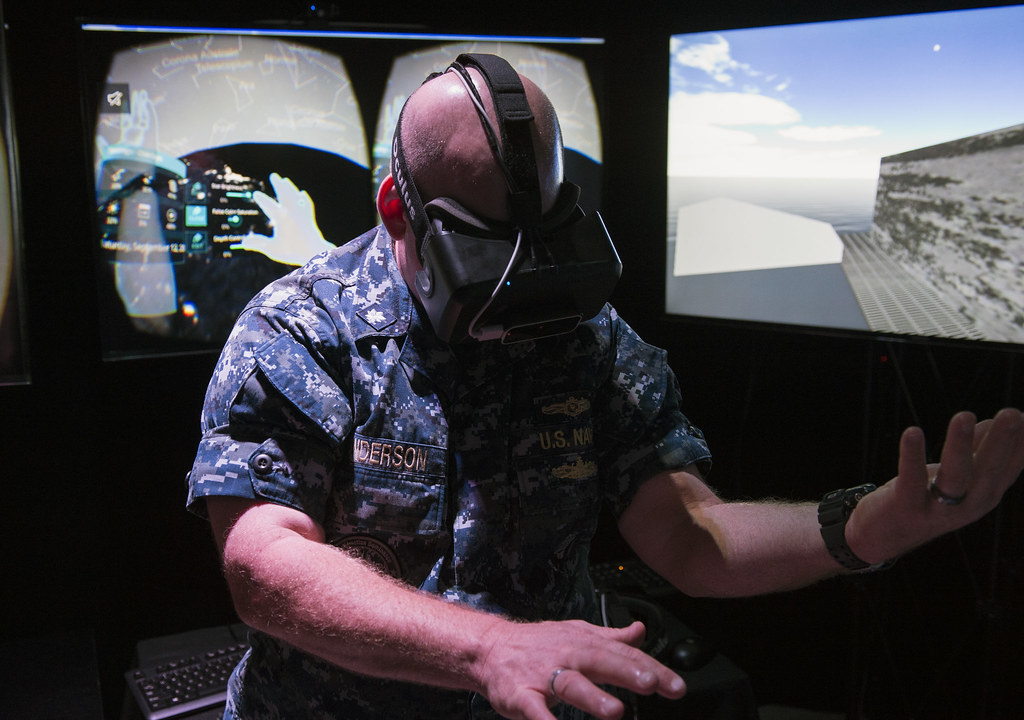
The device that Cooper tests in this episode is an “interactive augmented reality system,” a chimera of three technologies that exist today. The first, Virtual Reality (VR), involves wearing a headset that blinds you to the outside world, instead placing you in a virtual 360o environment that you can observe and reach out to touch with wearable, glove-like controllers. VR has become a popular technology in the world of gaming because of the feeling of full immersion that it gives the user. VR has even been used in both research and rehabilitation of human cognitive processes; for instance, scientists at Emory University use immersive VR exposure therapy to help treat combat-related post-traumatic stress disorder (PTSD) in veterans. Through controlling how faithfully a virtual environment represents traumatic stimuli, individuals with trauma disorders and phobias can safely confront “triggering” scenarios while practicing coping methods. The second technology, augmented reality (AR), differs from VR in that it overlays a virtual image onto a real environment. For example, the popular AR game “Pokémon Go" allows users to observe Pokémon in their homes, playgrounds, and shopping malls through their phone’s camera. 


Image courtesy of Wikimedia.

In Black Mirror, Cooper experiences a combination of these two technologies: using the mushroom was fully immersive like VR, but also projected objects into his real-world environment like AR. This combination is made possible through a Brain-Computer Interface (BCI), the third real-life technology used in Black Mirror. BCIs are direct connections between a brain and a computer, meaning the user can control the computer with their voluntary cognition, and the computer can sometimes affect the user with electrical stimulation. The uses for BCI are extensive, from advanced prosthetic limbs that can be moved with the user’s concentration and intent, to computer-controlled Deep Brain Stimulation (DBS) for the treatment of Parkinson’s disease and treatment-resistant depression. We are even on the verge of BCI-controlled video games, some of which will use electroencephalogram (EEG) electrodes to measure and interpret brain waves to control a game. 


Do I need to be worried about having a “mushroom device” in my brain? 


Though the mushroom device utilized in Black Mirror bears similarity to current technologies, it is important to consider the differences between what is presented in the media and what capabilities we have today. Both the mushroom and BCIs can be used to record the brain’s electrical activity while simultaneously stimulating the brain to affect its behavior. However, the mushroom in “Playtest” is inserted quickly and easily into Cooper’s brain, presumably by somebody with little or no medical training. BCIs, such as DBS or ECoG, that directly stimulate the central nervous system require an invasive surgical procedure performed by highly trained brain surgeons. Although the mushroom is advanced enough to determine Cooper’s fears and thoughts, our current ability to analyze and interpret brain activity does not allow for the degree of “mind-reading” exhibited in the show (contrary to the neuro-hype surrounding consumer BCIs). Neural activity recorded by a BCI device under highly controlled conditions can be translated into meaningful, but limited, psychological information, such as predicting intentions slightly before they are acted upon and recognizing thought patterns that are distinct for different objects. The closest we’ve come to “mind-reading” includes the neuroimaging work of Jack Gallant’s lab, but attempts for “mind-writing” images or words with BCI’s have yet to be done. 


Ethical issues featured in “Playtest” 


A DBS (deep brain stimulation) procedure. Image courtesy

of Wikimedia.

The technologies described in “Playtest” give rise to a host of ethical concerns, with one of the most salient being a violation of autonomy. Normally clinicians and patients work together to determine the correct level of stimulation that a therapeutic stimulation device like DBS should deliver to the brain. A future proposed version—on the horizon, but not yet employed in humans even experimentally—, “closed-loop” DBS, uses a computer algorithm to determine stimulation levels (with the goal of diminishing the need for external control by the user or clinician) based on current brain activity. This closed-loop system is how the mushroom in Cooper’s nervous system can first record his brain activity, then analyze it to determine his fears, and finally deliver a fearful experience to him using stimulation. To be clear, these technologies are not being developed for manipulating these kinds of complex sensory or perceptual images as in “Playtest.” Again, existing brain stimulation technology does not allow for the controlled, vivid hallucinations that Cooper sees. However, some ethicists are exploring whether “closing the loop” on brain stimulation could lessen a user’s real or perceived agency, or the capacity of the individual to act independently. Allowing internal readjustments of stimulation to be decided by the algorithm, rather than consciously manually adjusted by the patient or clinician, may have the end result of diminishing agency of the user, even if not for something as dramatic as illustrated in “Playtest,” like for facilitating movement. 


Similarly, the full immersion experience facilitated by VR and AR in “Playtest” represents an infringement of the user’s autonomy. One of the core appeals of VR in gaming is the factor of immersion: rather than learning which button on the controller makes you grab an object or move the camera, you simply reach out and grab the object with your hand or turn your head to observe more of your environment. This, however, leads us to the doorstep of a disturbing possibility—the inability to escape. I have listened to individuals playing horror games on VR devices exclaim, “Oh my gosh, it’s so much scarier because I can’t just look away.” They were not truly upset, because they knew that escape was as easy as taking off the headset, turning off the device, and leaving the room. But, if the VR capabilities are implanted into your brain, like those seen in this Black Mirror episode, it creates a scenario where there may be no escape from frightening, threatening, or even painful stimuli. While VR technology is currently being used to exhibit light, sound, and even touch through external manifestations, a BCI like the one used in “Playtest” directly “hijacks” your sensory system by causing you to experience stimuli that are not truly present. Black Mirror shows us a scenario that is only possible because of the unique features of BCI and VR: inescapable torture inflicted by an entertainment system. 


Image courtesy of Airman Magazine.

Finally, BCIs give rise to a unique privacy issue: if the gaming company in “Playtest” misplaced Cooper’s data, potentially anyone could know his innermost fears and personal thoughts. If the mushroom device was capable of “mind-reading” his subconscious fears, intentions, and more, that information could easily be saved and sold to interested companies; a law was enacted this April that allows internet service providers and other companies to sell their customers’ personal data, (like your social media and search engine browsing habits without consent). As discussed, our current understanding of brain data allows us to interpret limited information in a controlled environment, but as our ability to interpret brain signals improves (and as more data is aggregated) this issue of brain privacy may become more pressing. It is important that those involved in facilitating BCI understand and minimize the risk involved—engineers can design BCIs to be more safe and secure, clinicians can protect patients’ brain-data and explain the risks of BCI to their patients, and policy-makers can carefully consider how to protect an individuals’ right to his or her brain activity. 


Conclusion – Invasive BCI in Gaming


Entertaining media like Black Mirror raises interesting questions about the ethics of technology, but when trying to answer these questions, we need to be aware of the current state of technology and we must separate fact from fiction. Engineers, neuroscientists, and ethicists are working together to design safer, noninvasive and more ergonomic BCIs, and if they succeed it would improve brain stimulation treatment for patients, allow more individuals to safely use BCIs, and may even permit the implementation of more advanced BCIs in gaming. Perhaps we could even create, as stated in the episode, “the most personal survival horror game in history…one that works out how to scare you using your own mind.”


Want to cite this post?


Soloff, H. (2017). The Neuroethics Blog Series on Black Mirror: Virtual Reality. The Neuroethics Blog. Retrieved on , from http://www.theneuroethicsblog.com/2017/06/the-neuroethics-blog-series-on-black.html

Tuesday, April 11, 2017

VR and PTSD: Healing from trauma by confronting fears in virtual reality environments


By Katie Givens Kime


Image courtesy of Flikr

What are the ethical implications of therapeutically re-exposing patients to trauma via virtual reality technologies? Of the 2.7 million American veterans of the Iraq and Afghanistan wars, at least 20% suffer from depression and/or post-traumatic stress disorder (PTSD), and other studies peg that percentage even higher. As a chronic, debilitating mental illness, one PTSD symptom is hyperarousal, in which a person repeatedly re-experiences a trauma in the form of nightmares, panic attacks, and flashbacks.  One of the most long-trusted therapeutic approaches to PTSD is exposure therapy; now, virtual reality technology is increasingly being used to simulate exposure to traumatic events and to environments related to the traumatic event.


Image courtesy of Flikr

Last month’s Neuroethics and Neuroscience in the News event featured the recent research and observations of Barbara O. Rothbaum, who is the Paul A. Janssen Chair in Neuropsychopharmacology at the Emory University School of Medicine and Director of the Emory Veterans Program & Trauma and Anxiety Recovery Program. Rothbaum outlined the way in which exposure therapy (with or without the aid of virtual reality technology) is based on principles of learning and also discussed reliable findings with animals and phobic disorders (Foa & Kozak, 1986). The underlying premise of such therapy is that repeated and prolonged exposure to feared but realistically safe stimuli leads to habituation, and eventually to extinction.


The virtual reality exposure therapy (VRE) combat environments for “Virtual Vietnam” (developed by Georgia Tech and Emory Universities) includes a virtual Huey helicopter, a “fly” over the jungles of Vietnam, a “walk” in clearings near jungles and swamps, and other imaginal immersions in Vietnam-related stimuli. Other examples of VRE environments include “World Trade Center” (Weill Cornell Medical Center/University of Washington), “Terrorist Bus Bombing” (University of Haifa/University of Washington), “Motor Vehicle Accidents” (University of Buffalo), “Virtual Angola” (University of Lusófona de Humanidades e Tecnologias, Lisbon), and “Virtual Iraq” (USC Institute for Creative Technologies).


In some ways, VRE is an enormous innovation, particularly for treatment under a range of conditions not easily controlled or facilitated in the real world. For veterans with extreme anxiety due to in-flight combat events, for example, exposure to flight (including turbulence) is therapeutically valuable. With the help of VRE, recreating that exposure within the context of a 50-minute session in a therapist’s office is immensely more feasible than gaining access to a flight, with an appropriate amount of turbulence. Not only can VRE create dynamic, three-dimensional stimulus environments, it also allows for the recording of behavioral and physiological responses of the patient, which provides clinical assessment options previously unavailable.


While such innovations hold great potential, there are other ways in which VRE is simply an additional tool to aid in traditional exposure therapy, which remains based within the relationship between the clinician and the patient. In her talk, Rothbaum noted that many of the objections and concerns raised about VRE (detailed in an Ethical Issues in Clinical Neuropsychology article by Rothbaum and her colleagues) are similar to concerns raised about exposure therapy in general. Many people (including many clinicians) flinch at the idea of intentionally raising a patient’s anxiety. A primary motivation of any therapist is helping a patient feel better. Thus, exposure therapy can feel counterintuitive because it forces patients to re-experience their trauma and all of the emotions associated with that trauma.


Image courtesy of Flikr

Other ethical concerns about VRE include the potential for VR-related side effects like cyber-sickness (a form of motion sickness commonly reported with virtual reality technology), and other possible symptoms including disturbed locomotion, changes in postural control, perceptual-motor disturbances, fatigue, and generally lowered arousal. Rothbaum named several mitigating practices employed to limit such symptoms, such as limiting session time, keeping the room cool, using equipment with better resolution, and limiting head motion.


Concerns about misuse of VRE equipment by both clinicians and sufferers of PTSD also emerge. What if clinicians lacking training or expertise use VRE with patients? Or, what if clinicians, no matter how well trained, use VRE at the expense of the normal therapist/client relationship? Rothbaum noted the potentially problematic dynamic of how patients wearing head mounted displays cannot see their therapist, and therefore lose any nonverbal communication that would otherwise be absorbed visually. However, in standard imaginal exposure, patients’ eyes are closed, thus also limiting nonverbal communication. In terms of auditory information, the often loud virtual environments, such as Virtual Iraq or even the virtual airplane, can prevent the patient from hearing the therapist. Furthermore, VRE might allow an interpersonally awkward patient to “hide” behind the technology instead of interacting with the therapist.


In response to the potential for clinical misuse of VRE equipment and techniques, Rothbaum pointed out that “bad VRE therapy is just bad therapy.” While the creators of VRE clinical practices and associated equipment cannot prevent misuse, they can take steps to require appropriate training in as much as possible. As for the therapist-patient interpersonal communications, the VRE equipment includes a microphone that allows the therapist to talk directly with the patient and also privileges the therapist’s voice over the sounds of the virtual environment. A sort of “riding shotgun” intimacy is thus often achieved. Rothbaum also noted that the masking “barrier” of the VR headgear can facilitate more verbalization from patients instead of less, and mimics the therapeutic practice of having patients close their eyes when recounting particular events or feelings or sharing about particular emotional states and in standard imaginal exposure.


Image courtesy of Flikr

There are still more concerns of VRE misuse. Might continued access to virtual environments like “Virtual Vietnam” lead to cases of faulty self-diagnosis and self-treatment? When individuals are able to download or purchase VRE assessment and therapeutic tools, what might be the associated risks? A major concern is that of desensitization: by taking the opportunity to repeatedly immerse one’s self in violent and otherwise traumatic events, might VRE tools be encouraging desensitization? Rothbaum noted that 70% of us, statistically, will experience a traumatic event in our lifetime, but only a small percentage of us will develop PTSD. Rothbaum used the example of video games as one of myriad tools and methods engaged by those suffering with PTSD, with wide-ranging results. In the end, Rothbaum’s response to these concerns was, “We’re not trying to make realistically scary things less scary...We’re trying to help people cope better with something scary that happened in their past.”


Looking into the future of how virtual reality technology might change the landscape and potential of mental health care, a recent review of all studies employing VR for mental health conditions found many gaps in meaningful applications of the technology. However, on the basis that “Mental health problems are inseparable from the environment,” the reviewers concluded that the greatest potential for VR lies in its ability to take patient and caregiver to the particular contexts in which the patient struggles to respond appropriately.


Even more broadly, some VR innovators are finding some success in creating VR headsets that operate solely via the brain activity of the user. While using dry electrodes to record brain activity via electroencephalography (EEG) is not new, creating a modality that allows for the execution of virtual tasks just as efficiently as physical input devices (keyboard, touch screen, etc.) would be a new achievement. Such an advance might lead to an entirely different range of options and questions when considering how VR technology best serves the purposes of mental health care.


With VR, we can expect significant leaps forward in broadening access and modalities for those seeking care for their PTSD. 


References 


Foa, E.B., & Kozak, M.J. (1986). Emotional processing of fear: Exposure to corrective information. Psychological Bulletin, 99, 20-35.


Want to cite this post?


Kime, K.G. (2017). VR and PTSD: Healing from trauma by confronting fears in virtual reality environments. The Neuroethics Blog. Retrieved on , from http://www.theneuroethicsblog.com/2017/04/vr-and-ptsd-healing-from-trauma-by.html


Friday, May 24, 2013

Now Available! Neuroethics Journal Club Video Archives on YouTube


The Neuroethics Journal Club videos are now available on YouTube. Watch each discussion to learn about a variety of neuroethics issues, from treatments for pedophilia to neural plasticity in mice. For each video, one presenter introduced the journal topic and opened discussion to the audience. 


Neuroethics Journal Club: The Sexed Brain


The Sexed Brain: Between Science and Ideology


Catherine Vidal, Neuroethics, 2012 


Abstract: Despite tremendous advances in neuroscience, the topic “brain, sex and gender” remains a matter of misleading interpretations, that go well beyond the bounds of science. In the 19th century, the difference in brain sizes was a major argument to explain the hierarchy between men and women, and was supposed to reflect innate differences in mental capacity. Nowadays, our understanding of the human brain has progressed dramatically with the demonstration of cerebral plasticity. The new brain imaging techniques have revealed the role of the environment in continually re-shaping our brain all along our lifetimes as it goes through new experiences and acquires new knowledge. However, the idea that biology is a major determining factor for cognition and behavioral gender differentiation, is still very much alive. The media are far from being the only guilty party. Some scientific circles actively promote the idea of an innate origin of a gender difference in mental capacities. Experimental data from brain imaging, cognitive tests or genetics are often distorted to serve deterministic ideas. Such abuse of “scientific discourses” have to be counteracted by effective communication of clear and unbiased information to the citizens. This paper presents a critical analysis of selected examples which emphasize sex differences in three fields e.g. skills in language and mathematics, testosterone and financial risk-taking behavior, moral cognition. To shed light on the data and the methods used in some papers, we can now—with today’s knowledge on cerebral plasticity—challenge even more strongly, many false interpretations. Our goal here is double: we want to provide evidence against archaic beliefs about the biological determinism of sex differences but also promote a positive image of scientific research.


Neuroethics Journal Club: Pedophilia


Real-time functional magnetic imaging—brain–computer interface and virtual reality: Promising tools for the treatment of pedophilia 


Renaud et al, 2011


Abstract: This chapter proposes a prospective view on using a real-time functional magnetic imaging (rt-fMRI) brain-computer interface (BCI) application as a new treatment for pedophilia. Neurofeedback mediated by interactive virtual stimuli is presented as the key process in this new BCI application. Results on the diagnostic discriminant power of virtual characters depicting sexual stimuli relevant to pedophilia are given. Finally, practical and ethical implications are briefly addressed.


Neuroethics Journal Club: Social Pain 


The pain of social disconnection: examining the shared neural underpinnings of physical and social pain 


Eisenberger, 2011 


Nature Reviews Neuroscience


Abstract: Experiences of social rejection, exclusion or loss are generally considered to be some of the most 'painful' experiences that we endure. Indeed, many of us go to great lengths to avoid situations that may engender these experiences (such as public speaking). Why is it that these negative social experiences have such a profound effect on our emotional well-being? Emerging evidence suggests that experiences of social pain--the painful feelings associated with social disconnection--rely on some of the same neurobiological substrates that underlie experiences of physical pain. Understanding the ways in which physical and social pain overlap may provide new insights into the surprising relationship between these two types of experiences.


Neuroethics Journal Club: Plasticity and Learning 


Forebrain Engraftment by Human Glial Progenitor Cells Enhances Synaptic Plasticity and Learning in Adult Mice 


Han et al, 2013 Cell Stem Cell


Abstract: Human astrocytes are larger and more complex than those of infraprimate mammals, suggesting that their role in neural processing has expanded with evolution. To assess the cell-autonomous and species-selective properties of human glia, we engrafted human glial progenitor cells (GPCs) into neonatal immunodeficient mice. Upon maturation, the recipient brains exhibited large numbers and high proportions of both human glial progenitors and astrocytes. The engrafted human glia were gap-junction-coupled to host astroglia, yet retained the size and pleomorphism of hominid astroglia, and propagated Ca2+ signals 3-fold faster than their hosts. Long-term potentiation (LTP) was sharply enhanced in the human glial chimeric mice, as was their learning, as assessed by Barnes maze navigation, object-location memory, and both contextual and tone fear conditioning. Mice allografted with murine GPCs showed no enhancement of either LTP or learning. These findings indicate that human glia differentially enhance both activity-dependent plasticity and learning in mice.


Stay tuned for more Neuroethics Journal Club videos next year. Also, to get daily updates about emerging ideas in neuroethics, follow Emory Neuroethics on Facebook here and Twitter here.