Pages

Showing posts with label neuroessentialism. Show all posts

Tuesday, November 26, 2013

Just Neurons?

Neuroessentialism is the belief that you, your mind, your identity, are essentially just your brain. It gets touted as an example of how science has triumphed, once again, over superstitions of the past - your soul hasn't died, it was just an illusion! Created by the brain. With memory, sensation, speech, and just about every other human attribute found to be located in one gyrus or another, it seems like there isn't anything left that could be outside of the brain. Francis Crick referred to this as the “astonishing hypothesis[1],” and while Stephen Pinker pointed out that for most neuroscientists this idea hardly warranted much astonishment[2], what might be more astonishing is how quickly the idea is bleeding out of the laboratory into popular media.  The basic philosophical foundations of this notion have been around for a long time (as mentioned on the [highly entertaining] podcast “very bad wizards,” we've known for a long time that when you remove the head, the mind ceases to function. Grant Gillet mentions that even Aristotle held that the mind emerges as function of the body, rather than a separate spiritual entity that somehow inhabits the body).  However, the recent attention that neuroscience has been getting (especially with the advent of fMRI, which enabled a huge number of studies on healthy, awake humans) appears to have made this an easier pill for the public at large to swallow. Dr. Peter Reiner has even gone as far to document the rise of neuroessentialism and has begun to map out the potential positive and negative effects of this cultural shift[3].


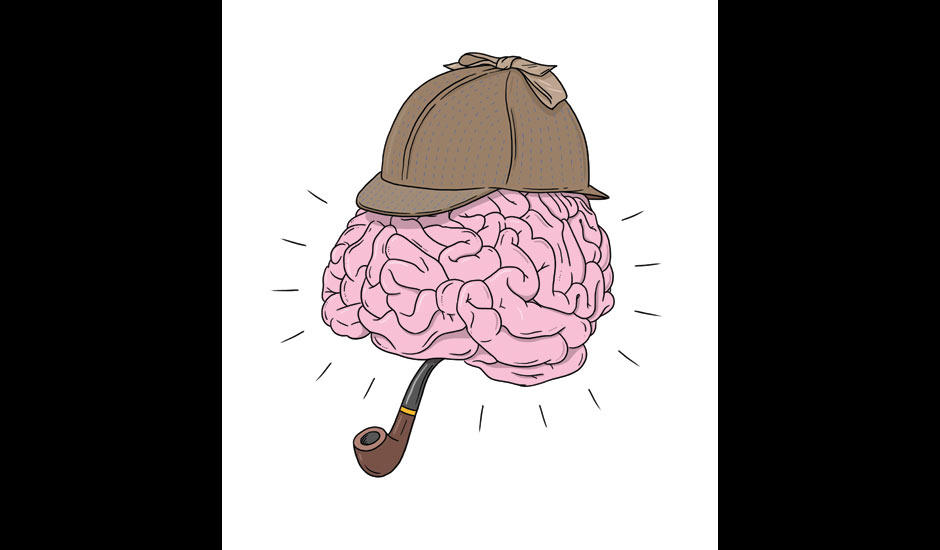
A distant relative of the brain-in-a-vat: the brain-in-a-hat.  "I am a brain, Watson. The rest of me is a mere appendix. Therefore, it is the brain I must consider." A very neuroessentialist sentiment of Sherlock Homes, in The Adventure of the Mazarin Stone by Sir Arthur Conan Doyle.  Image from here.


With the rise of any sort of public awareness, we should expect there to be reactionaries who warn us about going too far with our new idea and neuroessentialism is no different. Rather than defending old arguments in the face of overwhelming experimental evidence, these thinkers instead point cautiously forward and advise us to make our claims about the mind carefully, rather than jump on the neuro-bandwagon.  I'd like to display two of these recent, anti-essentialist thinkers here.  Both argue what might be considered further expansions of Clark and Chalmers' extended mind hypothesis[4]--which itself argued that pen & paper, computers, (and today, cell phones) could all be considered as vital components of cognitive processes, and thus as part of the mind.   


Walter Glannon, in his 2009 Neuroethics article "Our Brains are Not Us" tackles the problem of what he calls "neuroreductionism"- which with all the talk about scientific reductionism going on, certainly sounds worse than innocent "neuroessentialism."  The position that Glannon takes against this neuroreductionism is referred to as "the distributed mind." The basic premise is to say that the mind is a result of the interaction between brain, body and environment, rather than just the result of neural activity.  At first glance, this claim (like the extended mind hypothesis itself) might seem like a licentious redefinition of the term 'mind.'  However, Glannon motivates this shift in focus, to see the mind as embodied (being situated in a body) and embedded (being situated in a vast physical, social, and at times adversarial environment), by suggesting that such an expanded view of the mind allows for a broader view of what might affect the health of that mind.  If we become too focused on the brain, we lose sight of the fact that the rest of the body, as well as the environment, can also be a place where mental health-affirming interventions take place.  Examples of this might be environmental changes in dealing with addiction, or the ability of psychotherapy to cause physical changes in the brain.


Glannon's argument for this shift towards a distributed mind is broken into two sections.  The first, to situate the mind as embodied, can be thought of as following Antonio Damasio's Somatic Marker Hypothesis[6].  The principle here is that many mental states, most notably many emotions, emerge through an interaction between the brain and body.  Likewise, there are a host of transactions between the brain and the rest of the body that affect mood and cognition, such as those mediated by the endocrine system (think of a life without adrenaline), the immune system (remember how groggy you feel when sick), and the proprioceptive sense (try to imagine life with tentacles rather than bony arms).


Thus, the famed "brain in a vat" thought experiment wouldn't be able to have emotions in any sense familiar to you or me, unless it was connected to a carefully simulated body.  While one might argue that such a simulation would simply be part of the simulated 'world' that this brain resides in, one should consider whether the human mind is more defined by human emotions (a capacity of the joint body and brain), or the ability to process visual information (a capacity of the brain).  In viewing the mind as the accumulation of many capacities, the skull becomes a much less authoritative bound on the physical implementation of the mind.


XKCD's take on neuroessentialism.  Comic by Randal Munroe, from here.


Once Glannon's mind has seeped out of the skull and permeated the rest of the body, it becomes much easier to envision it wafting through the pores and out into the world at large.  Glannon's point here is that the meaning of an experience is tied to the physical and social situation in which it occurred, not just to the brain states that represent it.  The claims related to this point are a bit contentious, however.  Glannon claims that information gleaned from brain imaging could never recreate a remembered scene, or identify how that memory influenced the person, or describe other subjective, qualitative aspects of that experience.  While this is, for the most part, true regarding the current generation of brain scanners (remember the 'dream imaging' technique that hit the news in 2011, 2 years after Glannon's paper?), in principle the information necessary for at least a qualitative description of these aspects of experience should be present in the physical brain (how else could we talk about such memories, long after the event has passed?).  Some advanced brain-interrogation device might thus be able to infer from the structure of the brain the speech it might produce when asked questions of the subjective nature discussed by Glannon, or even find subtle associations between potential stimuli (a strong connection between brain regions responsible for mounting a fear response, and parts of the olfactory cortex that deal heavily with garlic, for instance) that wouldn't necessarily be consciously available to the speaker. Glannon is apparently pointing to a different aspect of subjectivity, however, as he very clearly asserts that "Neuroimaging cannot read minds because the mind is not located in the brain."


Grant Gillett, in his 2009 article "The Subjective Brain, Identity, and Neuroethics," takes a very different approach to expanding the mind out from the brain.  Gillett starts from Aristotle to provide a definition for what makes one "human"- which Aristotle defined as a rational, social being.  This definition importantly includes both a physical aspect-the being itself, as well as a narrative aspect- the rational, social life of this being.  Thus, any sort of discussion about a person's mind cannot be divorced from the story of how that mind interacts with the world, and thus must include the physical, social, cultural, geographical relationships that the mind participates in (a list which Gillett includes under Husserl's term "the human life-world").  In Gillett's own words, “...for a neo-Aristotelian, the human psyche (soul) is neither a ghostly or spiritual inner core of a human being nor is it comprehensible in the language of physical objects, biology, and causal relationships yet it is (pun intended) the soul of ethics and therefore of fundamental importance for neuroethics.”  


The implications of this view are surprisingly far-reaching. Instead of thinking of how the brain orchestrates our experience, Gillett's language places the brain in the somewhat more passive role of being molded or inscribed by our experience of the world, by our story as a character in that world. This affirms the notion of an individual brain, whose response to physical interventions (such as stimulation, surgery, etc) depends on how this story has shaped the brain. Gillet then illustrates the power of this way of thinking by using it to reframe several neuroethical dilemmas, ranging from the rights of human embryos, patients with disorders of consciousness, the utility of the notion of 'free will,' the otherwise nonsensical notion of "fighting against one's damaged brain," and the effect of neurodegenerative diseases on human identity.  


Both Glannon and Gillett provide alternative conceptions to the "brain first" view of the human mind and identity that is held by the neuroessentialist position, without resorting to the arguments that neuroessentialism explicitly refutes (such as dualism). While these views might seem somewhat alien and even intrusive to those of us steeped in neuroessentialist thought (those of us studying neurons in culture, for instance, might be a little indignant at the implication for the human meaning of our work), I think that they may also help to cushion the shock of a culture that is just beginning to come to grips with the implications of neuroscience by reminding us that no matter what neuroscientists may tell you about your brain, you still have a great deal more than that making up your mind.  


Want to cite this post?


Zeller-Townson, RT. (2013). Just Neurons? The Neuroethics Blog. Retrieved on from http://www.theneuroethicsblog.com/2013/09/just-neurons.html


References


[1]Crick, Francis. Astonishing hypothesis: The scientific search for the soul. Scribner, 1995.

[2]Pinker, Steven. "The mystery of consciousness." Time Magazine 29 (2007): 55-70.

[3]Reiner, Peter B. "The rise of neuroessentialism." Oxford handbook of neuroethics. Oxford University Press, Oxford (2010): 161-175.

[4] Clark, Andy, and David Chalmers. "The extended mind." analysis 58.1 (1998): 7-19.

[5] Glannon, Walter. "Our brains are not us." Bioethics 23.6 (2009): 321-329.

[6] Damasio, Antonio. Descartes' error: Emotion, reason, and the human brain. Penguin. com, 2005.

[7] Gillett, Grant R. "The subjective brain, identity, and neuroethics." The American Journal of Bioethics 9.9 (2009): 5-13.

Tuesday, October 8, 2013

Consciousness and Ethical Pain


Imagine you find that a beloved uncle has received a terrible injury that leaves him paralyzed, but still totally aware of his environment - a condition known as locked in syndrome. Now imagine that a doctor comes to you with a miracle cure: a new experimental treatment will repair your uncle's damaged brainstem allowing him to regain control of his body. The catch, however, is that this procedure is extremely painful. It actually seems like it might be the most painful experience possible: fMRI scans reveal that all the brain regions that are active during extreme pain are activated during this (imaginary) procedure. And it lasts for hours. However, your uncle won't complain about the procedure because 1) he's paralyzed and thus can't voice his suffering, and 2) the experience of this miracle treatment will mercifully be forgotten once the procedure is over, so your uncle won't raise any complaint afterwards. While many of us would probably sign off on the procedure, we might still feel guilty as we imagine what it must be like to go through that, even if our uncle wouldn't recall it later.


The neural 'signature' of pain, as seen through fMRI [8].  Image from here.


This scenario is meant to illustrate that there seems to be an aspect of the moral weight of pain - its significance in ethical discussion and decision making and guilt - that has to do specifically with what pain feels like. Not the way it makes us act, not the danger it represents, but that first person, qualitative, subjective experience of being in pain, or suffering through pain. The ability to have such qualitative, subjective experiences is called qualitative (or sometimes phenomenal) consciousness. We tend to assume that most humans are conscious, and that this is the primary reason why hurting them is wrong- indirect selfish reasons (like avoiding jail time or losing them as a friend and ally) are seen as being secondary to this primary fact: the evil of pain[1].


For this reason, discussions of pain taking place in unfamiliar creatures (which I'm using to refer to anything that isn't able to explicitly tell you how it feels - including humans with certain neurological conditions, as well as almost all non-human animals, and perhaps even stranger entities) are often intimately tied to the possibility of that creature being conscious. This occurs for instance when deciding whether a patient with Unresponsive Wakefulness Syndrome (formerly called vegetative state) should receive analgesia[2,3], or when debating about the necessary precautions that should be taken when fishing or slaughtering chickens. If it can be demonstrated that something doesn't meet our requirements for consciousness, suddenly we have free range to treat that thing as more of an object than a person[4].  If consciousness is suspected on the other hand, we become much more cautious with our treatment of the entity.  


Unfortunately, consciousness is very difficult to work with, especially from a neuroscience perspective. Since qualitative consciousness is by definition a private, personal thing, neuroscientists are limited to dealing with consciousness indirectly. This is done by looking at neural correlates of consciousness. These are the physical events that occur in brains that we agree are conscious (such as awake, healthy humans) but not in brains that we agree aren't conscious (such as the brains of humans that are in dreamless sleep)[5]. By comparing and contrasting these two 'known' points, it should be possible to identify what it is about 'conscious' brains that gives them 'consciousness,' right?


In healthy humans, probably. The danger might come from extrapolating these results to a neuroessentialist view of consciousness - the idea that consciousness is created purely as the result of the brain doing its thing. We might imagine that some neural circuit, once carefully tuned through currently unknown self-organizing properties, spontaneously generates a mysterious feedback loop.  Like Robert Downey Jr's glowing arc reactor in the Iron Man films, this unassuming physical matter almost magically produces something totally alien and awesome. But instead of enough power to defeat Jeff Bridges in hand-to-hand combat, the neural circuit produces something much stranger - a metaphysical shift that creates a conscious entity in a sea of unconscious biochemical machinery (that is, the rest of the brain). If this circuit was missing from either a brain damaged human or a non-human animal (or not yet fully developed in new born infants), we could calmly assert that no matter how much these entities appeared to suffer, such displays were unconscious reflexes that didn't actually reflect any internal, private, real suffering.  They would merely be biological machines, with the same moral status as toenails.  As Stephen Pinker phrased it in a 2007 article in Time [6], "...once we realize that our own consciousness is a product of our brains and that other people have brains like ours, a denial of other people's sentience becomes ludicrous. 'Hath not a Jew eyes?' asked Shylock. Today the question is more pointed: Hath not a Jew--or an Arab, or an African, or a baby, or a dog--a cerebral cortex and a thalamus?"


Compare and contrast. Left: the Arc Reactor activates in the first Iron Man film. Right: one of many blue glowing brains that one can find on while looking through popular articles on neuroscience. Is this how we should think about consciousness emerging from the brain? Images from here and here.


An issue that can be raised with this neuroessentialist view is that consciousness and suffering, in their roles of marking creatures as having a moral status, don't necessarily refer to events that happen in the nervous system.  Instead, they could refer to ethical relationships between entities, irrespective of the underlying neural circuitry that might enable those relationships.  Much like a giant set of quadriceps might enable a sprinter to win a race, a healthy brain might enable ethical relationships between humans.  However, much like the quadriceps need skeletal and nervous systems, as well as the cultural notion of a 'race' and a worthy opponent in order to win, so too does a brain need 'opposing players' and a culturally constructed moral landscape to participate in any ethically charged interaction, including pain and suffering.  'Winning' isn't something that occurs purely in the muscles of the sprinter, and neither is 'suffering' something that occurs purely in the brain.  


This dependence of morally charged terms like 'consciousness' and 'suffering' on non-neural components has been argued both in the discussion on the moral status of humans and non-humans.  In regards to humans, neuroethicist Grant Gillett points out that human identity and subjectivity (a term that is related to qualitative consciousness, specifically its necessarily private nature) is constructed through social relationships, not something that can be reduced down to individual neural circuits[7].  Likewise, neuroscientist Patrick Wall reprimanded veterinarians to avoid using human conceptions of pain to describe neural events in non-human animals.  Dr. Wall suggested that such a practice was purely culturally driven, rather than based on scientific evidence, and that non-human animals should be dealt with using values derived from their own reality, not by imposing human values onto them[8].  We might imagine that if the concept of consciousness developed to describe something about humans (about their moral status, ability to socially interact or have intentions, etc), using consciousness as the measuring stick to determine moral status in non-humans is effectively saying, "My compassion towards you is proportional to your resemblance towards me."


What are we left with if we avoid using consciousness to determine the value of neural correlates of pain and suffering (such as the fMRI signal discussed earlier)?  Should we still feel bad about the uncle we abandoned after the first paragraph?  I think the answer is still yes, but for different reasons than those initially given.  I think that the neural correlates of suffering that are now accessible through fMRI[9] and similar devices don't provide direct insight into a hidden world of subjective experience, so much as they provide novel channels of communication with otherwise isolated individuals[10].  Thus, these patients can now voice their suffering and participate in an ethically charged interaction - an interaction that is similar to describing their suffering verbally, though now mediated through complicated machinery that they do not control.  Likewise, a neural correlate of (human) suffering in non-human animals needs to be viewed as, at most, a cry for help rather than a private hell. It should be understood that different animals will likely cry for help in totally different ways (and thus have totally different neural correlates of suffering-like states).  Using this perspective, neuroscience is simply one more tool to enable ethically charged interactions to occur, rather than a final statement about the reality underlying all ethical interactions.  


 References:


[1] Ryder, Richard.  "All beings that feel pain deserve human rights" The Guardian, Saturday 6 August 2005 


[2]Farisco, Michele. "The ethical pain." Neuroethics (2011): 1-12.


[3] Demertzi, Athina, et al. "Pain perception in disorders of consciousness: neuroscience, clinical care, and ethics in dialogue." Neuroethics (2012): 1-14.


[4] Shriver, Adam. "Knocking out pain in livestock: Can technology succeed where morality has stalled?" Neuroethics 2.3 (2009): 115-124.


[5]Tononi, Giulio. "An information integration theory of consciousness." BMC neuroscience 5.1 (2004): 42.

[6] Pinker, Steven. "The mystery of consciousness." Time Magazine 29 (2007): 55-70.


[7] Gillett, Grant R. "The subjective brain, identity, and neuroethics." The American Journal of Bioethics 9.9 (2009): 5-13.


[8] Wall, Patrick D. "Defining pain in animals." Animal pain. New York: Churchill-Livingstone Inc (1992): 63-79.

[9] Wager, Tor D., et al. "An fMRI-based neurologic signature of physical pain." New England Journal of Medicine 368.15 (2013): 1388-1397.

[10] This view is also very similar to one discussed here: Levy, Neil, and Julian Savulescu. "Moral significance of phenomenal consciousness." Progress In Brain Research 177 (2009): 361-370.


Want to cite this post?


Zeller-Townson, RT.
(2013). Consciousness and the Ethical Pain. The Neuroethics Blog.
Retrieved on
, from http://www.theneuroethicsblog.com/2013/09/consciousness-and-ethical-pain.html