Pages

Showing posts with label Aristotle. Show all posts

Tuesday, November 26, 2013

Just Neurons?

Neuroessentialism is the belief that you, your mind, your identity, are essentially just your brain. It gets touted as an example of how science has triumphed, once again, over superstitions of the past - your soul hasn't died, it was just an illusion! Created by the brain. With memory, sensation, speech, and just about every other human attribute found to be located in one gyrus or another, it seems like there isn't anything left that could be outside of the brain. Francis Crick referred to this as the “astonishing hypothesis[1],” and while Stephen Pinker pointed out that for most neuroscientists this idea hardly warranted much astonishment[2], what might be more astonishing is how quickly the idea is bleeding out of the laboratory into popular media.  The basic philosophical foundations of this notion have been around for a long time (as mentioned on the [highly entertaining] podcast “very bad wizards,” we've known for a long time that when you remove the head, the mind ceases to function. Grant Gillet mentions that even Aristotle held that the mind emerges as function of the body, rather than a separate spiritual entity that somehow inhabits the body).  However, the recent attention that neuroscience has been getting (especially with the advent of fMRI, which enabled a huge number of studies on healthy, awake humans) appears to have made this an easier pill for the public at large to swallow. Dr. Peter Reiner has even gone as far to document the rise of neuroessentialism and has begun to map out the potential positive and negative effects of this cultural shift[3].


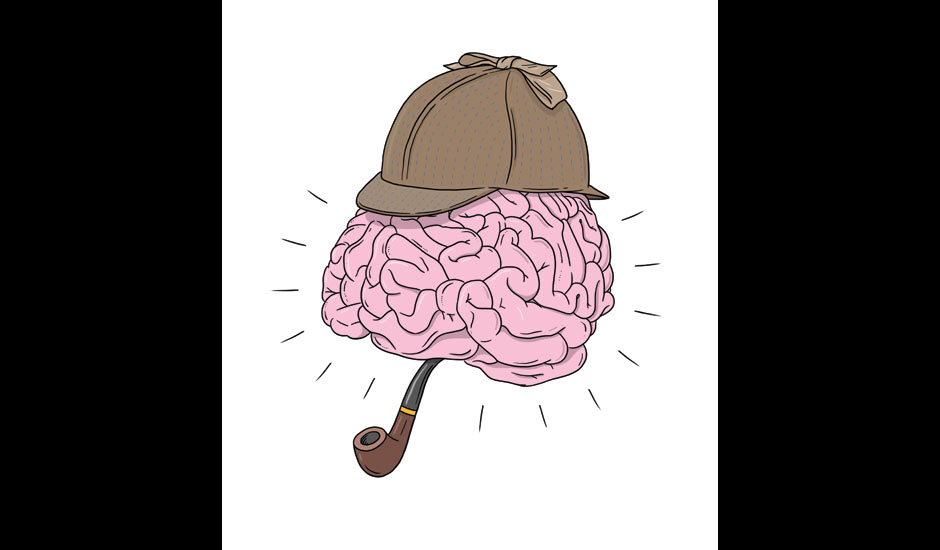
A distant relative of the brain-in-a-vat: the brain-in-a-hat.  "I am a brain, Watson. The rest of me is a mere appendix. Therefore, it is the brain I must consider." A very neuroessentialist sentiment of Sherlock Homes, in The Adventure of the Mazarin Stone by Sir Arthur Conan Doyle.  Image from here.


With the rise of any sort of public awareness, we should expect there to be reactionaries who warn us about going too far with our new idea and neuroessentialism is no different. Rather than defending old arguments in the face of overwhelming experimental evidence, these thinkers instead point cautiously forward and advise us to make our claims about the mind carefully, rather than jump on the neuro-bandwagon.  I'd like to display two of these recent, anti-essentialist thinkers here.  Both argue what might be considered further expansions of Clark and Chalmers' extended mind hypothesis[4]--which itself argued that pen & paper, computers, (and today, cell phones) could all be considered as vital components of cognitive processes, and thus as part of the mind.   


Walter Glannon, in his 2009 Neuroethics article "Our Brains are Not Us" tackles the problem of what he calls "neuroreductionism"- which with all the talk about scientific reductionism going on, certainly sounds worse than innocent "neuroessentialism."  The position that Glannon takes against this neuroreductionism is referred to as "the distributed mind." The basic premise is to say that the mind is a result of the interaction between brain, body and environment, rather than just the result of neural activity.  At first glance, this claim (like the extended mind hypothesis itself) might seem like a licentious redefinition of the term 'mind.'  However, Glannon motivates this shift in focus, to see the mind as embodied (being situated in a body) and embedded (being situated in a vast physical, social, and at times adversarial environment), by suggesting that such an expanded view of the mind allows for a broader view of what might affect the health of that mind.  If we become too focused on the brain, we lose sight of the fact that the rest of the body, as well as the environment, can also be a place where mental health-affirming interventions take place.  Examples of this might be environmental changes in dealing with addiction, or the ability of psychotherapy to cause physical changes in the brain.


Glannon's argument for this shift towards a distributed mind is broken into two sections.  The first, to situate the mind as embodied, can be thought of as following Antonio Damasio's Somatic Marker Hypothesis[6].  The principle here is that many mental states, most notably many emotions, emerge through an interaction between the brain and body.  Likewise, there are a host of transactions between the brain and the rest of the body that affect mood and cognition, such as those mediated by the endocrine system (think of a life without adrenaline), the immune system (remember how groggy you feel when sick), and the proprioceptive sense (try to imagine life with tentacles rather than bony arms).


Thus, the famed "brain in a vat" thought experiment wouldn't be able to have emotions in any sense familiar to you or me, unless it was connected to a carefully simulated body.  While one might argue that such a simulation would simply be part of the simulated 'world' that this brain resides in, one should consider whether the human mind is more defined by human emotions (a capacity of the joint body and brain), or the ability to process visual information (a capacity of the brain).  In viewing the mind as the accumulation of many capacities, the skull becomes a much less authoritative bound on the physical implementation of the mind.


XKCD's take on neuroessentialism.  Comic by Randal Munroe, from here.


Once Glannon's mind has seeped out of the skull and permeated the rest of the body, it becomes much easier to envision it wafting through the pores and out into the world at large.  Glannon's point here is that the meaning of an experience is tied to the physical and social situation in which it occurred, not just to the brain states that represent it.  The claims related to this point are a bit contentious, however.  Glannon claims that information gleaned from brain imaging could never recreate a remembered scene, or identify how that memory influenced the person, or describe other subjective, qualitative aspects of that experience.  While this is, for the most part, true regarding the current generation of brain scanners (remember the 'dream imaging' technique that hit the news in 2011, 2 years after Glannon's paper?), in principle the information necessary for at least a qualitative description of these aspects of experience should be present in the physical brain (how else could we talk about such memories, long after the event has passed?).  Some advanced brain-interrogation device might thus be able to infer from the structure of the brain the speech it might produce when asked questions of the subjective nature discussed by Glannon, or even find subtle associations between potential stimuli (a strong connection between brain regions responsible for mounting a fear response, and parts of the olfactory cortex that deal heavily with garlic, for instance) that wouldn't necessarily be consciously available to the speaker. Glannon is apparently pointing to a different aspect of subjectivity, however, as he very clearly asserts that "Neuroimaging cannot read minds because the mind is not located in the brain."


Grant Gillett, in his 2009 article "The Subjective Brain, Identity, and Neuroethics," takes a very different approach to expanding the mind out from the brain.  Gillett starts from Aristotle to provide a definition for what makes one "human"- which Aristotle defined as a rational, social being.  This definition importantly includes both a physical aspect-the being itself, as well as a narrative aspect- the rational, social life of this being.  Thus, any sort of discussion about a person's mind cannot be divorced from the story of how that mind interacts with the world, and thus must include the physical, social, cultural, geographical relationships that the mind participates in (a list which Gillett includes under Husserl's term "the human life-world").  In Gillett's own words, “...for a neo-Aristotelian, the human psyche (soul) is neither a ghostly or spiritual inner core of a human being nor is it comprehensible in the language of physical objects, biology, and causal relationships yet it is (pun intended) the soul of ethics and therefore of fundamental importance for neuroethics.”  


The implications of this view are surprisingly far-reaching. Instead of thinking of how the brain orchestrates our experience, Gillett's language places the brain in the somewhat more passive role of being molded or inscribed by our experience of the world, by our story as a character in that world. This affirms the notion of an individual brain, whose response to physical interventions (such as stimulation, surgery, etc) depends on how this story has shaped the brain. Gillet then illustrates the power of this way of thinking by using it to reframe several neuroethical dilemmas, ranging from the rights of human embryos, patients with disorders of consciousness, the utility of the notion of 'free will,' the otherwise nonsensical notion of "fighting against one's damaged brain," and the effect of neurodegenerative diseases on human identity.  


Both Glannon and Gillett provide alternative conceptions to the "brain first" view of the human mind and identity that is held by the neuroessentialist position, without resorting to the arguments that neuroessentialism explicitly refutes (such as dualism). While these views might seem somewhat alien and even intrusive to those of us steeped in neuroessentialist thought (those of us studying neurons in culture, for instance, might be a little indignant at the implication for the human meaning of our work), I think that they may also help to cushion the shock of a culture that is just beginning to come to grips with the implications of neuroscience by reminding us that no matter what neuroscientists may tell you about your brain, you still have a great deal more than that making up your mind.  


Want to cite this post?


Zeller-Townson, RT. (2013). Just Neurons? The Neuroethics Blog. Retrieved on from http://www.theneuroethicsblog.com/2013/09/just-neurons.html


References


[1]Crick, Francis. Astonishing hypothesis: The scientific search for the soul. Scribner, 1995.

[2]Pinker, Steven. "The mystery of consciousness." Time Magazine 29 (2007): 55-70.

[3]Reiner, Peter B. "The rise of neuroessentialism." Oxford handbook of neuroethics. Oxford University Press, Oxford (2010): 161-175.

[4] Clark, Andy, and David Chalmers. "The extended mind." analysis 58.1 (1998): 7-19.

[5] Glannon, Walter. "Our brains are not us." Bioethics 23.6 (2009): 321-329.

[6] Damasio, Antonio. Descartes' error: Emotion, reason, and the human brain. Penguin. com, 2005.

[7] Gillett, Grant R. "The subjective brain, identity, and neuroethics." The American Journal of Bioethics 9.9 (2009): 5-13.

Tuesday, December 18, 2012

Who's responsible for 'free will?' Reminding you that all ideas were once new


A figure adapted from Soon, Brass, Heinze and Haynes' 2008 


fMRI study where a "free decision" could be predicted above


 chance 7 seconds before it was consciously "felt."  Those 


green globs could be thought of as the unconscious part of 


your brain that is actually in control of your life.  Image here,


paper here 


As seen previously on this blog, the notion of "Free Will" is a bit of a Neuroethics battleground. About 30 years ago, Dr. Benjamin Libet et. al. published an experiment where the researchers were able to predict when human volunteers would press a button- a fraction of a second before the participants themselves realized they were going to do so.  And despite suggestions that the scientific method is breaking down, there is an entire cottage industry of scientists replicating Libet's result and finding more and more effective ways to predict what you are going to be 'freely' thinking.


I'll defer to Scott Adams of Dilbert fame to describe why this is a problem:


This is from 1992.  Libet's study was published in 1983.  Your life has been absurd  for the past 30 years. (I haven't been able to track down exactly what "Brain Research" Scott Adams was referencing here, but it seems to be similar  to  the Libet experiment.)  From http://dilbert.com/strips/comic/1992-09-13/  


The implications are pretty tremendous- if my conscious mind is just observing a decision that has already been made, and not participating in a decision, how is that decision mine?  How can I be blamed for decisions that I am merely watching?


However, it's hard to scientifically argue that free will is (or isn't) an illusion, unless you know exactly what it is in the first place.  So Jason Shepard and Shane Reuter ran a test to see how folks actually use the phrase 'free will.'  All well and good, that certainly beats just assuming that everyone has the same definition.


But then a sinking feeling emerges- here is an idea that is so precious to us, that we actually start becoming worse people when we hear that it is an illusion.  And yet this authoritative definition is coming to us through majority rule?  Our hero is roused to action, and sets out to find a 'correct' definition, not just a 'popular' one...


While using undergraduates in these sorts of psychology studies isn't necessarily problematic, I've been an undergraduate, and thus do not trust these people with my free will.  They might put it in a Dr. Pepper bottle filled with dry ice and chuck it into an abandoned parking lot late at night.  That would be terrible.  Image from www.quickmeme.com

But with so many variants on free will floating around, how do you choose a 'correct' definition?  Does free will mean free from the laws of physics (metaphysical libertarianism)?  Free from control by an omnipotent God?  Free from mental disease, free from peer pressure, free from our own emotions?  And what, exactly, is a 'will?'  Does it need to be 'conscious'?  Our hero thinks to himself, “what would Science do?”


And suddenly the answer becomes embarrassingly clear: why, just give the definition of the phrase to whoever coined it!  Those who followed should be forced to use different phrases for whatever 'revisionist' notions of free will they invented- free-ish will.  Free-range will.  Will Zero.  Our hero sits back and reflects on the cleverness and superiority of the Sciences over all other domains of thought [1].  Now all that is left to do is a wee bit of Googling.  Pish pish, easy post.


However, after significant Googling, and digging through two different libraries, and further Googling, and reading books that were over 100 years old[2], and talking to people who were familiar enough with the topic to actually respect its subtleties, and staring at a computer screen wondering what the hell he had gotten himself into, our hero realized that figuring out who is responsible for infecting us with an attachment to 'free will' wasn't going to be an easy task.  More like a thesis, or a career.


What is clear from the relatively small portion of the literature that I've been able to digest is that people have been talking about free will for over a millennium, but less than three millennia.  Probably.  In the early 20th century it was common to presume that folks have always had a notion of free will, an example being in 1923  when W.D. Ross confidently asserted that “Aristotle shared the plain man’s belief in free will.” This was despite Ross's admission, two pages later, that Aristotle “did not examine the problem very thoroughly, and did not express himself with perfect consistency.”[3]  Later scholars took this lack of clear discussion to conclude that Aristotle lacked a notion of will, free or otherwise, altogether.  So, Aristotle’s clean.  For now.


Would Shepard and Reuter's study have gone differently if St. Augustine

took a psychology class at Emory in the spring of 2012? Images from here and here

In his 1974 Sather lectures at Berkeley[4], Albrecht Dihle put forth his argument that St. Augustine, in the 4th century AD, was the first person to put together our 'Western notion' of free will.  St. Augustine came to an (arguably libertarian) notion of free will as a way to solve the problem of evil: how could a benevolent and omnipotent God allow for a world with evil? Answer: humans are responsible for evil due to their free will (which got tainted when Adam and Eve consumed a particular fruit).  Augustine describes this 'free will' as a first cause, with no causes before it, meaning God gets none of the blame and gets to remain omnipotent.  So, St. Augustine is the one responsible!  Or so it seems...


Fast forward to 1997, and we find Michael Frede putting forth an argument (in his own Sather lectures at Berkeley[5]) that Dihle was being too restrictive in his definition of 'Free Will,' and that St. Augustine got his idea about what free will was from the stoics.  Frede argues that it was actually the late stoic Epictetus[6] who first developed a full notion of will, in the 2nd century AD.  Epictetus gets the blame as he was the first to link three critical claims together: that all voluntary acts are caused by wishes, that wishes are created by the rational soul, and therefore that all voluntary acts are caused by acts of reason, which is to say, caused by choice.  This is contrasted with the Aristotelian and Platonic schools of thought, that held that voluntary acts could also be the result of non-rational urges (thirst, hunger, etc).  So Epictetus is responsible then.  Okay...


But coming up to the present, we see reactions to Frede's arguments.  Karen Neilsen recently published an article[7] where she argues that Aristotle (HIM again!) actually developed a notion of will prior to Epictetus, making the point that Frede translates the Greek 'prohairesis' as 'will' for Epictetus and as 'decision' for Aristotle (although Neilsen makes no comment on the 'free' aspect).  So to understand where 'will' came from, we are looking at shifting definitions in ancient Greek.  AAGH!


The lesson here is that this concept didn't emerge suddenly out of the history of the west.  "Free will," whatever it is, was a gradual development over thousands of years, with input from several schools of classic Greek thought, as well as Jewish and Christian traditions.  Perhaps then, instead of thinking of "free will" as a single well-defined idea, it should be thought of as an entire lineage of ideas.  If this is the case, neuroscientists, science writers, and the public at large need to be very cautious when asserting that "free will is an illusion" is a scientifically valid hypothesis.  If neuroscience wants to make points on "free will," it needs to be both more specific as to what variant of "free will" it refers to, and more broad in the variants of 'free will' it entertains.


[1]- I hope the childish language here makes it clear that I actually think otherwise.  Joking aside, there is an important point to be made here on the differences between philosophy and science (and the subsequent frustrations felt by both when they interact), especially considering that this is a NeuroEthics blog.  I don't have a real answer, but I'll start a discussion by pointing to Robert Hartman's 1963 paper “The Logical difference between Philosophy and Science.”  Hartman asserts that all of science is built on top of the super-system of mathematics, whereas each philosopher effectively creates its own, semi-independent system.  Seeing how Hartman admits to building on the ideas of famed 18th century philosopher Immanuel Kant, one might be tempted to call this bogus.  But perhaps Science can be thought of like Star Wars, where new authors are continually adding to the same (expanded) universe, where Philosophy can be thought of like Batman, where authors are continually re-telling the same story and re-imagining the same characters in different ways.  Or perhaps someone who studies the philosophy of science needs to slap me around a bit in the comments section.

[2] Keep in mind that I'm a neuroscientist here, so I rarely read things that were written more than 20 years ago: Wow.  I had to read the printed-in-1900 copy of Epictetus's discourses I found at Tech's library out loud.  Just in case it contained an incantation.  Also, the pages smelled AMAZING.

[3]W. D. Ross, Aristotle (London: Methuen, 1923), page 199-201

[4]A. Dihle, The Theory of Will in Classical Antiquity.  (Berkeley: University of California Press, 1982)

[5]M. Frede, A Free Will: Origin of the Notion in Ancient Thought  (Berkeley: University of California Press, 2011)

[6] Epictetus was a freed slave in the house of Nero.  As a former slave, his accusatory discussion on freedom in 'Discourses' is particularly difficult to write off.  Highly suggested.

[7]K. Neilsen, The Will – Origins of the Notion in Aristotle's Thought.  Antiquorum Philosophia (2012). Available at: http://works.bepress.com/karennielsen/16.  Note that I owe a lot of the structure of the history above to this source


Want to cite this post?

Zeller-Townson, RT. (2012). Who's responsible for 'free will?' Reminding you that all ideas were once new. The Neuroethics Blog. Retrieved on , from http://www.theneuroethicsblog.com/2012/12/whos-responsible-for-free-will.html