
the knowledge that atheism is prevalent in the scientific community, she wondered how is it that some neuroscientists are nevertheless able to integrate their
religious and scientific beliefs. One of the neuroscientists whose standpoint
she surveyed was Michael Graziano, a Professor of Neuroscience at the Princeton University Neuroscience Institute. Dr. Graziano believes that current research on the neurological basis of consciousness proves that spirituality is
not only a natural tendency of humans, but also that its foundations are visible in the very structure of the brain [1].
Several questions arise from Dr. Graziano’s statement, and I will try to shed some light on each.
To start with, is neurotheology actually studying spirituality, religion, or both?
What is the difference between the two? The conceptual separation between the
two terms is definitely blurred. In this interview for Big Think, American Buddhist writer and academic Robert Thurman says
that spirituality is “love and compassion”, is “going into a deeper area of
your mind where you are asserting your free will”, where “you let go of your
self-protective and defensive controls, and what you tap into is the nature of
the universe, the flow of energy interconnecting things”. In contrast, Thurman
believes religion is built upon spirituality, but has taken a secondary role
as a tool of social and state organizations. Rituals and rules specific to each
religion end up regulating the access to the spiritual, and become, in
Thurman’s words, a control rather than a regulating mechanism. Neuroscientist
and philosopher Sam Harris, who has recently authored a book called
Waking Up: A Guide to Spirituality Without Religion, seems to have similar views on the issue. He explains:
"Although
the claim seems to annoy believers and atheists equally, separating religion
from spirituality is a perfectly reasonable thing to do. It is to assert two
important truths simultaneously: Our world is dangerously riven by religious
doctrines that all educated people should condemn, and yet there is more to
understanding the human condition than science and secular culture generally
admit."
While Thurman and Harris see the separation of religion and spirituality as a necessity, Native American
specialist Jack Forbes defines religion in a way that resembles that in which the former two authors define spirituality. For Forbes, religion is the way we live and the dreams, hopes,
and aspirations we have. In Columbus and Cannibals: The Wétiko Disease of Exploitation, Imperialism, and Terrorism, he
says:
"Religion is not prayer, it is not church, it is not theistic, it is not atheistic, it
has little to do with what white people call ‘religion’. It is our every act."
The controversy around the meanings of religion and spirituality leads me into my next question: What are the research questions asked by neurotheologists? For example, Andrew Newberg,
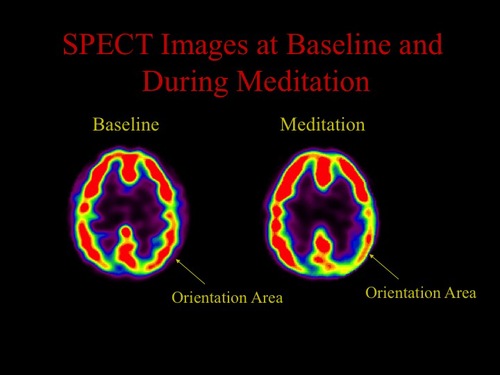
a neuroscientist who studies the brain functions of various mental states, used
SPECT (single
photon emission computed tomography) to scan the brains of Tibetan
Buddhists and to draw conclusions about “the neurophysiology of religious and
spiritual practices”.
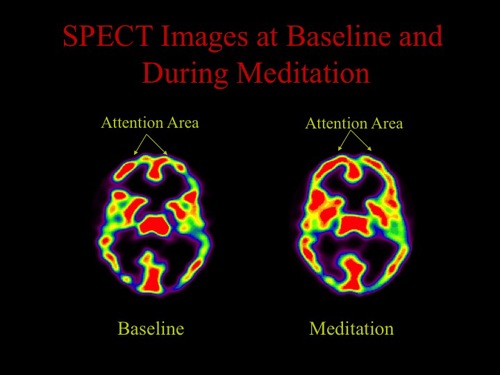 |
He found decreased activation in the parietal lobe (an area responsible for spatial and temporal orientation)
and increased activation in the frontal lobe (region responsible for attention and
concentration) of Buddhists who were instructed to meditate than in those of
participants who did not receive any instructions. In addition, activity in the
frontal lobe and inferior parietal lobe (a language area) increased during
prayer. Should meditation and prayer be taken as processes equally associated
with religion and spirituality? While the results of Dr. Newberg’s study are
truly thought provoking, it is important to not lose sight of what was actually
studied and what domains the results of the research can be extended to.
My third question is, what are the tools with which
neuroscientists are trying to study the brain’s take on religion and
spirituality? I provoke you to the following thought experiment.
God.
Let your mind freely explore the meaning of the word. Allow your senses to paint an
image, produce sounds, smells, tastes, feelings. Embrace the physiological and
emotional states that the word creates within you. Equally welcome the absence
of a reaction.
Now imagine that you were doing this exercise inside an fMRI machine, with the
specific background noise
present at all times, and a gigantic magnet inches above your face. Unless you
have significant training in isolating background noise and other distractors
(or what Dr. Robert Puff calls “finding
the silence in which the noise resides”), you will probably not reach the same
level of focus as you would were you mediating or praying in a dimly lit room
infused with the smell of incense or in a natural setting that smelled of
blossom, either alone or with others who are also seeking that transcendental,
spiritual state of the mind.
Yet, these are the kind of
procedures from which the field of neurotheology extracts its data and draws
its conclusions. In 2008, for example, a team of neuroscientists led by Sam
Harris at the University
of California in Los Angeles measured brain activation in committed Christian
believers and nonbelievers who were presented with various religious and
nonreligious propositions – like “The Biblical God really exists” and “Santa
Clause is a myth” – that they had to judge as either true or false [2]. The results of the study suggested that both religious and
nonreligious belief – in other words, statements that participants judged to be
true – was correlated with greater activation of the ventromedial prefrontal cortex (see image below).
 |
| Belief minus disbelief in Both Categories, Both Groups – image from Harris et al, 2010 |
This area is associated with representation of self, theory of mind, reward,
emotional associations, and goal-driven behavior. Added to other studies that
found religion to be related to medial prefrontal cortex circuitry [3] [4] or
even to the activity of the left hemisphere [5], this
study seemed to suggest that sustaining religious activities requires the activation
of particular brain areas.
I will return to the fact that religion
is widespread. Nine-in-ten Americans believe in the existence of God or
consider themselves spiritual [6] Is the religious or spiritual experience
simply a cognitive tendency that has been shaped by evolution? Cognitive
scientists such as Pascal Boyer, for example, have explained that the
propensity to religion is a consequence of the social nature of humans [7]. Our brains are built to deal with large amounts of social
information, and do that constantly. In order to integrate in today’s complex
societies, we spend incredible amounts of time creating, evaluating, and
updating our social relationships. Consider the amount of time we spend trying
to understand what others think and why they think it. Think about the ease
with which we remember faces, compared to other objects or even other parts of
the body [8]. Now, remember the occasion when you looked at the sky and
saw a cloud shaped like a human face, or when your breakfast toast had a
human-like design on it. We seek agency continuously, or, as Pascal Boyer calls
this phenomenon, we have a hyperactive agency detection system. So can it be
that gods and other supernatural agents exist because we are cognitively
disposed to believe in their existence? They certainly seem to master large
amounts of socially relevant information, and people often turn to them for
answers and guidance. The fact that gods and supernatural agents often have the
powers or characteristics of humans only makes them more memorable.
It might well be that spirituality is a cognitive by-product of the social
tendencies of humans. But even so, can
religion be a process within the reach of an empirical framework? Few neuroscientists
venture so far as to say that religion/spirituality is a product of activating certain
brain areas, rather remaining in the more neutral territory of “associated
with” and “important for”. As neuroscience research attempts to penetrate
spirituality, it will be fascinating to discuss the diversity in religious
experience, atheism, and why people who live in radically different
circumstances nevertheless share a similar connection with a god, gods, or
other transcendental spirits.
As for now, I
suggest that the field of neuroscience is too young to draw any conclusions about
religion and spirituality. While questioning the neurological basis of spirituality
is indeed fascinating, there is no clear consensus on how these brain processes
should be studied. Furthermore, technology available to do so is still not
sensitive enough. And even if the research methods agreed, and technological
advancements promised accurate results, what are we to do with the findings of
this kind of research? I believe that while this research is indeed promising,
there are many ethical matters arising around assigning something as intangible
as spirituality to a brain mechanism. Those who study spirituality and
religion, therefore, should be sincere about the potency of their research
methods and techniques, meticulous about their generalizations, and straightforward
in their reports to the public.
References
[1] Graziano, Michael. "The Spirit Constructed in the Brain." The Huffington Post. TheHuffingtonPost.com,
29 Apr. 2011. Web.
[2] Harris S, Kaplan JT, Curiel A, Bookheimer SY, Iacoboni M, Cohen MS (2009) The neuralcorrelates of religious and nonreligious belief. PLoS One 4(10): e7272.
[3] Azari NP, Nickel J, Wunderlich G (2001) Neural correlates of religious experience. Eur. J. Neurosci.
[4] Muramoto O (2004) The role of the medial prefrontal cortex in human religious activity. Med Hypotheses. 62(4): 479-85.
[5] Ramachandran VS (2010) “Split Brain with One Half Atheist and One Half Theist”. Youtube video www.youtube.com/watch?v=PFJPtVRlI64
[6]"Summary of Key Findings." Statistics on Religion in America Report. PewResearch. http://religions.pewforum.org/reports#. Retrieved 04 Sept. 2014.
[7] Boyer, P (2001) Religion Explained: The Evolutionary Origins of Religious Thought.
[8] Waxman OB (2014) “It’s ‘Perfectly Normal’ to see Jesus in Toast, Study Says”. Time, Newsfeed Science http://time.com/90810/its-perfectly-normal-to-see-jesus-in-toast-study-says/
Forbes J.D. (2008) Columbus and Cannibals: The Wétiko
Disease of Exploitation, Imperialism, and Terrorism. Seven Stories Press.
Want to cite this post?
Lucaciu, I. (2014). Can neuroscience discuss religion? The Neuroethics Blog. Retrieved on , from http://www.theneuroethicsblog.com/2014/10/can-neuroscience-discuss-religion.html
