Pages

Showing posts with label speech. Show all posts

Tuesday, June 19, 2018

Disrupting diagnosis: speech patterns, AI, and ethical issues of digital phenotyping


By Ryan Purcell, PhD


Jim Schwoebel, presenter at April The Future Now: (NEEDS)

Diagnosing schizophrenia can be complex, time-consuming, and expensive. The April seminar on The Future Now: (NEEDs) Neuroscience and Emerging Ethical Dilemmas at Emory focused on one innovative effort to improve this process in the flourishing field of digital phenotyping. Presenter and NeuroLex founder and CEO Jim Schwoebel had witnessed his brother struggle for several years with frequent headaches and anxiety, and saw him accrue nearly $15,000 in medical expenses before his first psychotic break. From there it took many more years and additional psychotic episodes before Jim’s brother began responding to medication and his condition stabilized. Unfortunately, this experience is not uncommon; a recent study found that the median period from the onset of psychotic symptoms until treatment is 74 weeks. Naturally, Schwoebel thought deeply about how this had happened and what clues might have been seen earlier. “I had been sensing that something was off about my brother’s speech, so after he was officially diagnosed, I looked more closely at his text messages before his psychotic break and saw noticeable abnormalities,” Schwoebel told Psychiatric News. For Schwoebel, a Georgia Tech alum and co-founder of the neuroscience startup accelerator NeuroLaunch, this was the spark of an idea. Looking into the academic literature he found a 2015 study led by researchers from Columbia University who applied machine learning to speech from a sample of participants at high risk for psychosis. They found that the artificial intelligence correctly predicted which individuals would transition to psychosis over the next several years.


Image Courtesy of Pixabay user mohamed_hassan.

Schwoebel went on to found NeuroLex Laboratories, which is developing technology to analyze speech samples for diagnostic purposes. For NeuroLex, schizophrenia is only one of several neuropsychiatric disorders that may be diagnosable by AI-mediated linguistic analysis. In their early stages, depression, Alzheimer’s (AD) and Parkinson’s disease (PD) also may affect the brain in unseen ways that algorithms can identify before a clinician. Early diagnosis of these conditions could have a profound impact on patient outcomes and the development of future treatments. While there are no disease-reversing cures available for any of these disorders currently, preventing psychotic episodes is a major goal in schizophrenia treatment and early diagnosis at least provides the opportunity for intervention. For neurodegenerative diseases, the case for early diagnosis may be even more compelling. By the time many patients are diagnosed with a neurodegenerative disease such as AD or PD, the disease has already done catastrophic and perhaps irreversible damage to the brain. Clinical trials that include such patients would therefore be doomed before they even begin. Knowing about the disease earlier could provide more opportunity for treatment, and would also have practical benefits for families wanting to plan for future care. 


NeuroLex is far from the only startup in the digital phenotyping space. Jeff Arnold, the founder of WebMD co-founded Sharecare, which offers analysis of phone calls to determine stress level among other personalized medical services. The former director of the US National Institute of Mental Health, Dr. Thomas Insel co-founded Mindstrong, which measures countless aspect of smartphone use as indicators of mental and emotional health. We know of Facebook’s efforts to identify users who may be suicidal and, it is safe to assume, Facebook and Google are interested in (if not already performing) other digital phenotyping analyses. 


Image Courtesy of Max Pixel

More efficient, more accurate, and earlier diagnosis of neuropsychiatric diseases could provide real benefits for patients, their families, and researchers. However, there are also real ethical issues that need to be considered. First, like any application involving AI, there is an increasing appreciation that bias may be a major hurdle. Related to speech, Schwoebel noted that there are obvious regional (think Brooklyn vs. Birmingham) as well as racial, ethnic, and gender differences in how people speak and the words that they choose. He emphasized the importance of a diverse training set, which would hopefully head off harmful and embarrassing situations like when a Google Photos algorithm generated some of the most racist tags imaginable. Yet the really scary part may be that the public will likely never know about most of the discrimination that happens in the background as we browse the web. Diverse training in the research phase and transparent computations would likely help avoid systemic biases but it is doubtful that they could be eliminated completely. 


Image Courtesy of Pexels user Andres Urena

Speech and voice data may contain everything from the most mundane to the very personal and sensitive and thus privacy issues could also present a significant challenge, both legally and ethically. From a legal perspective in the United States, different states have varying wiretapping and voice recording statutes. In some states, it is legal to record a conversation with the consent of only one party, in others the consent of all parties is required. This may seem like an easy ethical judgment – simply go with the stricter regulation and get everyone’s consent – but it probably is not that simple in practice. Another important consideration is how the speech data is collected. AI-powered home assistants like Google Home and Amazon Echo and even many smartphones and televisions are listening, and the owner of the device, not to mention other people within earshot, may not know exactly what they have consented to having recorded. Just recently, Amazon was asked to explain why exactly an Echo emailed an audio recording of a conversation that a Portland woman had at home to one of her husband’s co-workers. 


Lastly, there are concerns about how this technology could be used. Predictive data related to an individual’s likelihood to develop neuropsychiatric conditions that may result in long periods of disability would be very valuable to insurance companies and employers, as only two examples. In a one party voice recording consent state, an applicant for insurance or a job would not even need to agree to submit to this sort of analysis. In this era of deregulation, without obvious appetite for increased oversight at the Federal level, it will likely be up to the private sector to police itself and decide on ethical principles to guide the development and implementation of these technologies. After all, the more incidents of ugly AI bias and gross disregard for privacy that make it into the public view, the less interest there will be in adopting these technologies, which could seriously hamper their potential for good. There is little doubt that digital phenotyping in its many forms has the potential not only for improved efficiency at drastically lower cost, but also to enhance the ability and extend the reach of clinicians. Thoughtfully considering and addressing these concerns and should improve chances of reaching that potential, not hinder them.


Want to cite this post?


Purcell, R. (2018). Disrupting diagnosis: speech patterns, AI, and ethical issues of digital phenotyping. The Neuroethics Blog. Retrieved on , from http://www.theneuroethicsblog.com/2018/06/disrupting-diagnosis-speech-patterns-ai.html 

Tuesday, March 27, 2018

Neuroprosthetics for Speech and Challenges in Informed Consent


Hannah Maslen is the Deputy Director of the Oxford Uehiro Centre for Practical Ethics, University of Oxford. She works on a wide range of topics in applied philosophy and ethics, from neuroethics to moral emotions and criminal justice. Hannah is Co-PI on BrainCom, a 5-year European project working towards the development of neural speech prostheses. Here, she leads the work package on ‘Ethics, Implants and Society’.  


Scientists across Europe are combining their expertise to work towards the development of neuroprosthetic devices that will restore or substitute speech in patients with severe communication impairments. The most ambitious application will be in patients with locked-in syndrome who have completely lost the ability to speak. Locked-in syndrome is a condition in which the patient is awake and retains mental capacity but cannot express himself or herself due to the paralysis of afferent motor pathways, preventing speech and limb movements (except for some form of voluntary eye movement, usually up and down) (1).


BrainCom is a European Commission Horizon 2020 project that brings together engineers, neuroscientists, clinical researchers, and clinical practitioners to advance the basic understanding of the dynamics and neural information processing in cortical speech networks in addition to developing speech rehabilitation solutions using innovative brain-computer interfaces. 


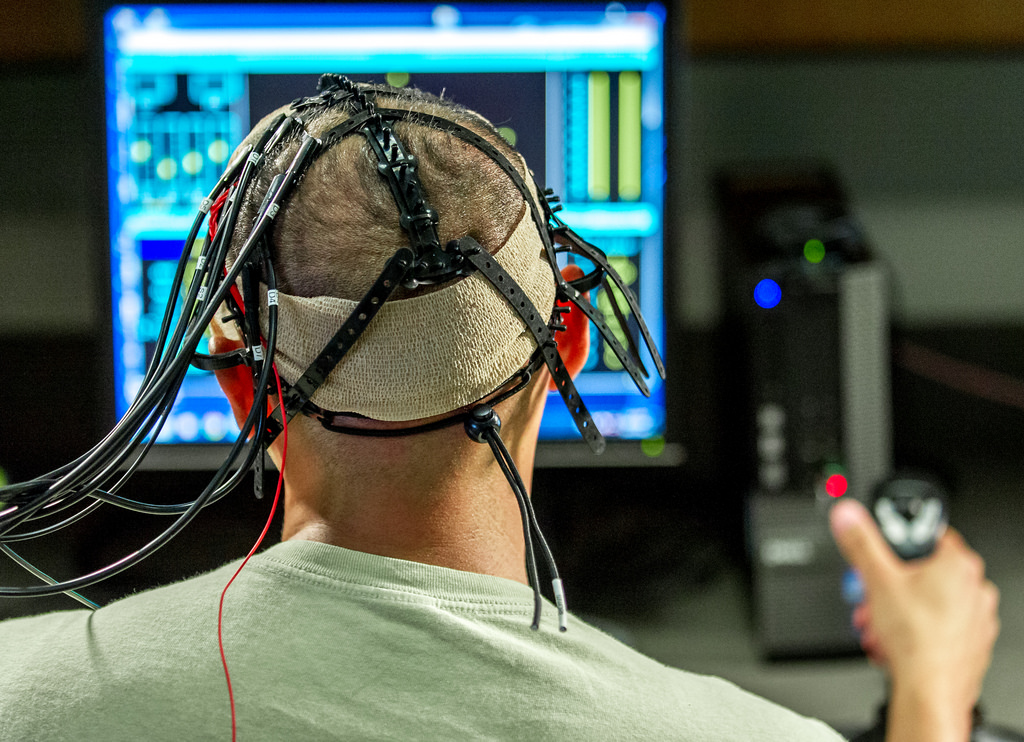
The basic idea behind the technology under development is that arrays of microelectrodes can be implanted onto the surface of an area of the brain involved in the production of speech. These electrodes would continuously record activity from these speech brain areas, and this activity would then be fed into a brain-computer interface (which processes and decodes the signals) so that they can finally be externalized as synthesized speech (2).


Image courtesy of Flickr.

One plausible recording site in the brain is the articulatory motor cortex – the part of the brain that controls the movement of the mouth, tongue, throat, etc. when talking. A user of the neuroprosthetic device would need to speak covertly – that is, clearly imagine herself speaking, like saying something loudly ‘in her head.’ The brain activity that is generated when people engage in covert speech approximates the brain activity generated when actually speaking out loud. This gives rise to the possibility of mapping the motor features of speech (which the brain activity represents or underlies) to the acoustic properties of those motor features, so that they can be ultimately produced as synthesized speech. 


Impaired communication and informed consent 


The research is still in its early days, and devices are not yet being trialed in patients with severe communication impairments. However, when the research and eventual application reaches the clinical population of intended users, there will be a number of challenges relating to obtaining the informed consent of those users. 


Obtaining informed consent is not only a matter of relaying a list of facts to a patient and acquiring her signature. To be fully informed, patients must have sufficient opportunity to ask questions and to discuss the course of action that will be in their best interests. This is often necessary for the patient’s full understanding of the materially relevant facts; as such, it is most often a prerequisite for autonomous decision-making. Further, since patients differ in their preferences and values, it should not be assumed that patients with similar clinical profiles would necessarily benefit in the same way from the same intervention. Even when statistically equally likely, risks of an intervention may be more significant for one patient than another, given individual differences in personal disposition, circumstances, and goals. 


Image courtesy of Flickr.

Underscoring the importance of the process of obtaining informed consent, those proposing the ‘liberal rationalist' (3) and other models of doctor-patient decision-making have defended an approach whereby doctors, patients, and in some circumstances family members, engage in a rational discussion about which course of action is best for the patient, all things considered. Such approaches are liberal in the sense of being open to disagreement regarding the value or disvalue that should be accorded to the various risks and benefits of a procedure. They are rationalist in the sense that, although the importance of effects of an intervention may be open to individual evaluation, decision-making about whether to undergo an intervention in the context of this evaluation should be made on the basis of comprehensive factual information, and without errors of reasoning. 


Neuroprosthetic challenges: talking about the device 


The ideal consent process outlined above explicitly requires discussion. Clearly, this requirement is going to generate a challenge when the patient or potential research participant has significant or even complete impairment in their capacity to communicate. How will a doctor be able to make sure the patient or potential research participant has understood the materially relevant facts and weighed up the risks and benefits as they pertain to her if she is not able to engage in discussion? 


Of course, this challenge is not unique to neuroprosthestics. There are relevant parallels with consenting aphasic patients for treatments. Although it should be noted that aphasia and communication impairment are not necessarily the same thing (aphasia is a condition typified by problems with verbal fluency, usually as a result of damage to the brain; patients who are locked-in often do not have damage to language areas of the brain), clinicians have had to find ways to facilitate discussion with aphasic patients to ensure that they have understood the materially relevant facts of a recommended treatment, and have had the opportunity to discuss alternatives. The consent process for such patients may require greater involvement from family members who take on the role of asking questions and offering an explanation of what the aphasic patient is trying to say (4). 


Image courtesy of Pixabay.

Although similar approaches may be appropriate in the context of consent for neuroprosthetics for speech, the challenge will be particularly acute here, especially as the research and application reaches the target clinical population. This is a function on the one hand of the complexity of the mechanism of the device and on the other hand of the severity of the communicative impairment of the patient or research participant. 


How the device works and interfaces directly with the user’s ‘thoughts’ may be difficult to grasp, as will the likely phenomenological experience of speaking through the device. Amongst the relevant challenges in delivering and discussing the information will be:


1. Whether the device’s benefits should be framed as restoring or as substituting for speech. Making sure the function of the device is not misrepresented has some parallels with the therapeutic misconception and will remain important even at the stage of clinical translation. Although it is not yet known how good these devices will be at continuously decoding and synthesising covert speech, if early versions are not able to render the user’s synthesised speech as fluent and articulate as her original speech, any such deficiencies must be clearly explained. 


2. How to avoid what might be labelled the ‘voyeuristic misconception’ regarding how the device works. This phrase captures the potential worry that the device will read and externalise all the users thoughts indiscriminately. The fear that the device might permit others to peer into the user’s mind is understandable. However, a challenge in the development of the device is to ensure either that the device can discriminate between covert speech that the user intends to be externalised, and private ‘thoughts’ with linguistic structure, or that some other mechanism of control is built in, such as a verification command. Of course, a misconception is only a misconception if it is not aligned with reality. How the device will operate and what, if any, risk of involuntary ‘speech’ remains will need careful explanation, both to avoid any misconception, but also to acknowledge any risks, if present. 


These two dimensions of understanding the device and what it will and won’t do will require extensive discussion in order to ensure that consent is sufficiently informed. Researchers and clinicians will need to find ways to engage communicatively impaired patients or research participants in this discussion. 


Neuroprosthetic challenges: talking via the device 


Image courtesy of Flickr.

The above challenge is not unique to neuroprosthetic devices for speech, even if particularly acute in this context. A more unique challenge relating to consent will be confronted in the case that users discuss treatment, or even end of life decisions, via the device. Surrogates are useful and even necessary in playing the role of discussant on the patient’s behalf when the patient cannot do so herself; nonetheless, it is always preferable to engage the patient herself as much as possible, since the surrogate will neither know all the questions the patient might want to ask nor interpret communicative efforts perfectly. 


If a patient has been implanted with a neuroprosthesis that allows her to play a greater role in discussion and to communicate preferences and decisions, her input must be given precedence over the input of a surrogate. However, there will be challenges presented by the patient communicating through a neuroprosthesis. Intention is clearly necessary for consent to be autonomous. So, in addition to ensuring that the patient has understood all the materially relevant facts (the first challenge), those engaging with the patient regarding her decisions must also ensure that any decision expressed is done so voluntarily. In the context of patients communicating via a neuroprosthesis, we will be concerned both about: 


1. the accuracy of the synthetic representation of the patient’s inner speech and  


2. whether what is represented (even if accurate) is intended by the patient as a statement of her reflectively endorsed preference or decision. 


The neuroprosthesis is likely to incorporate elements of artificial intelligence, which will serve to improve the continuity of the decoding and synthesis by predicting and correcting the input generated by the user’s brain activity. Whilst this will assist with fluency, it introduces an additional agent contributing to (although not determining) what is said. An interesting philosophical and psychological question will relate to the way in which ‘accuracy’ of speech should be conceived, given that natural speech often does not quite match what a speaker attempts to say and that speakers sometimes seem to find out what they think through speaking. Artificial intelligence that has a corrective and/or predictive function will add complexity to the question of whether the output is ‘accurate.” 


Image courtesy of Pixabay.

In terms of intention, even if there is a sense in which the synthetic output accurately represents the activity underlying the user’s covert speech, close attention will need to be paid to whether the user intended to express the decision or preference as her rationally endorsed ‘final say’ on the matter. Given the likely absence of accompanying tone of voice, facial expressions, and body language as cues to the speaker’s relationship to what they are saying, extra caution will be warranted. 


These challenges will not be insurmountable but will require thought and establishment of good practice. The continued role of surrogates and/or additional participants in the discussion will be crucial, as will multiple layers of verification. Ultimately, however, the hope is that the devices under development will allow individuals, who are otherwise precluded from engaging in discussions about what happens to them, to regain the ability to lead this discussion and to participate more fully in their social worlds. 


References 


1. Miller-Keane Encyclopedia and Dictionary of Medicine, Nursing, and Allied Health, Seventh Edition. (2003). Retrieved January 6 2018 from https://medical-dictionary.thefreedictionary.com/locked-in+syndrome 


2. Bocquelet, F., Hueber, T., Girin, L., Chabardès, S., & Yvert, B. (2016). Key considerations in designing a speech brain-computer interface. Journal of Physiology-Paris, 110(4), 392-401.


3. Savulescu, J. (1997). Liberal rationalism and medical decision-making. Bioethics, 11(2), 115-129.


4. Stein, J., & Brady Wagner, L. C. (2006). Is informed consent a “yes or no” response? Enhancing the shared decision-making process for persons with aphasia. Topics in stroke rehabilitation, 13(4), 42-46.


Want to cite this post?


Maslen, H. (2018). Neuroprosthetics for Speech and Challenges in Informed Consent. The Neuroethics Blog. Retrieved on , from http://www.theneuroethicsblog.com/2018/03/neuroprosthetics-for-speech-and.html