Pages

Showing posts with label Molly Crockett. Show all posts

Tuesday, February 17, 2015

Exchanging 'Reasons' for 'Values'

Julia Haas is a McDonnell Postdoctoral Fellow in the Philosophy-Neuroscience-Psychology program at Washington University in St. Louis. Her research focuses on decision-making.


Over the past two decades, computational and neurobiological research has had a big impact on the field of economics, bringing into existence a new and prominent interdisciplinary field of inquiry, ‘neuroeconomics.’ The guiding tenet of neuroeconomics has been that by combining both theoretical and empirical tools from neuroscience, psychology and economics, the resulting synthesis could provide valuable insights into all three of its parent disciplines (Glimcher 2009). And although some economists have resisted the influence of neuroscience research (Gul and Psendorfer 2008), neuroeconomics has by all measures thrived as a theoretical endeavor, and proven itself as a discipline capable of marshaling substantial institutional and financial resources.


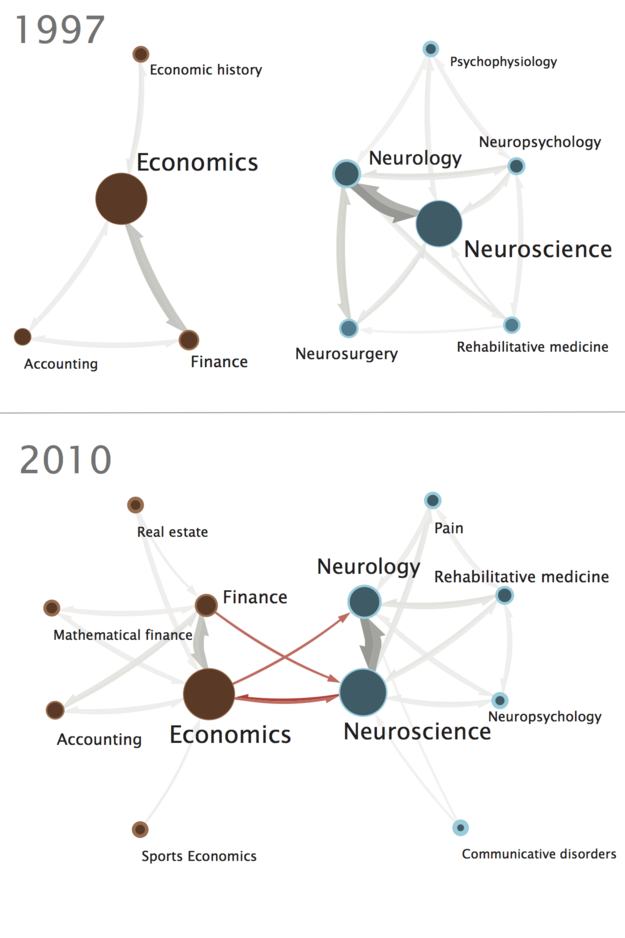
For example, theories from economics and psychology have already begun to restructure our neurobiological understanding of decision-making, and a number of recent neurobiological findings are beginning to suggest constraints on theoretical models of choice developed in both economic and psychological domains. Similarly, a study by the Eigenfactor project at the University of Washington showed that while there were no citations from either of these disciplines to the other in 1997, by 2010, there were 195 citations from economics journals to neuroscience journals, and 74 citations from neuroscience journals to economics journals.


Disciplinary cross-pollination 

This interdisciplinary partnership has caught the attention of the National Institutes of Health, which finances 21 current research projects with "neuroeconomics" in their descriptions, to the tune of $7.6-million. The agency gives out many more millions for other neurobiology work related to decision-making: Caltech got $9-million this month to establish a center in this field. The National Science Foundation has backed eight neuroeconomics projects with $3.5-million in research money.


Neuroeconomics: A Role Model for the Neuroscience of Ethics 


Neuroeconomics has thus been one of the most significant and astute beneficiaries of computational and neuroscientific research on decision-making. By contrast, the discipline of philosophy has fallen behind. Although many insights from computational and decision neuroscience are directly relevant to philosophical discussions about deliberation and choice, the vast majority of them have fallen by the philosophical wayside. This is not to say that philosophy has ignored neuroscience: this would not at all be true. Beginning with the publication of Patricia Churchland’s Neurophilosophy in 1985, both neurophilosophy and the philosophy of neuroscience have become active research areas across philosophy departments. But many of these neuroscientific contributions have focused on issues pertaining to traditional metaphysics (such as consciousness and free will) and epistemology (such as perception and representation). By contrast, the implications of computational and decision neuroscience for philosophical theories of decision-making and practical reasoning have yet to be realized.


Where it all got started

Again, this is not to say that neuroscience has not been brought to bear on issues in ethics! I have written about Molly Crockett’s research on this blog, Neil Levy and Julian Savulescu have made important contributions, and there are many valuable neuroscientific contributions to the study of altruism, utilitarianism, spirituality, aggression, and so on. But what I want to suggest that is that the neuroscience of decision-making can help philosophers arrive at a more wide-ranging theory underlying specific kinds of moral decisions: namely, it can help us understand how we make decisions in general. And this understanding should in turn provide a valuable constraint and useful platform for understanding what happens in moments of having to make tough, moral decisions.


Some general principles are, I think, beginning to emerge. For example, while philosophers frequently turn to concepts such as reasons and intentions to try and explain human action, there is good evidence to suggest that human beings rely on something that is closer to the metaphor of evaluating or ‘weighing.’ We come to value objects and actions over the course of our experiences, and these positive valuations lead us to elect those objects or actions when it comes time to make a concrete decision. Moreover, computational neuroscientists are beginning to understand the mechanisms whereby these valuations are carried out in the mind/brain, and they are increasingly in position to make detailed predictions about how human beings make decisions in all kinds of situations involving risk, delay and stress. From my perspective, these same situations often form the backdrop for our toughest ethical dilemmas, so we should gradually be able to untangle why people ‘mis-value’ certain options and make unethical decisions.


Some might argue that moral decisions are too complex for neuroscience to help us understand them. But the same was once said of economic choices, and it is safe to say that neuroeconomics has come a long way in advancing our understanding of them. I look forward to, and hope to be a part of, seeing practical and moral philosophy follow suit.


References


Glimcher, P. W. (2009). Choice: towards a standard back-pocket model. Neuroeconomics: Decision making and the brain, 501-519.


Gul, F., & Pesendorfer, W. (2008). The case for mindless economics. The foundations of positive and normative economics, 3-42.


Want to cite this post?

Hass, J. (2015). Exchanging 'Reasons' for 'Values'. The Neuroethics Blog. Retrieved on

, from http://www.theneuroethicsblog.com/2015/02/exchanging-reasons-for-values.html

Tuesday, December 10, 2013

It's Complicated: Molly Crocket and Patricia Churchland Discuss the Future of the Neuroscience of Morality

Last month, as a recipient of the Emory Neuroethics Program Neuroethics Travel Award, I had the wonderful opportunity of attending the International Neuroethics Society Annual Meeting in San Diego, California. The conference brought together leading neuroethics scholars from around the world and focused on the themes of moral enhancement, disorders of consciousness, and the role of neuroscience in the courtroom. (The conference was structured around three star-studded panels. For a full program, please visit here. For full videos of the panels, please visit here.) There were also five oral presentations and a poster session. As part of the event, I exhibited a poster entitled “Revising Weakness of Will: A Reply to Neil Levy,” where I challenged Levy’s use of the theory of ego depletion as an explanation of weakness of will and provided an alternate, neurocomputational account.


Presenting my poster at INS.

Photo credit: Karen Rommelfanger

As a philosopher interested in the intersection of the computational neurosciences and morality, “The Science and Ethics of Moral Enhancement” session was a particularly enlightening one for me. It brought together three leading women neuroethics scholars, Barbara Sahakian (as Moderator), Molly Crockett, and Patricia Churchland, as well as neuroethicist Julian Savulescu of the Oxford University Center for Neuroethics. It was a remarkable conversation. Throughout their discussions and even in the question period that followed, I was struck by how clearheaded the panelists were about the challenges facing the field. At the same time, and despite their very different perspectives, they evidently shared a real optimism about the future of this area of research. As the session moderator, neuroscientist and neuroethicist Barbara Sahakian of Cambridge University set the tone by explaining that the panelists would tackle, “the science of what’s possible now,” but also look at “what we may be able to do in the future.”


A Morality Pill?


Molly Crockett

The first panelist, Molly Crockett, is a leading neuroscientist working at the University College London and the University of Zurich. She is also in the process of setting up a lab at Oxford University. She explained that, as a scientist, the aim of her presentation would be to describe, “What it’s like, on the ground, doing this research.” In particular, she focused on how own area of expertise, which is in exploring how different brain chemicals influence moral behavior.


To start off, she emphasized, “It’s complicated.” She described how, in light of her work on the neurotransmitter serotonin, people often ask her about the possibility of a morality pill. She explained that she often feels compelled to point out that both the moral behaviors in question and the biological systems underlying them are very complex. For example, she noted, her research on serotonin and sociality was picked up in the media in such as away as to suggest that “Enhanced serotonin biases moral judgment and decision-making toward sociality.” While not necessarily inaccurate, she explained, she also wanted to make clear that there is a lot more going on.


In her talk, Crockett laid out three major reasons for why she believed a straightforward ‘science of moral enhancement’ would not happen overnight. First, she noted, there is ongoing discussion as to exactly what constitutes ‘moral behavior,’ and hence, what it is exactly that we would want to enhance if we could. Second, she detailed how that all the neurochemicals in question do many different things: oxytocin may enhance empathy, for instance, but also increase Schadenfreude in individuals participating in economic games.


Finally, Crockett emphasized that moral behavior is highly context-specific. For example, it is not clear that we would want to be helpful to anyone we meet, wherever or whenever. There is a technical term for this kind of individual, she noted: “Sucker.” The audience loved the joke but also certainly appreciated the point. Like cognition, morality is so complex that it cannot simply be replicated in specific circumstances.


In her own efforts to study morality, Crockett noted, she found it useful to hone in what she called “low-hanging fruits,” that is, on behaviors that almost no one would find to be morally objectionable. As an example of such a behavior, she discussed Peter Singer's dilemma regarding the duty of easy rescue, where an agent passes a drowning child and decides whether to help or not. "These are a set of behaviors we would want to target if we could," she noted.


'Before Going Whole Hog'


Patricia Churchland discusses oxytocin

The second panelist, philosopher Patricia Churchland, is Professor Emerita of the Department of Philosophy University of California San Diego. Like Crockett, Churchland emphasized that she was skeptical of the idea of a ‘morality pill’ and argued against the claim that morality could be something like a “swiss army knife” set of moral modules. But she proposed to tackle the issue from a slightly different perspective, proposing to examine some of troubling issues surrounding the frequently touted molecule of oxytocin.


Oxytocin is known to play an important role in childbirth, lactation, intimacy, pair bonding, and trust. In a recent study, researchers at Yale argued that “intranasal administration of oxytocin enhances activity in the brain for socially meaningful stimuli and attenuates its response to nonsocially meaningful stimuli in children with autism spectrum disorder (ASD) as measured via functional MRI.” But, Churchland argued, the issue is not so simple.


To start, Churchland outlined some general problems with oxytocin and its recent popularity in both scientific research and the popular press. Its mechanisms are relatively poorly understood, it interacts with other neurochemicals, it makes female voles go into estrous, and there is very little known about the long term effects of its administration. In addition, she added, the general and unregulated availability of oxytocin makes it vulnerable to abuse. Nonetheless, the problems go even deeper for Churchland. The main body of her talk emphasized that how oxytocin is administered and measured in human beings plays a surprising role in how the molecule becomes understood, reported, and used by scientists in the field.


In human beings, oxytocin is measured by comparing levels of the molecule before and after a behavioral manipulation. For example, a plasma sample is taken, the participant is given a massage, and then a second plasma sample is taken. Researchers then compare oxytocin levels to examine the effect of the manipulation. But how is oxytocin measured in these kinds of studies? Churchland explained there are two standard ways to look at plasma and measure oxytocin. She described the first method as the ‘gold standard,’ using a radioimmunoassay to “tag the thing in question” on extracted, highly purified samples. By contrast, the second method is commercially available and relies on a much easier-to-use enzyme-linked immunoassay (EIA). But it has the disadvantage of often not producing accurate results.


In a recent paper, Michael McCullough, Churchland, and Armando Mendez compared the two kinds of assays. In addition, they tested the commercial kits independently and found that that were misidentifying all kinds of molecules as oxytocin, including vasopressin. This led them to argue that the EIAs “lack reliability when used on unextracted samples of human fluids, and that they tag molecules in addition to oxytocin, yielding estimates that are wildly discrepant with an extensive body of earlier findings that were obtained using methods that are well validated, but more laborious.”  Building on this finding, Churchland showed a rather striking comparison of data. One the one hand, she she showed how, using the ‘gold standard’ radioimmunoassay, women in late stages of labor register between 1-5 pc/ml of oxytocin in their plasma. By contrast, using the commercial kits, individuals who had merely received a massage appeared to have 200 times as much oxytocin in their blood. Despite these shortcomings, however, Churchland noted that the results achieved using EIAs are “widely cited and widely used in good faith to apply oxytocin to children with social difficulties.”


Here, Churchland made clear the ethical import of what earlier on she had acknowledged was a rather ‘technical’ talk. She noted, “if the way you’re measuring oxytocin is unreliable, you have results that are un-interpretable, then you have to ask yourself if it’s okay to be giving oxytocin to people with schizophrenia or with autism.” And then she added, “What we really need to do, before going whole hog on using oxytocin as a treatment for socially difficult children, is we really need to get this straight.”


In her conclusion, Churchland acknowledged that her talk may have sounded rather negative and, in general, a little bit too pessimistic about the neuroscience of morality. To counter this, she emphasized, “I think it can be done.” But she emphasized that it must be done with patience and care for those involved all along the way.


All in all, in was an enlightening experience. I’m already looking forward to the 2014 International Neuroethics Society meeting in Washington, DC!


Want to Cite This Post? 


Hass, J. (2013). It's Complicated: Molly Crocket and Patricia Churchland Discuss the Future of the Neuroscience of Morality. The Neuroethics Blog. Retrieved on
, from http://www.theneuroethicsblog.com/2013/12/its-complicated-molly-crocket-and.html

Friday, June 7, 2013

International Neuroethics Society Meeting on Nov 7-8, 2013 in San Diego!

The International Neuroethics Society announces its 5th Annual Meeting (a satellite of the Society for Neuroscience Meeting) November 7 & 8 San Diego.


 Abstracts are due June 15, 2013.  For more information and the program see here.


 Listen to INS Member Molly Crockett cordially invite you here.


Bring your friends and family to the open-to-the-public program November 7 on Neurogaming: What’s Neuroscience and Ethics Got to Do with It?

Register for the meeting on November 8 here.


The speaker lineup includes Barbara Sahakian & John Pickard, University of Cambridge, Julian Savulescu, University of Oxford, Patricia Churchland, University of California-San Diego, Molly Crockett, University of Zurich, Jens Clausen, University of Tubingen, Lisa Claydon, Bristol Law School, University of the West England, Joe Fins & Niko Schiff, Weill Cornell Medical College, Holly Moore, Columbia University, New York State Psychiatric Institute, Mauricio Delgado, Rutgers University, Catherine Sebastian, Royal Holloway, University of London, J. David Jentsch, University of California – Los Angeles, and Honorable Robert Trentacosta, Presiding Judge of San Diego Superior Court.

See you in San Diego!